|
|
This newsletter is a summary of recent ESO Science Announcement items. Follow the links or visit ESO Science Announcements to read more.
|
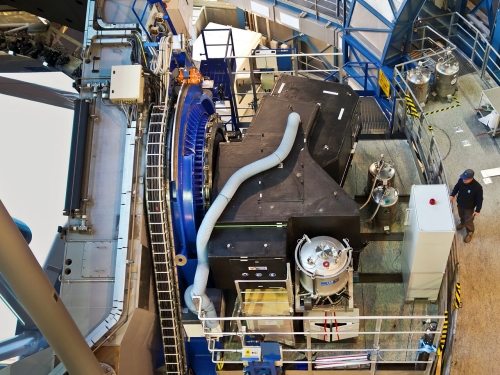
21 Oct 2014: The most recently installed instrument at Paranal, the ESO Planet-finder instrument SPHERE, underwent its last commissioning run during 05 тАУ 15 October 2014. SPHERE saw first light on 04 May 2014 (see the Release) and was followed by three periods of commissioning in May, July and August 2014.
|
|
| Read more
|
|
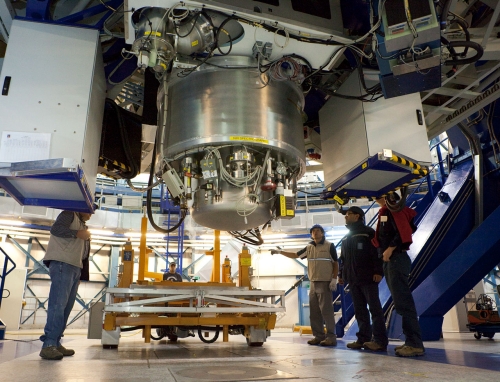
21 Oct 2014: After a year at UT3, X-shooter was re-installed at UT2 earlier this month to make room for the re-commissioning and integration of VISIR on UT3, which will start next month. In spite of poor weather conditions, which delayed the precise measurement of the telescope focus for X-shooter, the long list of recommissioning tasks, were completed as planned, thanks to the efficient work of the science and engineering teams. Routine science operations with X-shooter have re-commenced.
|
|
| Read more
|
|
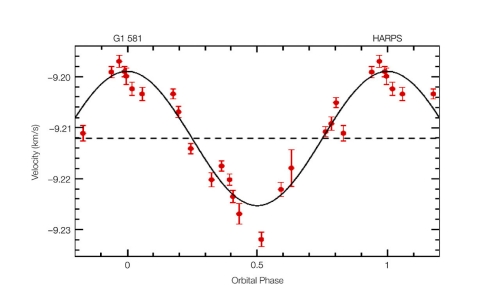
21 Oct 2014: Pipeline processed HARPS echelle data are now available as Science Data Products via the Phase 3 spectral query form. The data consist of 1D spectra in the ESO/SDP format and the tar files containing unaltered output of the HARPS pipeline (DRS v. 3.5), as previously available.
|
|
| Read more
|
|
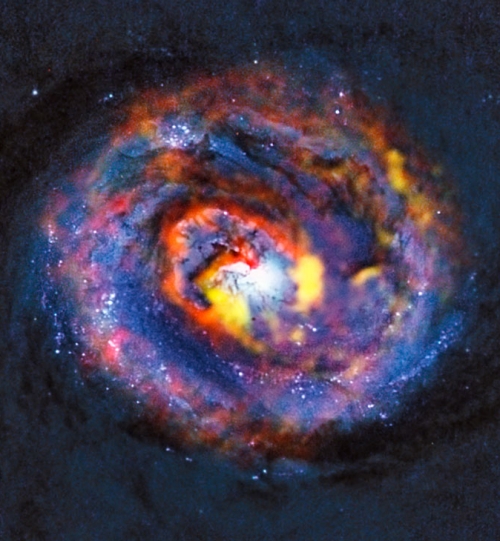
21 Oct 2014: ESO Workshop, Vitacura, Santiago, Chile, 23тАУ27 March 2015
Angular and spectral resolutions are fundamental limitations to our understanding of the properties of galaxies in the nearby and distant Universe. The advent of state-of-the-art facilities with high angular and spectral resolution capabilities coupled with high sensitivity, such as ALMA, allows the interstellar medium and star formation properties of galaxies at intermediate redshift to be probed in unprecedented detail, along with their counterparts in the local Universe.
|
|
| Read more
|
|
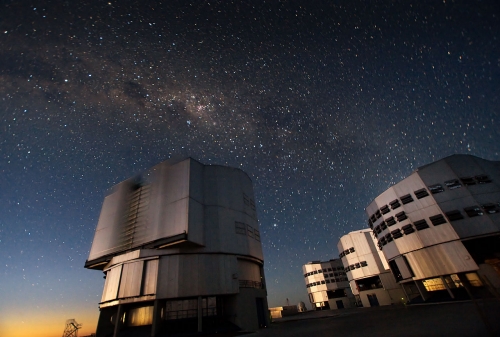
17 Oct 2014: The proposal submission for ESO Period 95 (1 April тАУ 30 September 2015) closed on 01 October 2014. 931 proposals were received, including 17 Large Programme and 50 Target of Opportunity (ToO) proposals, for a total of 2428 nights.
|
|
| Read more
|

|
15 Oct 2014: The Multi-Object Optical and Near-infrared Spectrograph (MOONS) is a red and near-infrared (0.64 тАУ 1.8 ѕ®m), medium (R=4000) and high (R=20000) resolution, multi-object spectrograph with 1024 fibres, planned for installation at the VLT Nasmyth focus in 2018. The agreement to build MOONS was recently signed between ESO and the MOONS Consortium, composed of institutes from the ESO Member States and led by the UK STFC. See the public announcement for details.
|
|
| Read more
|
|
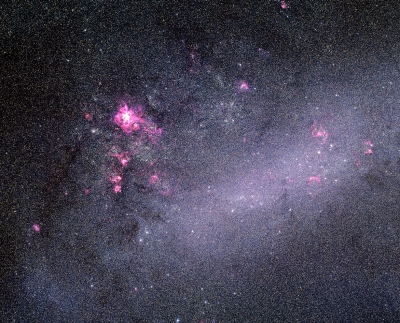
13 Oct 2014: New data products from the VISTA Survey of the Magellanic system Public Survey (VMC) are now available via the dedicated Phase 3 query interface. The current release is based on the observations of five new VMC survey tiles (three in the LMC and two in the SMC), as well as on improved reduction of two tiles released earlier.
|
|
| Read more
|
|
10 Oct 2014: ESO Workshop, ESO Headquarters, Garching, Germany, 23тАУ27 February 2015
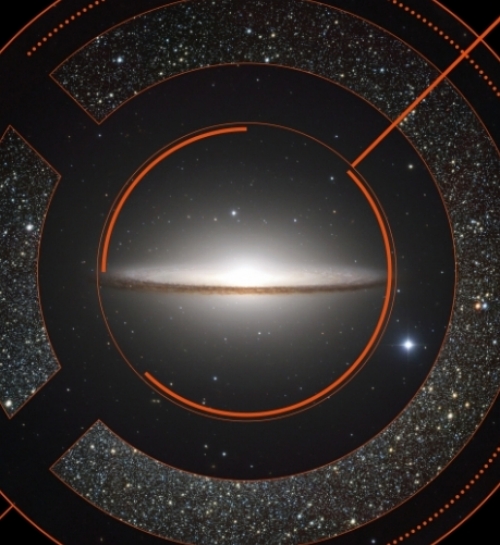
Stellar halos are ubiquitous in luminous galaxies, but their low surface brightness hampers detailed study in distant galaxies. With the advent of large cameras and surveys, several late- and early-type galaxies have revealed similar low luminosity extended structures. These halos have complex morphologies with multiple stellar components, kinematics and substructures indicating the merger history. The halo morphologies resemble the density maps from cosmological simulations of galaxy formation in a hierarchical Universe.
|
|
| Read more
|
|
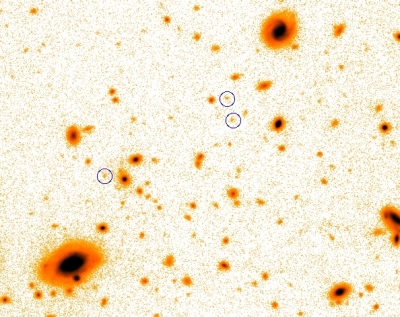
07 Oct 2014: The HAWK-I Ultra Deep Survey and GOODS Survey (HUGS) is an near-infrared imaging survey executed with HAWK-I (PI: A. Fontana); an overview can be found here. HUGS covers two CANDELS extragalactic fields: a sub-area of the UKIDSS Ultra-Deep Survey (UDS) and GOODS-South. HUGS delivers the deepest, highest quality images ever collected in the K-band: to Ks=27.3 (1№Г) in UDS and to Ks=27.8 in GOODS-South. Deep Y-band images in the UDS field have also been acquired.
|
|
| Read more
|
|
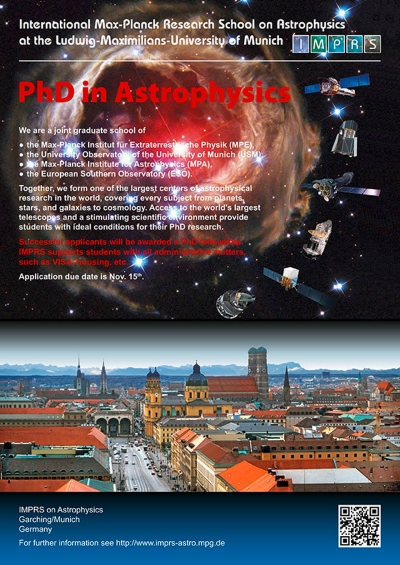
07 Oct 2014: If you wish to conduct a PhD in astronomy-astrophysics within one of the largest centres of astrophysical research in the world, which covers every subject from planets, stars, and galaxies to cosmology, you should ser | | | | | | |
