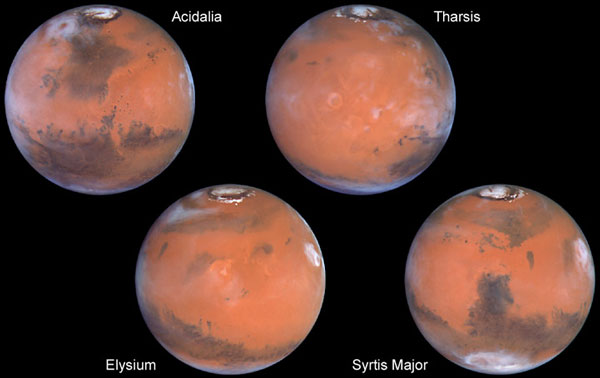
Four Faces of Mars
Explanation:
As Mars rotates, most of its surface becomes visible. During
Earth's recent pass between
Mars and the
Sun, the
Hubble Space Telescope was able to
capture the most detailed time-lapse pictures ever from the
Earth.
Dark and light
sand and gravel create an unusual
blotted appearance for the
red planet.
Winds cause sand-tinted
features on the
Martian surface
to shift over time.
Visible in the
above pictures are the
north polar cap, made of
water ice and
dry ice,
clouds including an
unusual cyclone, and
huge volcanoes
leftover from ancient times.
The
Mars Global Surveyor satellite orbiting
Mars continues to scan the surface
for good places to land
future robot explorers.
Authors & editors:
Robert Nemiroff
(MTU) &
Jerry Bonnell
(USRA)
NASA Web Site Statements, Warnings,
and Disclaimers
NASA Official: Jay Norris.
Specific
rights apply.
A service of:
LHEA at
NASA /
GSFC
& Michigan Tech. U.

