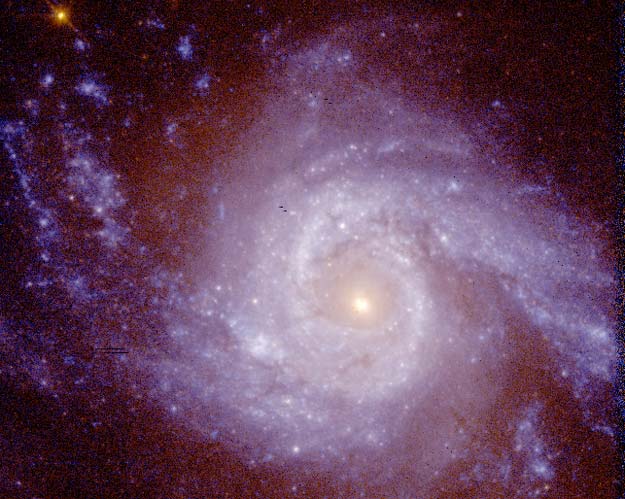
Spiral Galaxy NGC 3310 in Ultraviolet
Explanation:
Why is NGC 3310 bursting with young stars?
The brightest of these new stars are so hot that they light up this spiral galaxy not only in blue light, but in light so blue humans can't see it:
ultraviolet.
The
Hubble Space Telescope
took the
above photograph in different bands of ultraviolet light.
Speculation holds that
NGC 3310 collided with one of its own
dwarf companion galaxies
only about 50 million years previously.
This merger sent
density waves rippling around the spiral disk,
causing many gas clouds to condense into star forming regions.
Imaging nearby galaxies in ultraviolet light
allows astronomers to better understand the
images of distant highly
redshifted galaxies in visible light,
and so to understand why many of these
distant galaxies appear relatively fragmented.
The
unusually smooth NGC 3310 spans over 20 thousand
light years and lies about 50 million light years away towards
the constellation of
Ursa Major.
Authors & editors:
Robert Nemiroff
(MTU) &
Jerry Bonnell
(USRA)
NASA Web Site Statements, Warnings,
and Disclaimers
NASA Official: Jay Norris.
Specific
rights apply.
A service of:
LHEA at
NASA /
GSFC
& Michigan Tech. U.

