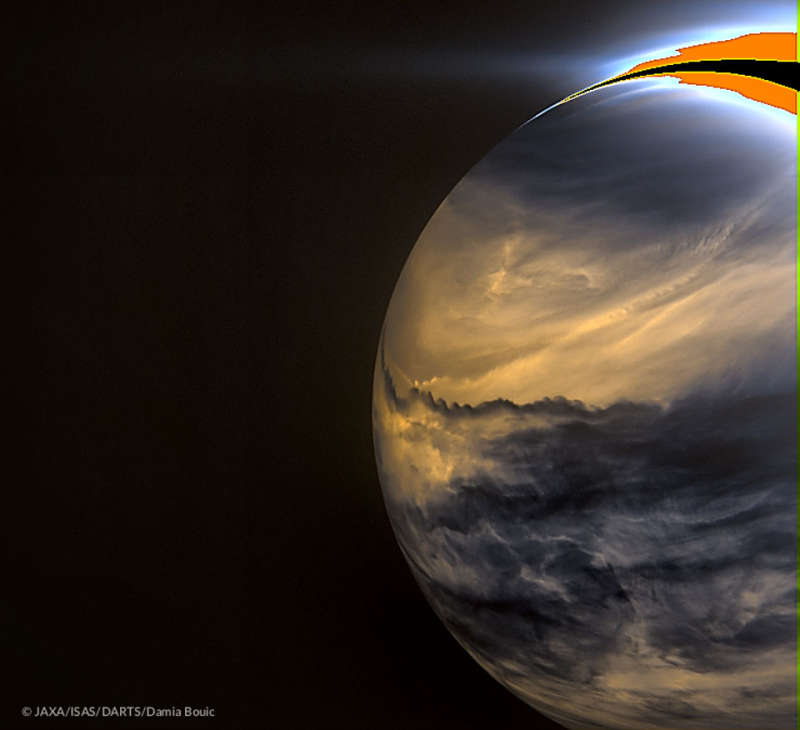
Venus at Night in Infrared from Akatsuki
Explanation:
Why is Venus so different from Earth?
To help find out,
Japan launched the robotic
Akatsuki spacecraft which
entered orbit around Venus late
in 2015 after an unplanned five-year adventure around the inner
Solar System.
Even though Akatsuki was past its original planned lifetime,
the spacecraft and instruments were operating
so well that much of its original mission was
reinstated.
Also known as the
Venus
Climate Orbiter,
Akatsuki's
instruments
investigated unknowns about Earth's sister planet, including whether
volcanoes are still active,
whether lightning occurs in the dense atmosphere, and why wind speeds
greatly exceed the planet's rotation speed.
In the
featured
image taken by
Akatsuki's
IR2 camera, Venus's night side shows a jagged-edged equatorial band
of high dark clouds absorbing infrared light from hotter layers deeper in
Venus' atmosphere.
The bright orange and black stripe on the upper right is a false digital
artifact that covers part of the much brighter day side
of
Venus.
Analyses of
Akatsuki images
and data has shown that Venus has
equatorial jet similar to
Earth's jet stream.
Watch:
Lunar Extravaganza
Authors & editors:
Robert Nemiroff
(MTU) &
Jerry Bonnell
(USRA)
NASA Web Site Statements, Warnings,
and Disclaimers
NASA Official: Jay Norris.
Specific
rights apply.
A service of:
LHEA at
NASA /
GSFC
& Michigan Tech. U.