APOD: 2025 November 2 Б A Horseshoe Einstein Ring from Hubble
Explanation:
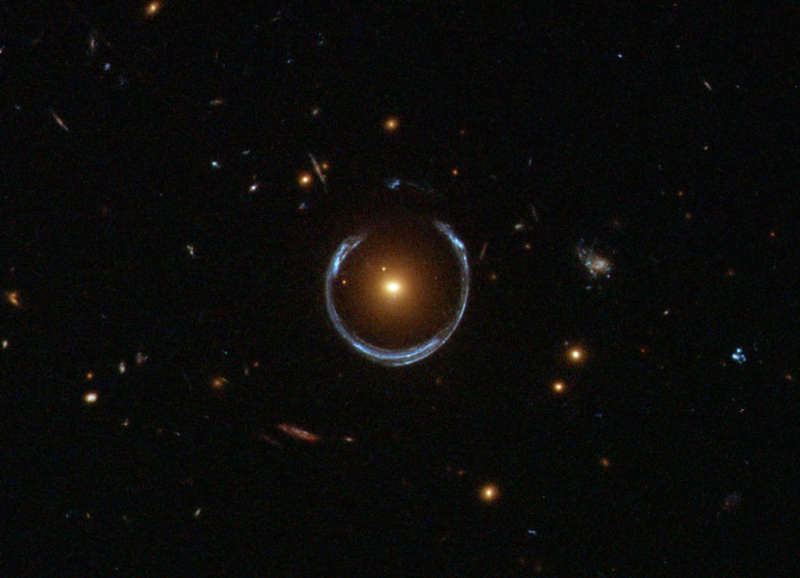
What's large and blue and can wrap itself around an entire galaxy?
A
gravitational lens mirage.
Pictured here,
the gravity of a massive elliptical galaxy
(luminous red galaxy:
LRG) has
gravitationally distorted
the light from a much more distant blue galaxy.
More typically, such light bending results in
two discernible images
of the distant galaxy, but here the
lens alignment is so precise that the background
galaxy is distorted into a horseshoe -- a nearly complete ring: an
Einstein ring.
Although LRG 3-757 was discovered in 2007 in data from the
Sloan Digital Sky Survey (SDSS),
the image shown above is a follow-up observation taken with the
Hubble Space Telescope's
Wide Field Camera 3.
A recent
lens analysis of the central galaxy
indicates that it likely hosts the single most massive black hole yet discovered: 36 billion times the mass of
our Sun.
Authors & editors:
Robert Nemiroff
(MTU) &
Jerry Bonnell
(USRA)
NASA Web Site Statements, Warnings,
and Disclaimers
NASA Official: Jay Norris.
Specific
rights apply.
A service of:
LHEA at
NASA /
GSFC
& Michigan Tech. U.

