|
Peremennye Zvezdy (Variable Stars) 45, No. 13, 2025 Received 26 September; accepted 21 October. |
Article in PDF |
|
DOI: 10.24412/2221-0474-2025-45-115-123
|
Results of the Light Curve Analysis of TIC 372275195
B. Sh. Juraev1, O. A. Burkhonov1, Sh. A. Ehgamberdiev1, R. G. Karimov1, M. M. Muminov2
- Ulugh Beg Astronomical Institute, Uzbek Academy of
Sciences, Astronomicheskaya Str., 33, 100072, Tashkent,
Uzbekistan; e-mail: bolkin@astrin.uz (Juraev), boa@astrin.uz
(Burkhonov)
- Andijan State University, Universitet str. 129, Andijan city 170100, Uzbekistan
We present the results of our analysis of the light
curves of the star TIC 372275195 based on observations from the
TESS mission. Our frequency analysis has revealed the fundamental
frequency,  , and the subharmonic frequency, , and the subharmonic frequency,  , while , while
 and and  correspond to higher harmonics. The star TIC
372275195 pulsates in the radial p-mode at the fundamental
frequency correspond to higher harmonics. The star TIC
372275195 pulsates in the radial p-mode at the fundamental
frequency  day day , corresponding to the period , corresponding to the period
 , and is located on the main sequence of the
Hertzsprung-Russell diagram. The star exhibits a relatively low
metallicity index and belongs to the , and is located on the main sequence of the
Hertzsprung-Russell diagram. The star exhibits a relatively low
metallicity index and belongs to the  Scuti type. The
light curve of TIC 372275195 has an asymmetric shape. Using the
value of the pulsation constant, a physical model of the star was
constructed. The pulsation constant was found to be Scuti type. The
light curve of TIC 372275195 has an asymmetric shape. Using the
value of the pulsation constant, a physical model of the star was
constructed. The pulsation constant was found to be
 , which is larger than the characteristic values of the
pulsation constant for typical Scuti stars. , which is larger than the characteristic values of the
pulsation constant for typical Scuti stars.
|
1. Introduction
Variable stars of the Scuti type belong to spectral types
ranging from A0 to F5 and are located on the main sequence of the
HertzsprungБ-Russell diagram or in its immediate vicinity, as
well as within the classical instability strip. The stellar masses
of this type are approximately in the range of
 (Netzel & Smolec 2022). In particular, Delta
Scuti stars have attracted considerable attention in the recent
years due to their large number of radial and non-radial pulsation
modes, driven primarily by the
(Netzel & Smolec 2022). In particular, Delta
Scuti stars have attracted considerable attention in the recent
years due to their large number of radial and non-radial pulsation
modes, driven primarily by the  mechanism, which operates
in the He II ionization zone (Wang et al. 2024). These pulsations
provide valuable information about the internal structure of
Scuti stars, especially concerning the processes of
energy transport in the transition region between the radiative
core and the convective envelope (Aerts et al. 2010). Luminosities
of Scuti stars cover a broad range, typically between 2
and 50
mechanism, which operates
in the He II ionization zone (Wang et al. 2024). These pulsations
provide valuable information about the internal structure of
Scuti stars, especially concerning the processes of
energy transport in the transition region between the radiative
core and the convective envelope (Aerts et al. 2010). Luminosities
of Scuti stars cover a broad range, typically between 2
and 50  (Kurtz 2022). They belong to short-period
variable stars, with oscillation periods from about 0
(Kurtz 2022). They belong to short-period
variable stars, with oscillation periods from about 0 02 to
025. Variability amplitudes range from 3 millimagnitudes up
to 0.9 magnitudes (Qian et al. 2018).
02 to
025. Variability amplitudes range from 3 millimagnitudes up
to 0.9 magnitudes (Qian et al. 2018).
2. Cross-identification and Observational Data
Within the framework of the Transiting Exoplanet Survey Satellite
(TESS) mission (Ricker et al. 2015), the star with Gaia DR3 (Gaia
Collaboration 2022) coordinates
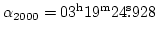 ,
,
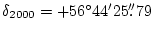 is listed under the designation TIC 372275195 (TIC is the TESS
Input Catalog). In the APASS catalog (AAVSO Photometric All-Sky
Survey), it is identified as APASS 57229944; in the Two Micron All
Sky Survey, it is registered as 2MASS 03192491+5644257; in the
Gaia mission, as Gaia DR3 448018797543294464; in the UCAC catalog
(U.S. Naval Observatory CCD Astrograph Catalog), as UCAC
734-029884; and in the AllWISE catalog (All Wide-field Infrared
Survey Explorer), as AllWISE J031924.90+564425.8. The star TIC
372275195 was identified as a rotational variable star with a
period of 377.960394 days in the study by Qiao et al. (2024) and
was included in the LAMOST DR9 catalog under the number 537603216
(Qiao et al. 2024). Figure 1 presents a chart of TIC 372275195.
is listed under the designation TIC 372275195 (TIC is the TESS
Input Catalog). In the APASS catalog (AAVSO Photometric All-Sky
Survey), it is identified as APASS 57229944; in the Two Micron All
Sky Survey, it is registered as 2MASS 03192491+5644257; in the
Gaia mission, as Gaia DR3 448018797543294464; in the UCAC catalog
(U.S. Naval Observatory CCD Astrograph Catalog), as UCAC
734-029884; and in the AllWISE catalog (All Wide-field Infrared
Survey Explorer), as AllWISE J031924.90+564425.8. The star TIC
372275195 was identified as a rotational variable star with a
period of 377.960394 days in the study by Qiao et al. (2024) and
was included in the LAMOST DR9 catalog under the number 537603216
(Qiao et al. 2024). Figure 1 presents a chart of TIC 372275195.
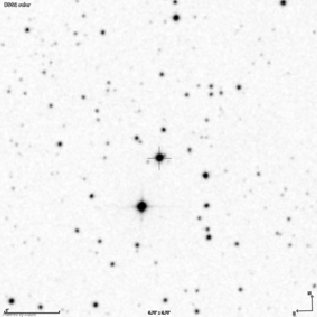 |
Fig. 1.
The field (
|
 )
around TIC 372275195 (in the center). North is up, and east is to
the left. The visualization was generated using Aladin v12.0.
)
around TIC 372275195 (in the center). North is up, and east is to
the left. The visualization was generated using Aladin v12.0.Photometric data for TIC 372275195 were obtained by the TESS mission in Sectors 18, 19, 58, 59, and 86. For the present study, we used photometric data from the preliminary Quick-Look Pipeline (QLP, Huang et al. 2020), which were retrieved from the Mikulski Archive for Space Telescopes (MAST)1. The physical parameters of TIC 372275195 are summarized in Table 1. The data are from the TESS Input Catalog v8.2 (Paegert et al. 2021) and from the Gaia DR3 catalog (Gaia Collaboration 2022).
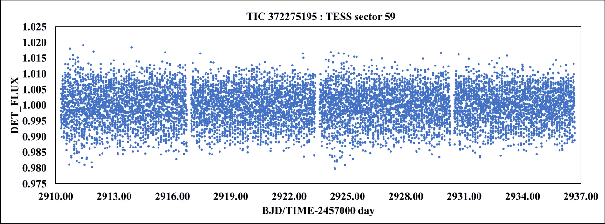
The overall light curve of TIC 372275195, showing DET_FLUX (Detection Flux) in Sector 59 versus BJD/TIME (Barycentric Julian Date), is presented in Fig. 2.
Table 1. Stellar Parameters of TIC 372275195
| Parameter | Value | Error |
| TESS Input Catalog v8.2 | ||
 (mag) (mag) |
13.545 | 0.039 |
 (mag) (mag) |
12.786 | 0.092 |
| TESS (mag) | 12.020 | 0.006 |
 (K) (K) |
6538 | 202.18 |
 (cm/s (cm/s ) ) |
4.239 | 0.096 |
Mass ( ) ) |
1.349 | 0.229 |
Radius ( ) ) |
1.459 | 0.066 |
| Contam. Ratio | 0.2600947 | - |
| Gaia DR3 | ||
| RUWE | 0.952 | - |
| Plx (mas) | 2.1187 | 0.011 |
 |
-0.328 | - |
| RV (km/s) | 15.66 | 1.2 |
3. Frequency Analysis
To identify pulsation or oscillation frequencies of TIC 372275195 based on its brightness variations, a frequency analysis was performed using the Period04 software (Lenz & Breger 2005). To improve the signal-to-noise ratio (SNR) in the TESS observations, data sequences with 1800-second exposures from Sectors 18 and 19 were combined, including the parameters BJD/TIME and KSPSAP_FLUX (Kepler Spline Simple Aperture Photometry), together with the corresponding uncertainties KSPSAP_FLUX_ERR (Vanderburg & Johnson 2014). A similar procedure was applied to the datasets with 200-second exposures from Sectors 58, 59, and 86. The amplitude spectrum of TIC 372275195 was constructed using BJD/TIME, DET_FLUX, and DET_FLUX_ERR from TESS Sector 59 (Fig. 3).
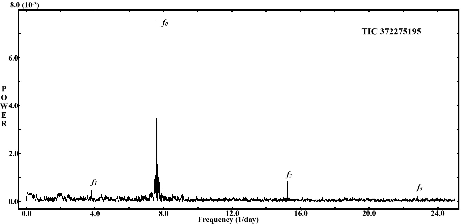
Using the Period04 software, the pulsation (oscillation) frequencies, amplitudes, phases, their uncertainties, as well as the signal-to-noise ratios (SNRs), were calculated for the star (Table 2).
Table 2. Frequencies, amplitudes, phases, and SNRs of TIC 372275195 from TESS observations
| TESS Observation | |||
|
Frequency (day) |
Amplitude (mmag) | Phase (rad) | SNR |
| Sectors 18, 19 | |||
 |
 |
 |
25.4 |
 |
 |
 |
13.1 |
 |
 |
 |
8.4 |
| Sectors 58, 59, 86 | |||
 |
 |
 |
27.3 |
 |
 |
 |
4.4 |
 |
 |
 |
11.5 |
 |
 |
 |
5.5 |
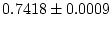
For our program star TIC 372275195, the frequency is
identified as the fundamental mode: it exhibits the highest
stability as well as the largest amplitude and signal-to-noise
ratio compared to the other detected frequencies (Table 2). The
fundamental frequency determines the key properties and
characteristics of the star. The fundamental frequency is day, which corresponds to the period
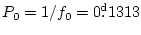 .
.
3.1. Characteristics of oscillation modes
In order to investigate the pulsational properties of TIC
372275195, we employed the period ratio method introduced by
Petersen (1973). This diagnostic tool enables us to assess whether
the star exhibits radial or non-radial oscillations in the
fundamental mode and to identify the presence of possible
overtones. The method has proven to be particularly valuable for a
wide range of pulsating variable stars, including Scuti
(DSCT),  Doradus (GDOR), RR Lyrae, SX Phoenicis (SXPHE),
and Cepheid-type variables, as it provides a means to discern the
fundamental mode, its overtones, and the interrelations among
different pulsation modes (Poretti & Beltrame 2004; Smolec &
Sniegowska 2016). The primary purpose of applying this method
is to determine the pulsation regime of the star and to assess its
consistency with theoretical stellar models. According to the
Petersen method, the fundamental and overtone frequencies exhibit
well-defined ratios. For typical pulsating stars, the
first-overtone to fundamental-mode ratio is
Doradus (GDOR), RR Lyrae, SX Phoenicis (SXPHE),
and Cepheid-type variables, as it provides a means to discern the
fundamental mode, its overtones, and the interrelations among
different pulsation modes (Poretti & Beltrame 2004; Smolec &
Sniegowska 2016). The primary purpose of applying this method
is to determine the pulsation regime of the star and to assess its
consistency with theoretical stellar models. According to the
Petersen method, the fundamental and overtone frequencies exhibit
well-defined ratios. For typical pulsating stars, the
first-overtone to fundamental-mode ratio is
 ,
while the second-overtone to fundamental-mode ratio is
,
while the second-overtone to fundamental-mode ratio is
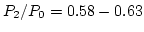 (Rathour et al. 2021; Popielski et al. 2000).
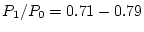
Transforming the frequencies , , from Table 2 into
periods, we calculated the ratios
(Rathour et al. 2021; Popielski et al. 2000).
Transforming the frequencies , , from Table 2 into
periods, we calculated the ratios  to examine whether
they correspond to overtones or other pulsation modes:
to examine whether
they correspond to overtones or other pulsation modes:
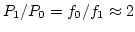 allows us to interpret as a
subharmonic of the fundamental frequency or a possible g-mode;
allows us to interpret as a
subharmonic of the fundamental frequency or a possible g-mode;
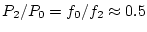 indicates that may
represent the second harmonic of the fundamental frequency,
characteristic of a high-frequency radial mode;
indicates that may
represent the second harmonic of the fundamental frequency,
characteristic of a high-frequency radial mode;
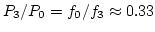 suggests that is close to the
third harmonic of the fundamental frequency.
suggests that is close to the
third harmonic of the fundamental frequency.
Based on these ratios, we conclude that , , are
not overtones of the fundamental frequency , but rather
harmonics. This in turn may indicate the presence of subharmonic
frequencies caused by nonlinear non-radial pulsation modes or by
the influence of another component in the system. If
 , this is a clear signature of a strongly nonlinear
subharmonic resonance rather than a g-mode. The frequencies
and are harmonics, integer multiples of the fundamental
frequency , and may represent the physical manifestation of
modulated emission. The presence of high-frequency modes,
particularly , could be related to stellar rotation or to
resonance phenomena. As shown in Table 2, the following pattern is
observed:
, this is a clear signature of a strongly nonlinear
subharmonic resonance rather than a g-mode. The frequencies
and are harmonics, integer multiples of the fundamental
frequency , and may represent the physical manifestation of
modulated emission. The presence of high-frequency modes,
particularly , could be related to stellar rotation or to
resonance phenomena. As shown in Table 2, the following pattern is
observed:
 ,
,
 ,
,
 . If no overtones are observed in the stellar
pulsations and only the fundamental mode is detected, it can be
concluded that the pulsations are active exclusively in this
single mode. In such a case, no radial nodes arise, and the star
contracts and expands spherically symmetrically throughout its
volume, it pulsates in the radial mode (Percy 2007). In the case
of TIC 372275195, in addition to the fundamental mode, subharmonic
and high-frequency harmonic modes are also present. The observed
pulsation modes of this star exhibit dominant characteristics of
p-modes, which is typical of Scuti-type stars.
. If no overtones are observed in the stellar
pulsations and only the fundamental mode is detected, it can be
concluded that the pulsations are active exclusively in this
single mode. In such a case, no radial nodes arise, and the star
contracts and expands spherically symmetrically throughout its
volume, it pulsates in the radial mode (Percy 2007). In the case
of TIC 372275195, in addition to the fundamental mode, subharmonic
and high-frequency harmonic modes are also present. The observed
pulsation modes of this star exhibit dominant characteristics of
p-modes, which is typical of Scuti-type stars.
3.2. Light Curve
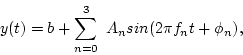
The mathematical model of brightness variations for TIC 372275195 was constructed based on temporal evolution using a harmonic sinusoidal equation, derived from the frequencies, amplitudes, and phases presented in Table 2:
 |
(1) |
 is a constant bringing the mathematical model
in agreement with the observed flux variations;
is a constant bringing the mathematical model
in agreement with the observed flux variations;  is amplitude;
 is frequency;
  is phase; and
  is time. In our case,
since the variation in stellar magnitudes is normalized to the
light flux relative to unity, we adopt
is time. In our case,
since the variation in stellar magnitudes is normalized to the
light flux relative to unity, we adopt  , while the values of
, , and are taken from Table 2. The parameter is
the observation time BJD/Time for each sector. TESS observations
of the star TIC 372275195 within the time interval of Sector 59
(from BJD/Time 2912.2 to 2912.8) were used to construct the light
curve based on the DET_FLUX values. A comparative plot of the
observed light curve and the mathematical model obtained from
equation (1) is presented in Fig. 4.
, while the values of
, , and are taken from Table 2. The parameter is
the observation time BJD/Time for each sector. TESS observations
of the star TIC 372275195 within the time interval of Sector 59
(from BJD/Time 2912.2 to 2912.8) were used to construct the light
curve based on the DET_FLUX values. A comparative plot of the
observed light curve and the mathematical model obtained from
equation (1) is presented in Fig. 4.
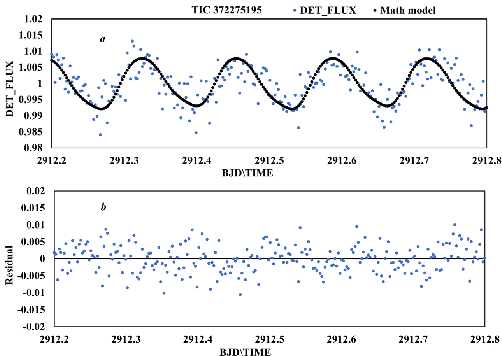 |
Fig. 4. The light curve of TIC 372275195 modelled from TESS observations; observing data are blue points; the asymmetric mathematical model is shown with black points (a); panel (b) displays the residuals (noise). |
The star TIC 372275195 pulsates in the fundamental radial mode;
however, this pulsation is nonlinear in its nature. The presence
of harmonic frequencies  and
and  indicates that the
pulsations exhibit slightly asymmetric shapes, which is typical of
this type of stars. In the case of TIC 372275195, the observed
variability is not due to multiperiodicity but rather to a
nonlinear fundamental pulsation.
indicates that the
pulsations exhibit slightly asymmetric shapes, which is typical of
this type of stars. In the case of TIC 372275195, the observed
variability is not due to multiperiodicity but rather to a
nonlinear fundamental pulsation.
4. Discussion
The construction of a model for the pulsating star TIC 372275195
was carried out on the basis of its fundamental frequency
day (
). For this purpose, the
fundamental physical parameters of the star were employed, such as
the effective temperature, mass, radius, surface gravity, and
metallicity index, as listed in Table 1. In asteroseismology, a
well-established empirical relation exists between the pulsation
period of a star and its mean density (Christensen-Dalsgaard
1993):
 |
(2) |
 is the fundamental pulsation period of the
star, and
is the fundamental pulsation period of the
star, and  is its mean density. It follows from
equation (2) that, as the density decreases, the pulsation period
increases; in other words, stars with larger radii pulsate slower.
Equation (2) can be expressed in a more precise form as follows:
is its mean density. It follows from
equation (2) that, as the density decreases, the pulsation period
increases; in other words, stars with larger radii pulsate slower.
Equation (2) can be expressed in a more precise form as follows:
 |
(3) |
 is the mean density of the Sun,
is the mean density of the star, and
is the mean density of the Sun,
is the mean density of the star, and  is the
pulsation constant, which depends on the internal structure of the
star. This quantity reflects the physical state of the pulsations,
the pulsation mode, and the internal stellar structure. The
parameter carries information about the type of pulsation
regime and is widely used as a diagnostic of pulsational
properties (Handler & Shobbrook 2002). It should be emphasized
that the value of is specific to each class of pulsating
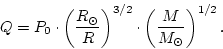
stars. can be expressed in terms of the pulsation period of
the star, its mass, and radius by the following relation:
is the
pulsation constant, which depends on the internal structure of the
star. This quantity reflects the physical state of the pulsations,
the pulsation mode, and the internal stellar structure. The
parameter carries information about the type of pulsation
regime and is widely used as a diagnostic of pulsational
properties (Handler & Shobbrook 2002). It should be emphasized
that the value of is specific to each class of pulsating
stars. can be expressed in terms of the pulsation period of
the star, its mass, and radius by the following relation:
 |
(4) |
For the star TIC 372275195, the pulsation constant , calculated
using equation (4), is:
 |
(5) |
. We can compare the values of
the pulsation constant , calculated using equation (4) for
TIC 372275195 and for typical Scuti stars: Sct
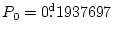
and V784 Cas. The pulsation period for Sct (TIC
162499828) is
 ,
,
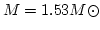 ,
,
 ,
,
 ; for V784 Cas (TIC 12221925),
 ,
,
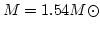 ,
,  ,
,
 . The periods were taken from the GCVS 5.12 (Samus et al.
2017), while the masses and radii were taken from the TESS Input
Catalog v8.2.
. The periods were taken from the GCVS 5.12 (Samus et al.
2017), while the masses and radii were taken from the TESS Input
Catalog v8.2.
The mass, effective temperature, , and pulsation period of
TIC 372275195 correspond to typical parameters of
Scuti-type stars. However, for representative members of
this class, the value of the pulsation constant is usually
within the range
 (Breger 1990). This
naturally raises the question: if TIC 372275195 indeed belongs to
the Scuti type, why does its pulsation constant
significantly exceed the expected range?
(Breger 1990). This
naturally raises the question: if TIC 372275195 indeed belongs to
the Scuti type, why does its pulsation constant
significantly exceed the expected range?
To address this question, we perform a theoretical estimate of the
fundamental radial pulsation frequency of TIC 372275195. Using the
stellar parameters provided in Table 1, we obtain a mean density
of
 . Assuming the theoretical value
of the pulsation constant
. Assuming the theoretical value
of the pulsation constant
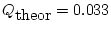 , we then
calculate the pulsation period according to equation (3):
, we then
calculate the pulsation period according to equation (3):
 , this corresponds
to the theoretical fundamental frequency
, this corresponds
to the theoretical fundamental frequency
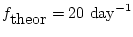 . Thus, the theoretical value of the fundamental
frequency
. Thus, the theoretical value of the fundamental
frequency
 is significantly higher than the
observed fundamental frequency of TIC 372275195. From this,
two possible conclusions can be drawn. The first interpretation is
that TIC 372275195 does not pulsate in the fundamental radial
mode, but rather in a high-order radial p-mode. The second
solution is that, when calculating the pulsation constant in this
study, we used values for the star's physical characteristics
taken from the TESS catalog. These were not measured directly, but
rather calculated using various data sources (GAIA measurements in
combination with theoretical models of stellar evolution and
various empirical relationships). Their accuracy, therefore, can
vary depending on the measurements used and the type of star
(Stassun et al. 2019). The average density of the star in our case
could have been underestimated, meaning that its radius was
overestimated and its mass, underestimated. Consequently, if we
assume that the mass of TIC 372275195 is lower and its radius is
higher than the initial estimates, its parameters could be
consistent with those of RR Lyrae stars. However, the observed
pulsation period would still differ from the typical values for
RR Lyrae variables.
is significantly higher than the
observed fundamental frequency of TIC 372275195. From this,
two possible conclusions can be drawn. The first interpretation is
that TIC 372275195 does not pulsate in the fundamental radial
mode, but rather in a high-order radial p-mode. The second
solution is that, when calculating the pulsation constant in this
study, we used values for the star's physical characteristics
taken from the TESS catalog. These were not measured directly, but
rather calculated using various data sources (GAIA measurements in
combination with theoretical models of stellar evolution and
various empirical relationships). Their accuracy, therefore, can
vary depending on the measurements used and the type of star
(Stassun et al. 2019). The average density of the star in our case
could have been underestimated, meaning that its radius was
overestimated and its mass, underestimated. Consequently, if we
assume that the mass of TIC 372275195 is lower and its radius is
higher than the initial estimates, its parameters could be
consistent with those of RR Lyrae stars. However, the observed
pulsation period would still differ from the typical values for
RR Lyrae variables.
According to the first interpretation, the frequencies and
, observed in the pulsations of TIC 372275195, represent
harmonics of the fundamental frequency . The frequency
is close to the theoretically calculated
;
however, it was detected only in TESS Sectors 58, 59, and 86, and
its occurrence was unstable and of relatively low amplitude.
Therefore, cannot be considered the fundamental pulsation
frequency of TIC 372275195.
According to the second interpretation, the mass of
Scuti-type stars lies within the range of
 (Uytterhoeven et al. 2011), the effective surface
temperature is from 6300 to 8500 K, the surface gravity ranges
between 3.2 and 4.3 (Kirmizitas et al. 2022). Based
on these parameters, the radius of Scuti stars may vary
from
(Uytterhoeven et al. 2011), the effective surface
temperature is from 6300 to 8500 K, the surface gravity ranges
between 3.2 and 4.3 (Kirmizitas et al. 2022). Based
on these parameters, the radius of Scuti stars may vary
from  to
to  . If the radius of TIC 372275195 is
estimated within the interval of
. If the radius of TIC 372275195 is
estimated within the interval of
 , the resulting
value of the pulsation constant would be consistent with the
characteristics of Scuti-type stars. The frequency and
light curve analysis of TIC 372275195 confirms that the frequency
day represents its fundamental mode.
According to the values of mass, , and effective
temperature presented in Table 1, TIC 372275195 is located on the
main sequence of the Hertzsprung-Russell diagram. Taking into
account its metallicity, it can be concluded that the star has not
yet evolved into the subgigant phase and is not at the terminal
stage of stellar evolution.
, the resulting
value of the pulsation constant would be consistent with the
characteristics of Scuti-type stars. The frequency and
light curve analysis of TIC 372275195 confirms that the frequency
day represents its fundamental mode.
According to the values of mass, , and effective
temperature presented in Table 1, TIC 372275195 is located on the
main sequence of the Hertzsprung-Russell diagram. Taking into
account its metallicity, it can be concluded that the star has not
yet evolved into the subgigant phase and is not at the terminal
stage of stellar evolution.
5. Conclusion
Based on the TESS observations of TIC 372275195, the period ratios
of its pulsations were analyzed to investigate the relationships
between different pulsation modes, revealing that the star
possessed a complex pulsation structure. The frequency
day represents the fundamental mode and
determines the main pulsation characteristics of this star. TIC
372275195 is classified as a Scuti star with a low
metallicity index (see Table 1); it pulsates in a radial mode at
the frequency . In addition, the subharmonic , as well
as the second- and third-order harmonics and , are
detected. The light curve of the star shows a certain asymmetry,
which is characteristic of RR Lyrae stars and indicates
sensitivity of the stellar interior to the boundaries of the
convective zone. The observed combination of pulsation modes
points to the dominance of the p-mode, which is typical of
Scuti stars.
However, it should be noted that, for low-amplitude Scuti
stars, a rich spectrum of closely spaced frequencies is usually
observed, associated with excitation of non-radial p-modes, which
may be driven by various internal or external conditions. Also,
the frequency spectrum often contains combination frequencies
superimposed on the intrinsic modes. The presence of such a
spectrum, together with existing asteroseismological techniques,
makes it possible to infer information on the rotation, internal
structure, and evolutionary stage of the star. In the case of TIC
372275195, however, despite the use of TESS data, we were able to
identify only a single fundamental oscillation frequency, which is
a rather rare occurrence for this type of stars.
From the observed fundamental frequency day
obtained from TESS data, the pulsation constant of the star was
calculated as  . The theoretical pulsation constant
for typical Scuti stars is
,
corresponding to the theoretically predicted fundamental frequency
of
. The theoretical pulsation constant
for typical Scuti stars is
,
corresponding to the theoretically predicted fundamental frequency
of
 day. The significant
discrepancy between the experimental and theoretical values of the
pulsation constant is most likely related to uncertainties in the
estimates of stellar mass and radius. Nevertheless, the frequency
analysis and the mathematical model constructed from the light
curve confirm that is indeed the fundamental mode of TIC
372275195.
day. The significant
discrepancy between the experimental and theoretical values of the
pulsation constant is most likely related to uncertainties in the
estimates of stellar mass and radius. Nevertheless, the frequency
analysis and the mathematical model constructed from the light
curve confirm that is indeed the fundamental mode of TIC
372275195.
Acknowledgments: This work was carried out at the Astronomical Institute of the Academy of Sciences of the Republic of Uzbekistan, within the framework of the basic research program of the Laboratory of Galactic Astronomy.
References:
Aerts, C., Christensen-Dalsgaard, J., & Kurtz, D. W. 2010, Asteroseismology, Berlin: Springer
Breger, M., 1990, Delta Scuti Star Newsletter, No. 2, 13
Christensen-Dalsgaard, J. 1993, in: IAU Colloquium 137: Inside the Stars, W. W. Weiss & A. Baglin (eds.), ASP Conference Series, 40, 483
Gaia Collaboration 2022, VizieR Online Catalog I/355
Handler, G. & Shobbrook, R. R. 2002, Monthly Notices Roy. Astron. Soc., 333, No. 2, 251
Huang, C. X., Vanderburg, A., Pál, A., et al. 2020, Research Notes of the AAS, 4, No. 11, article id. 204
Kirmizitas, Ö., Çavius, S., & Aliçavius, F. K. 2022, Astrophys. Bull., 77, No. 3, 316
Kurtz, D. W. 2022, Ann. Rev. Astron. & Astrophys., 60, No. 1, 31
Lenz, P. & Breger, M. 2005, Communications in Asteroseismology, 146, 53
Netzel, H. & Smolec, R. 2022, Monthly Notices Roy. Astron. Soc., 515, No. 3, 4574
Paegert, M., Stassun, K. G., Collins, K. A., et al. 2021, arXiv 2108.04778
Percy, J. R. 2007, Understanding variable stars, Cambridge: Cambridge University Press, 2007
Petersen, J. O. 1973, Astron. & Astrophys., 27, No. 1, 89
Popielski, B. L., Dziembowski, W. A., & Cassisi, S. 2000, Acta Astron., 50, No. 4, 491
Poretti, E. & Beltrame, M. 2004, Communications in Asteroseismology, 145, 55
Qian, S.-B., Li, L.-J., He, J.-J., et al. 2018, Monthly Notices Roy. Astron. Soc., 475, No. 1, 478
Qiao, P., Xu, T., Wang, F., et al. 2024, Astrophys. J., Suppl. Ser., 272, No. 1, article id. 1
Rathour, R. S., Smolec, R., & Netzel, H. 2021, Monthly Notices Roy. Astron. Soc., 505, No. 4, 5412
Ricker, G. R., Winn, J. N., Vanderspek, R., et al. 2015, Journal of Astron. Telescopes, Instruments, and Systems, 1, No. 1, 014003
Samus, N. N., Kazarovets, E. V., Durlevich, O. V., et al. 2017, Astron. Reports, 61, No. 1, 80
Smolec, R. & Sniegowska, M. 2016, Monthly Notices Roy. Astron. Soc., 458, 3561
Stassun, K. G., Oelkers, R. J., Paegert, M., et al. 2019, Astron. J., 158, No. 4, id. 138
Uytterhoeven, K., Moya, A., Grigahcène, A., et al. 2011, Astron. & Astrophys., 534, id. A125
Vanderburg, A. & Johnson, J. A. 2014, Publ. Astron. Soc. Pacific, 126, 948
Wang, J., Chen, X., Deng, L., et al. 2024, Astrophys. J., 978, No. 1, article id. 53