|
Peremennye Zvezdy (Variable Stars) 46, No. 1, 2026 Received 4 March; accepted 29 April. |
Article in PDF |
|
DOI: 10.24412/2221-0474-2026-46-1-12
|
A Study of Four Southern RR Lyrae Stars Based on MASTER, TESS, and ASAS-SN Data
T. V. Migal1,2, A. N. Tarasenkov1, V. M. Lipunov3,1, P. V. Balanutsa1,4, A. S. Kuznetsov1, M. M. Shilova1, C. Francile5,6, F. Podesta5,6
- Sternberg Astronomical Institute, Moscow State University,
Universitetskij pr. 13, Moscow 119992, Russia
- Moscow Institute of Physics and Technology, Institutsky
per. 9, Dolgoprudny 141700, Russia
- Lomonosov Moscow State University, GSP-1, Leninskie Gory,
Moscow, 119991, Russia
- National Research Center Kurchatov Institute, 123098,
Moscow, Russia
- Observatorio Astronomico Felix Aguilar (OAFA), Avda
Benavides 8175, Rivadavia, El Leonsito, San Juan 5400, Argentina
- Facultad de Ciencias Exactas Fisicas y Naturales, San Juan National University, Casilla de Correo 49, San Juan 5400, Argentina
| We present our photometric analysis of four RR Lyrae variables detected by the MASTER robotic net. Variability of these stars was detected by automatic routines for detecting astrophysical transients based on frame subtraction algorithms. To clarify the variability type and period, we used the TESS and ASAS-SN data. As a result, the VSX classification and period were corrected for one of the stars, SSS J195436.8-522301, and periods were refined for three others: Gaia DR3 6012658518794440064, SSS J134829.5-225501, and V2247 Sgr. |
1. Introduction
One of the main scientific goals of the MASTER Robotic Net is to search for new astrophysical transients and variable objects (Lipunov et al. 2010). The search for transients is performed using a special automatic detection system, which can use different operating modes to search for different types of transients (Kornilov et al. 2012; Gorbovskoy et al. 2013; Lipunov et al. 2019). The main search algorithm is to compare two frames taken within a short interval of time with an archival reference frame. This method allows us to find flares and outbursts of various astrophysical nature: GRBs, outbursts of cataclysmic variables, flares of UV Ceti stars, etc. (Lipunov et al. 2022, Lipunov et al. 2024), as well as to identify fading and variable objects (Lipunov et al. 2016). However, to search for supernovae and weakly variable objects, the frame subtraction method is usually used. It demonstrates high efficiency under non-uniform background illumination and, in particular, made it possible to detect a kilonova (an optical counterpart of the GW170817 event, Abbott et al. 2017ab; Lipunov et al. 2017).
While exploring transient candidates, variable stars are often detected by the auto-detection system as transient candidates, but usually not enough attention is paid to their detailed study. Using data from the TESS space mission (Ricker et al. 2015) allows us to solve this problem, since the TESS data archive permits to obtain continuous light curves for almost any variable star. This paper describes the discovery and study of four RR Lyrae variable stars identified by the MASTER network auto-detection system, which were identified with the known variables, based on TESS data. All four variables were detected on frames obtained by the MASTER-OAFA telescope in Argentina. Since the periods and variability types published in the VSX database (Watson et al. 2006) for the objects under study were obtained by automatic systems, they are not correct for some stars. Light curves, obtained from TESS data for each of these stars, reveal their true types and pulsation periods. Since TESS data have a fairly high photometric accuracy, they make classification and period determination possible. However, the light curve duration is 27 days of continuous monitoring, and there may be biases in the time calculation between sectors (Volkova & Volkov 2025), so we used ASAS-SN (Shappee et al. 2014, Kochanek et al. 2017) data where possible to accurately determine the period.
2. Investigation of RR Lyrae variables
To extract TESS photometry, we used a  script (Tarasenkov
2024) based on the
script (Tarasenkov
2024) based on the  library (Lightkurve Collaboration
et al. 2018). The photometric apertures for the object and
background were set to maximize the flux from the object and
minimize the effects of background illumination and contamination
from field stars. Next, outliers and trends were removed using a
polynomial fit. The result were purified light curves, then
subjected to periodogram analysis.
library (Lightkurve Collaboration
et al. 2018). The photometric apertures for the object and
background were set to maximize the flux from the object and
minimize the effects of background illumination and contamination
from field stars. Next, outliers and trends were removed using a
polynomial fit. The result were purified light curves, then
subjected to periodogram analysis.
To study periodicities in the TESS data, the Lomb-Scargle
periodogram (VanderPlas 2018) implemented in the  package
(Astropy Collaboration et al. 2013) was used. For accurate
determination of the period based on ASAS-SN data, the Deeming
(1975) method implemented in the WinEfk
program1 was used.
package
(Astropy Collaboration et al. 2013) was used. For accurate
determination of the period based on ASAS-SN data, the Deeming
(1975) method implemented in the WinEfk
program1 was used.
2.1. SSS J195436.8-522301
|
Fig. 1.
MASTER-OAFA |
 cutout frames of
SSS J195436.8-522301. From left to right: detection frame,
comparison frame, difference frame, and POSS2 Red archival plate
cutout.
cutout frames of
SSS J195436.8-522301. From left to right: detection frame,
comparison frame, difference frame, and POSS2 Red archival plate
cutout.
The variable star SSS J195436.8-522301 (ASASSN-V
J195436.84-522303.3) (J2000 coordinates: RA = 19 54
54 36
36 78,
Decl = -52
78,
Decl = -52 23
23 03
03
 2) was identified as a periodic
variable by Catalina Siding Spring Survey (Drake et al. 2017) and
ASAS-SN survey (Jayasinghe et al 2018, 2020). In the latter
survey, the object is designated as a rotating variable (ROT type
in VSX) with a period of 1
2) was identified as a periodic
variable by Catalina Siding Spring Survey (Drake et al. 2017) and
ASAS-SN survey (Jayasinghe et al 2018, 2020). In the latter
survey, the object is designated as a rotating variable (ROT type
in VSX) with a period of 1 0046.
0046.
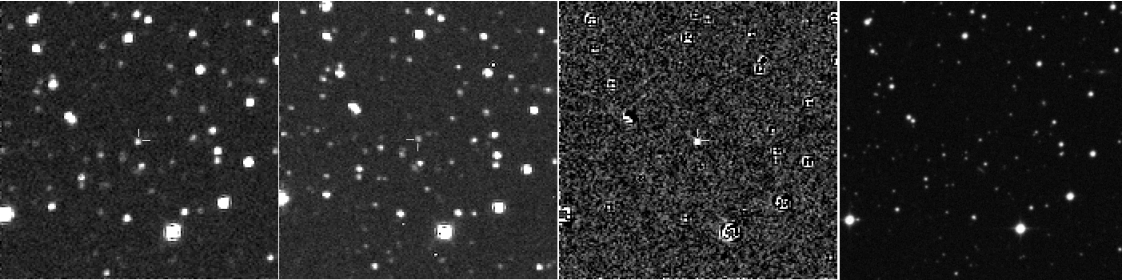
Variability of SSS J195436.8-522301 was detected on frames
obtained by the MASTER-OAFA robotic telescope at 2025-08-04
02:02:43 UT with limiting magnitude of 19 1 in the unfiltered
band. The comparison archive frame was taken at 2025-06-24
05:18:21 UT with limiting magnitude of 203 in unfiltered band.
Variability of SSS J195436.8-522301 is clearly visible in the
difference frame (see Fig. 1).
1 in the unfiltered
band. The comparison archive frame was taken at 2025-06-24
05:18:21 UT with limiting magnitude of 203 in unfiltered band.
Variability of SSS J195436.8-522301 is clearly visible in the
difference frame (see Fig. 1).
SSS J195436.8-522301 was observed by the TESS space mission in
Sectors 13, 27, 67 and 94. Periodogram analysis of TESS data
reveals that the object is misclassified in the Drake et al.
(2017) catalog. A period of
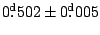 , twice
shorter than that determined by ground-based means, is clearly
revealed. The error was estimated as the width of the peak of the
power spectrum at the half of its height. Period calculations for
individual sectors are presented in Table 1. The light curves,
folded with these periods, show a clearly asymmetric shape with a
short ascending branch and a smoother decline. The geometry of the
curve is stable throughout the entire TESS observation period,
which is completely uncharacteristic for most spotted stars. The
periodograms with highlighted best frequency and folded light
curves of SSS J195436.8-522301 are shown in Fig. 2. The light
curves obtained from data from later sectors have more data points
and stronger scattering due to shorter exposure times used. Since
TESS has a very large pixel size (
, twice
shorter than that determined by ground-based means, is clearly
revealed. The error was estimated as the width of the peak of the
power spectrum at the half of its height. Period calculations for
individual sectors are presented in Table 1. The light curves,
folded with these periods, show a clearly asymmetric shape with a
short ascending branch and a smoother decline. The geometry of the
curve is stable throughout the entire TESS observation period,
which is completely uncharacteristic for most spotted stars. The
periodograms with highlighted best frequency and folded light
curves of SSS J195436.8-522301 are shown in Fig. 2. The light
curves obtained from data from later sectors have more data points
and stronger scattering due to shorter exposure times used. Since
TESS has a very large pixel size (
 ) and the target is
quite faint (about
) and the target is
quite faint (about
 in the
  band), contamination from
neighboring stars cannot be completely subtracted even using
special algorithms. Therefore, an exact determination of the
amplitude is impossible.
band), contamination from
neighboring stars cannot be completely subtracted even using
special algorithms. Therefore, an exact determination of the
amplitude is impossible.
| Sector 13 | Sector 27 | Sector 67 | Sector 94 | |
| Period, days | 0.503 | 0.502 | 0.501 | 0.502 |
| Error, days | 0.004 | 0.004 | 0.004 | 0.005 |
For SSS J195436.8-522301, no high-quality observations of ASAS-SN are available, so it is impossible to derive the period with a high accuracy.
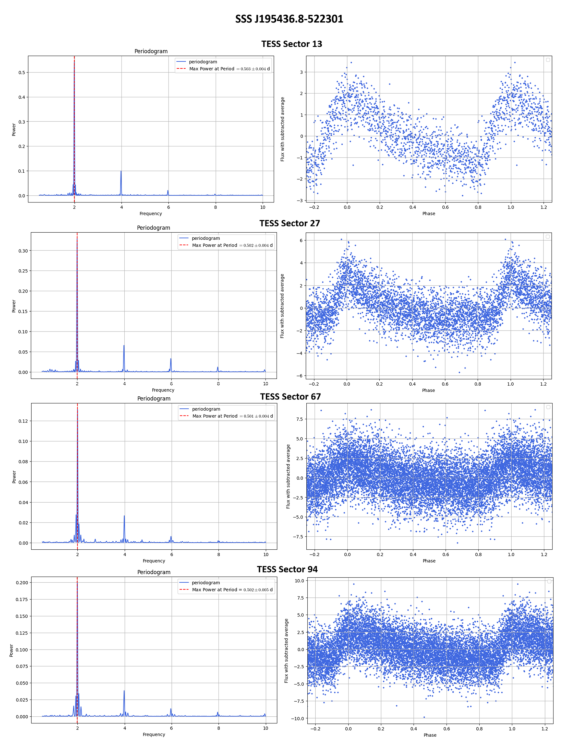 |
Fig. 2. Periodograms (left panels) and folded light curves (right panels) for SSS J195436.8-522301 based on TESS data. |
The period, the characteristic asymmetric light curve, as well as the presence of a small bump before the minimum, allow us to conclude that SSS J195436.8-522301 is an RR Lyrae star pulsating in the fundamental mode (RRAB type). The overall shape of the light curve does not show any obvious changes in amplitude, so we argue that the Blazhko effect is either absent or has a small amplitude that cannot be detected without further observations.
2.2. Gaia DR3 6012658518794440064
Variability of Gaia DR3 6012658518794440064 was detected on
frames obtained by the MASTER-OAFA robotic telescope at 2025-08-04
01:52:38 UT with the limiting magnitude of 1768 in unfiltered
band. The comparison archive frame was taken at 2025-07-28
00:22:06 UT with the limiting magnitude of 191 in unfiltered
band. Variability of Gaia DR3 6012658518794440064 is clearly
visible in the difference frame (see Fig. 3).
The variable Gaia DR3 6012658518794440064 (J2000 coordinates:
15292016,
-372820
7) is identified as
an RRAB variable in the Gaia variability catalog (Gaia
collaboration et al. 2023). TESS observed Gaia DR3
6012658518794440064 in Sector 65. The periodogram analysis reveals
the period of
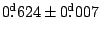 , which is consistent with
the period given in the VSX and Gaia variability catalog.
, which is consistent with
the period given in the VSX and Gaia variability catalog.
The light curve of Gaia DR3 6012658518794440064, like that of the
previous variable, has an asymmetric shape with a rapid
( of the period) rise to the maximum and a slower
decline, characteristic of RR Lyrae stars. The periodogram and
folded light curve are presented in Fig. 4. We were unable to
identify the presence of Blazhko effect for this star. Thus, we
confirm the classification of Gaia DR3 6012658518794440064,
presented in the VSX, as an RR Lyrae star pulsating in the
fundamental mode (RRAB type).
of the period) rise to the maximum and a slower
decline, characteristic of RR Lyrae stars. The periodogram and
folded light curve are presented in Fig. 4. We were unable to
identify the presence of Blazhko effect for this star. Thus, we
confirm the classification of Gaia DR3 6012658518794440064,
presented in the VSX, as an RR Lyrae star pulsating in the
fundamental mode (RRAB type).
To improve the period, we computed it using the WinEfk program
from ASAS-SN data. The Deeming method was used, with the error
calculated from the set of periods that gave the best-quality
light curve. The resulting period is
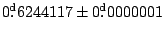 , and the full light elements are
 . The ASAS-SN
light curve, folded with these elements, and the periodogram for
these data are shown in Fig. 5.
. The ASAS-SN
light curve, folded with these elements, and the periodogram for
these data are shown in Fig. 5.
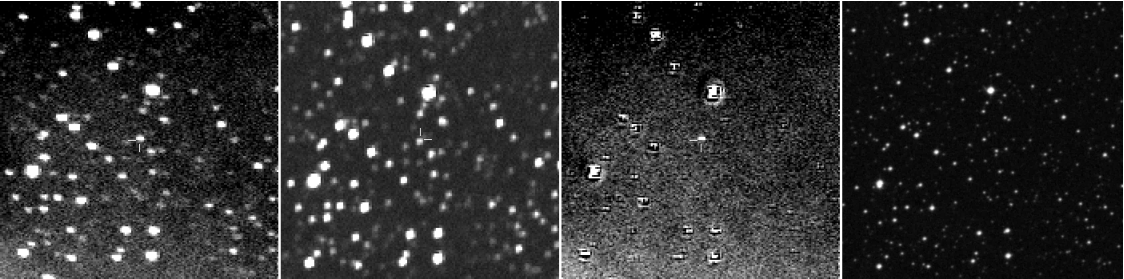 |
Fig. 3.
MASTER-OAFA |
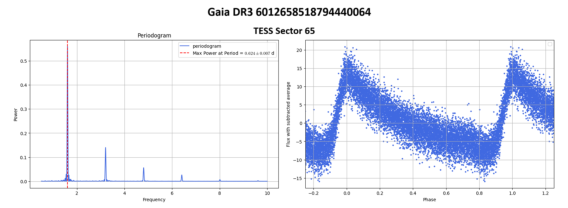 |
Fig. 4. Periodogram (left panel) and folded light curve (right panel) for Gaia DR3 6012658518794440064 based on TESS data. |
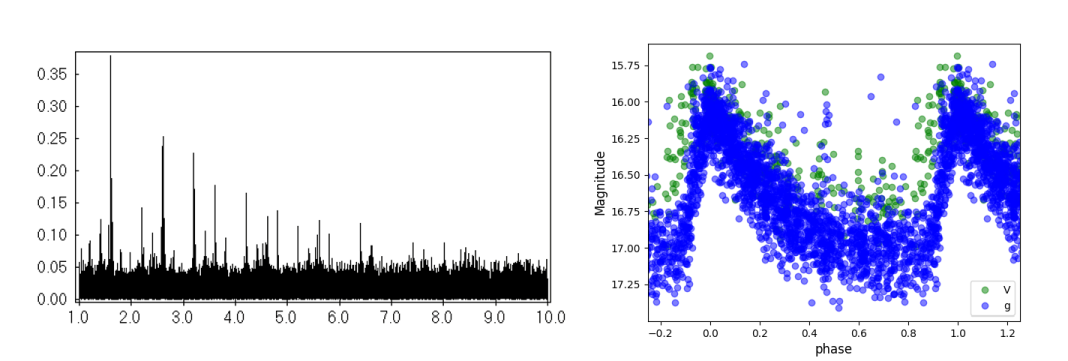 |
Fig. 5. Periodogram (left panel) and folded light curve (right panel) for Gaia DR3 6012658518794440064 based on ASAS-SN data. |
2.3. SSS J134829.5-225501
Variability of SSS J134829.5-225501 was detected on frames
obtained by the MASTER-OAFA robotic telescope at 2025-08-05
01:31:37 UT with limiting magnitude of 1783 in unfiltered
band. The comparison archive frame was taken at 2025-04-05
05:04:49 UT with limiting magnitude of 2065 in unfiltered
band. Variability of SSS J134829.5-225501 is clearly visible in
the difference frame (see Fig. 6).
The variable SSS J134829.5-225501 (ASASSN-V J134829.48-225500.7)
(J2000 coordinates: 13482953, -225501
2)
was identified as a periodic variable by the Catalina Siding
Spring Survey (Drake et al. 2017) and the ASAS-SN survey
(Jayasinghe et al. 2018, 2020).
TESS observed SSS J134829.5-225501 in Sectors 37, 64, and 91 in 2021, 2023 and 2025. Table 2 presents the results of period determination for these sectors by the Lomb-Scargle method.
| Sector 37 | Sector 64 | Sector 91 | |
| Period, days | 0.450 | 0.450 | 0.450 |
| Error, days | 0.003 | 0.004 | 0.003 |
As the result, the pulsation period of SSS J134829.5-225501 can
be estimated as
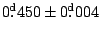 . It is in a good
agreement with the period reported in VSX.
. It is in a good
agreement with the period reported in VSX.
The period of SSS J134829.5-225501 does not show noticeable
changes over the TESS observation time. Other harmonics were also
not reliably detected. The light curve corresponds to the RRC
type: it has an approximately symmetric sinusoidal shape, with a
small bump at the phase  , which is observed for many RRC
stars. Although this object is listed as RRD in the VSX database,
we cannot confirm this classification because of no reliably
detected multiperiodicity. It is possible that
SSS J134829.5-225501 experienced a mode switch from double-mode
to single-mode pulsations. A similar effect was observed for some
RR Lyrae stars (Soszynski at al. 2014, Khruslov et al. 2017).
Therefore, we classify SSS J134829.5-225501 as an RRC star at the
time of TESS observations.
, which is observed for many RRC
stars. Although this object is listed as RRD in the VSX database,
we cannot confirm this classification because of no reliably
detected multiperiodicity. It is possible that
SSS J134829.5-225501 experienced a mode switch from double-mode
to single-mode pulsations. A similar effect was observed for some
RR Lyrae stars (Soszynski at al. 2014, Khruslov et al. 2017).
Therefore, we classify SSS J134829.5-225501 as an RRC star at the
time of TESS observations.
To improve the period, we determined it using the WinEfk program
from ASAS-SN data. The Deeming method was used, with the error
calculated from a set of periods that gave the best shape of the
light curve. The resulting period is
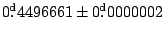 , the full light elements being
 . The ASAS-SN
light curve, folded with these elements, and the periodogram for
these data are shown in Fig. 8.
. The ASAS-SN
light curve, folded with these elements, and the periodogram for
these data are shown in Fig. 8.
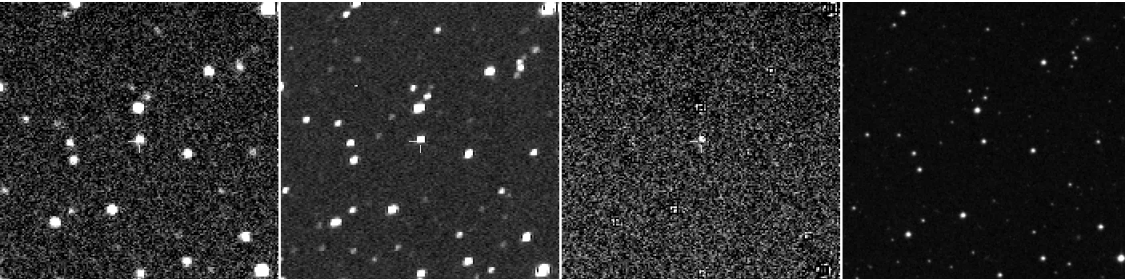 |
Fig. 6.
MASTER-OAFA |
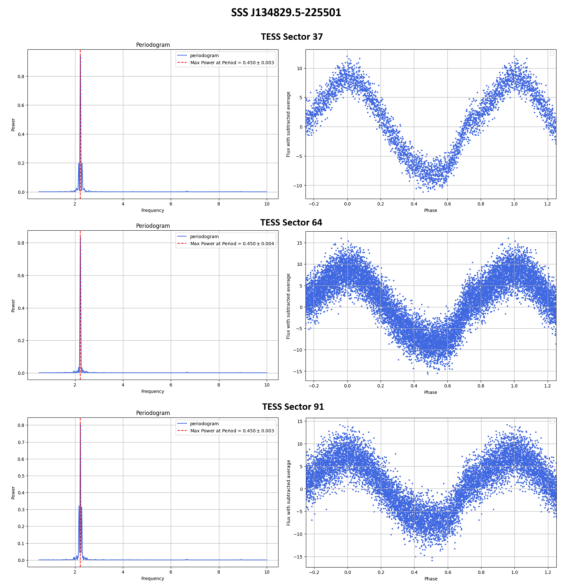 |
Fig. 7. Periodograms (left panels) and folded light curves (right panels) for SSS J134829.5-225501 based on TESS data. |
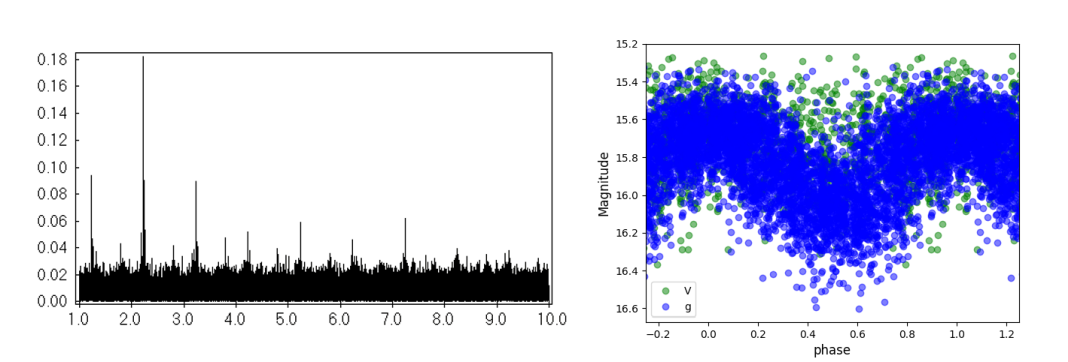 |
Fig. 8. Periodogram (left panel) and folded light curve (right panel) for SSS J134829.5-225501 based on ASAS-SN data. |
2.4. V2247 Sgr
The variable star V2247 Sgr was identified by MASTER autodetection
system on frames obtained by the MASTER-OAFA robotic telescope at
2025-08-01 03:11:51 UT with limiting magnitude of 1933 in
unfiltered band. The comparison archive frame was taken at
2025-07-02 04:28:27 UT with limiting magnitude 1988 in
unfiltered band. Variability of V2247 Sgr is clearly visible in
the difference frame (see Fig. 9).
Variability of V2247 Sgr was first discovered by Hoffmeister
(1963). The star enters the GCVS (Samus' et al. 2017) as an RR
variable. V2247 Sgr (J2000 coordinates: 20130412,
-380937
4) was also identified as an RR Lyrae
variable by Catalina Survey (Torrealba et al. 2015) and Gaia
(Clementini et al. 2019, 2023). The star was also observed by WISE
in the mid-infrared (Gavrilchenko et al. 2014). TESS observed this
star in 3 sectors in 2020, 2023 and 2025, but only Sector 67 data
(observed in 2023) allowed us to obtain a light curve, while in
other sectors, the target was inaccessible due to instrumental
limitations.
The Lomb-Scargle periodogram gives the period of
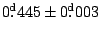 , which agrees well with that in VSX.
The folded light curve shows asymmetric shape characteristic of
RRAB stars. The duration of the ascending branch is approximately
 of the period, while the descending branch is much longer.
The light curve is shown in Fig. 10. We therefore confirm the RRAB
classification of V2247 Sgr given in VSX.
of the period, while the descending branch is much longer.
The light curve is shown in Fig. 10. We therefore confirm the RRAB
classification of V2247 Sgr given in VSX.
To improve the period, we determined it using the WinEfk code from
ASAS-SN data. The Deeming method was used, with the error
calculated from the set of periods giving the best light curve.
The resulting period is
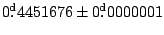 , the full
light elements being
, the full
light elements being
 . The ASAS-SN light curve folded with these elements and the
periodogram for these data are shown in Fig. 11.
. The ASAS-SN light curve folded with these elements and the
periodogram for these data are shown in Fig. 11.
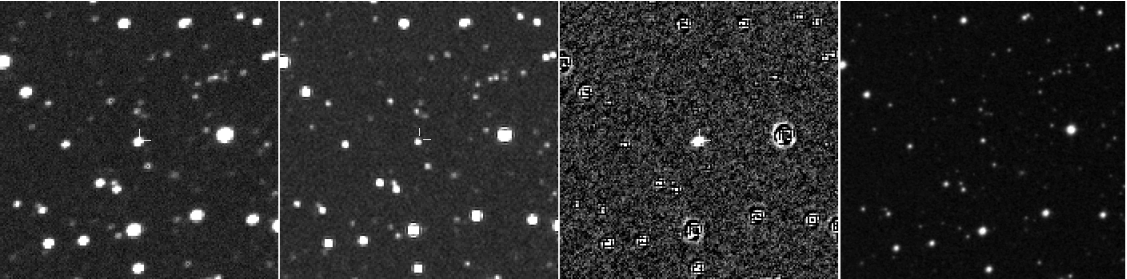 |
Fig. 9.
MASTER-OAFA |
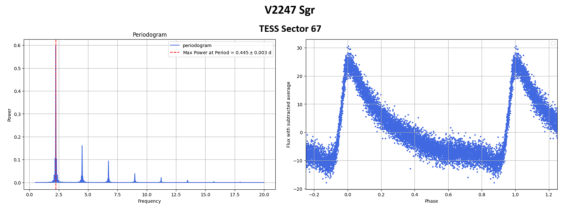 |
Fig. 10. Periodogram (left panel) and folded light curve (right panel) for V2247 Sgr based on TESS data. |
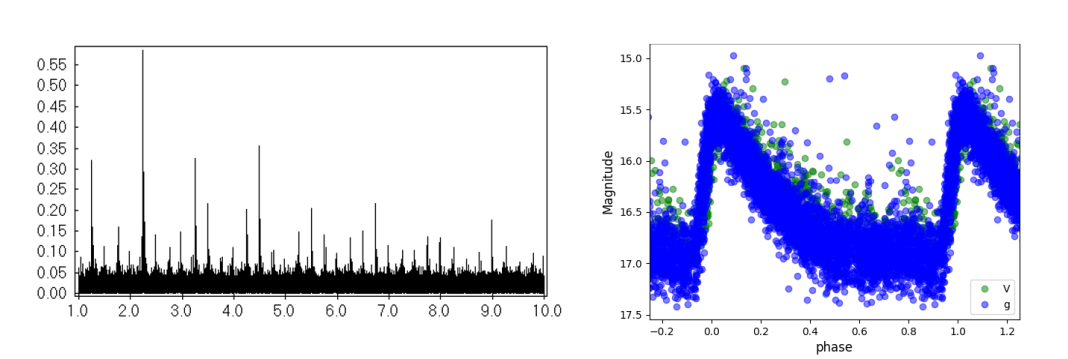 |
Fig. 11. Periodogram (left panel) and folded light curve (right panel) for V2247 Sgr based on ASAS-SN data. |
3. Discussion
This work shows that the automatic processing tools of the MASTER network, developed for detecting astrophysical transients (Lipunov et al. 2019), can be used to detect variable stars, including those with a relatively small variability amplitude, such as pulsating variables. Since the MASTER network has an extensive archive of images obtained over 20 years of operation (Tarasenkov et al. 2024a), this stimulates a systematic search for variable stars of selected types and studies of their properties (Tarasenkov et al. 2026).
However, this approach is not optimal for RR Lyrae stars because the accuracy and duty cycle of MASTER measurements do not provide sufficient capabilities to resolve subtle variations in the light curves, such as the Blazhko effect. Therefore, for such variables, it is necessary to combine different data sources for the most complete study, as suggested in a number of studies (Li et al. 2022; Juraev et al. 2025a; Tarasenkov et al. 2024b).
The crucial part of such studies is using data from the TESS mission, which provides high-quality data for studying pulsating stars. TESS supplies dense, high-precision light curves that allow us to determine periods with high accuracy, including the case of multiperiodicity (Juraev et al. 2025b), to track the Blazhko effect (Wilhelm et al. 2023), and even to estimate physical parameters of RR Lyraes and other pulsating stars (Kumar et al. 2025).
4. Conclusions
As a result of verification of optical transient candidates proposed by the MASTER network's automatic detection system using the frame subtraction method, we identified four variable stars. We performed an analysis of TESS photometry for all these stars, which allowed us to classify them as RR Lyrae variables, determine their subtype and exact period. The results are presented in Table 4.
This result shows that the frame-subtraction transient detection
system used on the MASTER network telescopes can detect objects
whose variability amplitude is quite small by the standards of
astrophysical transients (1-2). Moreover, the use of TESS data
for analyzing the shape of the light curve and ASAS-SN data for
calculating the exact period allows us to achieve a high quality
of classification that is inaccessible to mass automatic
identification systems.
| Star | α, δ J2000.0 | Type | P |
| SSS J195436.8-522301 |
 , ,
 |
RRAB | 0502 ±0005
|
| Gaia DR3 6012658518794440064 |
 , ,
 |
RRAB | 06244117
±00000001
|
| SSS J134829.5-225501 |
 , ,
 |
RRC | 04496661
±00000002
|
| V2247 Sgr |
 , ,
 |
RRAB | 04451676
±00000001
|
Acknowledgements. A.Tarasenkov acknowledges the support of
the Foundation for the Development of Theoretical Physics and
Mathematics BASIS (project 25-2-1-39-1). The authors express their
sincere gratitude to the Gravity Frontiers Foundation for
supporting the team and this research. MASTER database research is
carried out using the equipment of the shared research facilities
of HPC computing resources at Lomonosov MSU (Voevodin et al.
2019). The study was conducted under the state assignment of
Lomonosov MSU. The authors would like to thank Dr. V. P. Goranskij
for the opportunity to use the WinEfk code and Prof. N. N. Samus
for useful comments that helped to improve the article.
References:
Abbott, B. P., Abbott, R., Abbott, T. D., et al. 2017a, Nature, 551, No. 7678, 85
Abbott, B. P., Abbott, R., Abbott, T. D., et al. 2017b, Astrophys. J. Letters, 848, No. 2, article id. L12
Astropy Collaboration, Robitaille, T. P., Tollerud, E. J., Greenfield, P, et al. 2013, Astron. & Astrophys., 558, article id. A33
Clementini, G., Ripepi, V., Garofalo, A., et al. 2023, Astron. & Astrophys., 674, article id. A18
Clementini, G., Ripepi, V., Molinaro, R., et al. 2019, Astron. & Astrophys., 622, article id. A60
Deeming, T. J. 1975, Astrophys. & Space Sci., 36, No. 1, 137
Drake, A. J., Djorgovski, S. G., Catelan, M., et al. 2017, Monthly Notices Roy. Astron. Soc., 469, No. 3, 3688
Gaia Collaboration, Vallenari, A., Brown, A. G. A., Prusti, T., et al. 2023, Astron. & Astrophys., 674, article id. A1
Gavrilchenko, T., Klein, C. R., Bloom, J. S., & Richards, J. W. 2014, Monthly Notices Roy. Astron. Soc., 441, No. 1, 715
Gorbovskoy, E. S., Lipunov, V. M., Kornilov, V. G., et al. 2013, Astron. Reports, 57, No. 4, 233
Hoffmeister, C. 1963, Veröff. Sternwarte Sonneberg, 6, 1
Jayasinghe, T., Kochanek, C. S., Stanek, K. Z., et al. 2018, Monthly Notices Roy. Astron. Soc., 477, No. 3, 3145
Jayasinghe, T., Stanek, K. Z., Kochanek, C. S., et al. 2020, Monthly Notices Roy. Astron. Soc., 491, No. 1, 13
Juraev, B. Sh., Burkhonov, O. A., Ehgamberdiev, Sh. A., et al. 2025a, Astron. & Astrophys. Transactions, 35, No. 3, 275
Juraev, B., Burkhonov, O., Ehgamberdiev, S. A., et al. 2025b, Perem. Zvezdy / Variable Stars, 45, No. 13, 115
Khruslov, A. V., Kusakin, A. V., & Reva, I. V. 2017, Acta Astronomica, 67, No. 4, 317
Kochanek, C. S., Shappee, B. J., Stanek, K. Z., et al. 2017, Publ. Astron. Soc. Pacific, 129, No. 980, 104502
Kornilov, V. G., Lipunov, V. M., Gorbovskoy, E. S., et al. 2012, Experimental Astronomy, 33, No. 1, 173
Kumar, N., Singh, H. P., Malkov, O., et al. 2025, Universe, 11, No. 7, id. 207
Li, L.-J., Qian, S.-B., & Zhu, L.-Y. 2022, Monthly Notices Roy. Astron. Soc., 510, No. 4, 6050
Lightkurve Collaboration, Cardoso, J. V. M., Hedges, C., et al. 2018, Astrophysics Source Code Library, record ascl:1812.013
Lipunov, V. M., Balanutsa, P. V., Pavlenko, E. P., et al. 2024, Astron. Reports, 68, No. 12, 1364
Lipunov, V., Gorbovskoy, E., Afanasiev, V., et al. 2016, Astron. & Astrophys., 588, article id. A90
Lipunov, V. M., Gorbovskoy, E., Kornilov, V. G., et al. 2017, Astrophys. J. Letters, 850, No. 1, article id. L1
Lipunov, V., Kornilov, V., Gorbovskoy, E., et al. 2010, Advances in Astronomy, article id. 349171
Lipunov, V. M., Kornilov, V. G., Topolev, V. V., et al. 2022, Astron. Letters 48, No 11, 623
Lipunov, V. M., Vladimirov, V. V., Gorbovskoi, E. S., et al. 2019, Astron. Reports 63, No. 4, 293
Ricker, G. R., Winn, J. N., Vanderspek, R., et al. 2015, Journal of Astronomical Telescopes, Instruments, and Systems, 1, article id. 014003
Samus', N. N., Kazarovets, E. V., Durlevich, O. V., et al. 2017, Astron. Reports, 61, No. 1, 80
Shappee, B. J., Prieto, J. L., Grupe, D., et al. 2014, Astrophys. J., 788, No. 1, article id. 48
Soszynski, I., Udalski, A., Szymanski, M. K., et al. 2014, Acta Astronomica, 64, No. 3, 177
Tarasenkov, A. N. 2024, INASAN Science Reports, 9, No. 3, 89
Tarasenkov, A. N., Lipunov, V. M., Antipov, G. A., et al. 2024a, Lobachevskii J. Math., 45, 3188
Tarasenkov, A. N., Lipunov, V.`M., Kuznetsov, A. S., et al. 2026, Astrophys. & Space Sci., 371, id. 22
Tarasenkov, A., Zubareva, A. M., Maslennikova, N., et al. 2024b, Perem. Zvezdy Prilozh. / Variable Stars Suppl., 24, No. 1, 1
Torrealba, G., Catelan, M., Drake, A. J., et al. 2015, Monthly Notices Roy. Astron. Soc., 446, No. 3, 2251
VanderPlas, J. T. 2018, Astrophys. J. Suppl. Ser., 236, No. 1, article id. 16
Voevodin, V. V., Antonov, A. S., Nikitenko, D. A., et al. 2019 Supercomput. Front. Innov., 6, No. 2, 4
Volkova, A. S. & Volkov, I. M. 2025, Astron. Reports. 69, No. 11, 1169
Watson, C. L., Henden, A.`A., & Price, A. 2006, in The Society for Astronomical Sciences 25th Annual Symposium on Telescope Science, Big Bear, CA, May 23-25, 2006
Wilhelm, R., Carrell, K., Means, H. H., et al. 2023, Astron. J., 165, No. 5, id. 194