
|
Keyword: gravitational lens
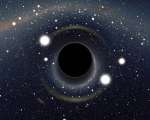 Too Close to a Black Hole
26.10.2014
What would you see if you went right up to a black hole? Featured is a computer generated image highlighting how strange things would look. The black hole has such strong gravity that light is noticeably bent towards it - causing some very unusual visual distortions.
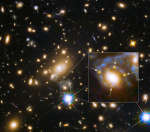 Galaxy and Cluster Create Four Images of Distant Supernova
8.03.2015
What are the unusual spots surrounding that galaxy? They are all images of the same supernova. For the first time, a single supernova explosion has been seen split into multiple images by the gravitational lens deflections of intervening masses. In this case the masses are a large galaxy and its home galaxy cluster.
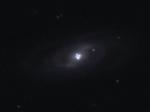 The Einstein Cross Gravitational Lens
11.03.2007
Most galaxies have a single nucleus -- does this galaxy have four? The strange answer leads astronomers to conclude that the nucleus of the surrounding galaxy is not even visible in this image. The central cloverleaf is rather light emitted from a background quasar.
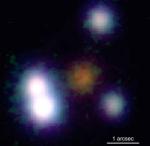 PG 1115+080: A Gravitational Cloverleaf
31.03.1999
All four blue images in the above photograph are the same object. The gravitational lens effect of the red, foreground, elliptical galaxy visible near image center creates a cloverleaf image of the single distant quasar. Light from the quasar is pulled around the massive galaxy in different paths, corresponding to different images.
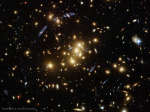 Giant Cluster Bends Breaks Images
23.08.2015
What are those strange blue objects? Many of the brightest blue images are of a single, unusual, beaded, blue, ring-like galaxy which just happens to line-up behind a giant cluster of galaxies. Cluster galaxies here typically appear yellow and -- together with the cluster's dark matter -- act as a gravitational lens.
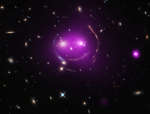 Gravity s Grin
27.11.2015
Albert Einstein's general theory of relativity, published 100 years ago this month, predicted the phenomenon of gravitational lensing. And that's what gives these distant galaxies such a whimsical appearance, seen through the looking glass of X-ray and optical image data from the Chandra and Hubble space telescopes.
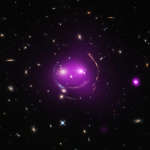 Gravity s Grin
26.10.2019
Albert Einstein's general theory of relativity, published over 100 years ago, predicted the phenomenon of gravitational lensing. And that's what gives these distant galaxies such a whimsical appearance, seen through the looking glass of X-ray and optical image data from the Chandra and Hubble space telescopes.
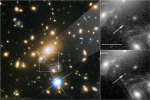 Fortuitous Flash Candidate for the Farthest Star Yet Seen
11.04.2018
Was this flash the farthest star yet seen? An unexpected flash of light noticed fortuitously on Hubble Space Telescope images may prove to be not only an unusual gravitational lensing event but also an image of a normal star 100 times farther away than any star previously imaged individually.
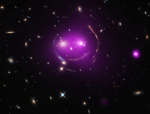 Gravity s Grin
5.08.2017
Albert Einstein's general theory of relativity, published over 100 years ago, predicted the phenomenon of gravitational lensing. And that's what gives these distant galaxies such a whimsical appearance, seen through the looking glass of X-ray and optical image data from the Chandra and Hubble space telescopes.
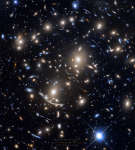 Abell 370: Galaxy Cluster Gravitational Lens
19.03.2019
What are those strange arcs? While imaging the cluster of galaxies Abell 370, astronomers noticed an unusual arc. The arc wasn't understood right away -- not until better images showed that...
|
January February March April May June July August September October |
|||||||||||||||||||||||||||||||||||||||||||||||||