
|
Keyword: globular cluster
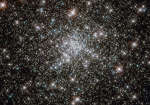 At the Core of NGC 6752
10.02.2012
This sharp Hubble Space Telescope view looks deep into NGC 6752. Some 13,000 light-years away toward the southern constellation Pavo, the globular star cluster roams the halo of our Milky Way galaxy. Over...
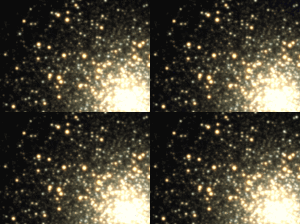 M3: Inconstant Star Cluster
12.10.2004
Star clusters appear constant because photographs of them are frozen in time. In reality, though, cluster stars swarm the center and frequently fluctuate in brightness. Although the time it takes for stars to cross...
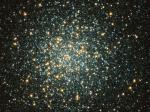 Globular Cluster M3 from WIYN
12.03.2006
This huge ball of stars predates our Sun. Long before humankind evolved, before dinosaurs roamed, and even before our Earth existed, ancient globs of stars condensed and orbited a young Milky Way Galaxy.
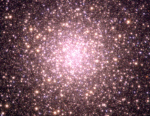 Globular Cluster M3
19.07.1998
This huge ball of stars predates our Sun. Long before mankind evolved, before dinosaurs roamed, and even before our Earth existed, ancient globs of stars condensed and orbited a young Milky Way Galaxy.
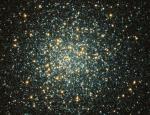 Globular Cluster M3
15.09.2003
This huge ball of stars predates our Sun. Long before humankind evolved, before dinosaurs roamed, and even before our Earth existed, ancient globs of stars condensed and orbited a young Milky Way Galaxy.
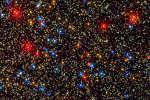 The Center of Globular Cluster Omega Centauri
14.09.2009
What is left over after stars collide? To help answer this question, astronomers have been studying the center of the most massive ball of stars in our Milky Way Galaxy. In the center of globular cluster Omega Centauri, stars are packed in 10,000 times more densely than near our Sun.
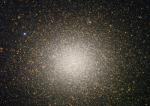 NGC 5139: Omega Centauri
19.04.2007
Centaurus is one of the most striking constellations in the southern sky. The Milky Way flows through this celestial expanse whose wonders also include the closest star system to the Sun, Alpha Centauri, and the largest globular star cluster in our galaxy, Omega Centauri (aka NGC 5139).
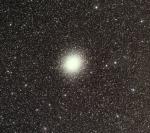 Omega Centauri
26.05.2006
Centaurus, the Centaur, is one of the most striking constellations in the southern sky. The Milky Way flows through this celestial expanse whose wonders also include the closest star to the sun, Alpha Centauri, and the largest globular star cluster in our galaxy, Omega Centauri.
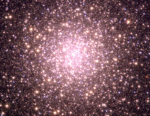 Globular Cluster M3
6.12.1996
This huge ball of stars predates our Sun. Long before mankind evolved, before dinosaurs roamed, and even before our Earth existed, ancient globs of stars condensed and orbited a young Milky Way Galaxy.
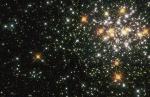 NGC 1818: A Young Globular Cluster
14.02.1997
Globular clusters once ruled the Milky Way. Back in the old days, back when our Galaxy first formed, perhaps thousands of globular clusters roamed our Galaxy. Today, there are perhaps 200 left. Many globular clusters were destroyed over the eons by repeated fateful encounters with each other or the Galactic center.
|
January February March April May June July August September October |
|||||||||||||||||||||||||||||||||||||||||||||||||