
|
Keyword: star cluster
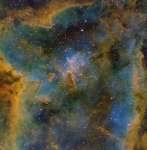 Melotte 15 in the Heart
25.09.2010
Cosmic clouds seem to form fantastic shapes in the central regions of emission nebula IC 1805. Of course, the clouds are sculpted by stellar winds and radiation from massive hot stars in the nebula's newborn star cluster, Melotte 15.
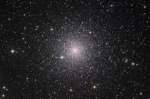 Globular Star Cluster NGC 6752
5.07.2013
Some 13,000 light-years away toward the southern constellation Pavo, the globular star cluster NGC 6752 roams the halo of our Milky Way galaxy. Over 10 billion years old, NGC 6752 follows clusters Omega Centauri and 47 Tucanae as the third brightest globular in planet Earth's night sky.
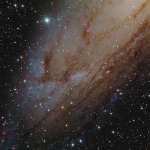 NGC 206 and the Star Clouds of Andromeda
24.10.2012
The large stellar association cataloged as NGC 206 is nestled within the dusty arms of neighboring spiral galaxy Andromeda (M31), 2.5 million light-years distant. Seen near the center of this gorgeous close-up of the southwestern extent of Andromeda's disk, the bright, blue stars of NGC 206 indicate its youth.
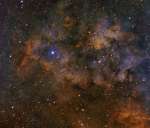 Sharpless 115
14.06.2013
Sharpless 115 stands just north and west of Deneb, the alpha star of Cygnus the Swan in planet Earth's skies. Noted in the 1959 catalog by astronomer Stewart Sharpless (as Sh2-115) the faint...
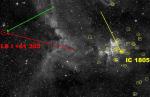 Microquasar in Motion
16.09.2004
Microquasars, bizarre binary star systems, generating high-energy radiation and blasting out jets of particles at nearly the speed of light, live in our Milky Way galaxy. The energetic microquasar systems seem to consist...
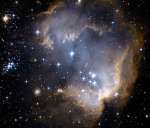 NGC 602 and Beyond
3.04.2010
Near the outskirts of the Small Magellanic Cloud, a satellite galaxy some 200 thousand light-years distant, lies 5 million year young star cluster NGC 602. Surrounded by natal gas and dust, NGC 602 is featured in this stunning Hubble image of the region.
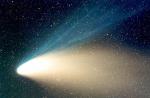 A Star Cluster Through Hale-Bopp's Tail
16.04.1997
Comet Hale-Bopp continues to look impressive. The photograph above captured the comet on April 7th passing nearly in front of M34, a star cluster in the constellation of Perseus. Many of the stars in this open cluster can be seen through Comet Hale-Bopp's white dust tail.
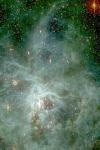 In the Heart of the Tarantula Nebula
27.10.1999
In the heart of monstrous Tarantula Nebula lies one of the most unusual star clusters. Known as NGC 2070 or R136, it is home to a great number of hot young stars. The energetic light from these stars continually ionizes nebula gas, while their energetic particle wind blows bubbles and defines intricate filaments.
 30 Doradus: The Tarantula Nebula
26.10.1999
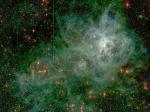
30 Doradus is an immense star forming region in a nearby galaxy known as the Large Magellanic Cloud. Its spidery appearance is responsible for its popular name, the Tarantula Nebula, except that this tarantula is about 1,000 light-years across, and 165,000 light-years away in the southern constellation Dorado.
 A Flock of Stars
6.09.2008
Only a few stars can be found within ten light-years of our lonely Sun, situated near an outer spiral arm of the Milky Way galaxy. But if the Sun were found within one of our galaxy's star clusters, thousands of stars might occupy a similar space.
|
January February March April May June July August September |
|||||||||||||||||||||||||||||||||||||||||||||||||