
|
Keyword: impact
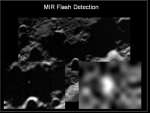 LCROSS Centaur Impact Flash
10.10.2009
This mid-infrared image was taken in the last minutes of the LCROSS flight mission to the Moon. The small white spot (enlarged in the insets) seen within the dark shadow of lunar crater walls is the initial flash created by the impact of a spent Centaur upper stage rocket.
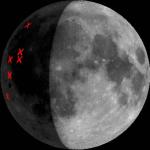 Moon Struck
7.12.2001
Craters produced by ancient impacts on the airless Moon have long been a familiar sight. But only since 1999 have observers seen elusive optical flashes on the lunar surface - likely explosions resulting from impacting meteoroids. These startling observations were made with modest telescopes and video equipment during the 1999 and 2001 Leonid meteor showers.
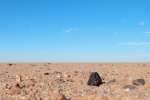 Almahata Sitta 15
27.03.2009
Small asteroid 2008 TC3 fell to Earth at dawn on October 7, 2008, tracking through the skies over the Nubian Desert in northern Sudan. That event was remarkable because it was the first time an asteroid was detected in space before crashing into planet Earth's atmosphere.
 Impact on Jupiter
28.07.1998
In 1993, a strange string of comet pieces was discovered near the planet Jupiter. So unusual a sight, Comet Shoemaker-Levy 9 (SL9) quickly became the object of much scientific curiosity. Studies showed that the Sun would soon perturb the orbit of SL9 so that it would actually
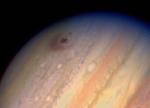
 Hubble View: Jupiter Impact
31.07.2009
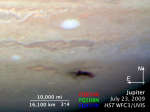
This sprawling dark marking is Jupiter's latest impact scar, a debris plume created as a small asteroid or comet disintegrated after plunging into the gas giant's atmosphere. Located in Jupiter's south polar region, the new feature was discovered by Australian amateur astronomer Anthony Wesley on July 19.
 Impact Moon
25.03.1999
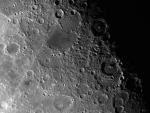
The Moon's surface is covered with craters, scars of frequent impacts during the early history of the solar system. Now, recent results from the Lunar Prospector spacecraft support the idea that the Moon itself formed from the debris of a giant impact of a mars-sized planetary body with the
 A Year of Assessing Astronomical Hazards
30.12.2002
Could an asteroid destroy civilization on Earth? Mountain-sized space rocks could potentially impact the Earth causing global effects, and perhaps even be mistaken for a nuclear blast of terrestrial origin. Such large impacts are rare but have happened before. Modern telescopes have therefore begun to scan the skies for signs of approaching celestial hazards.
 Moon Struck
7.12.1999
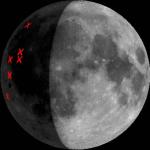
Craters produced by ancient impacts on the airless Moon have long been a familiar sight. But now observers have seen elusive optical flashes on the lunar surface - likely the fleeting result of impacting meteoroids. Orchestrated by David Dunham, president of the International Occultation
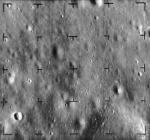 The Sea of Tranquillity: 5 Seconds To Impact
30.07.1999
On February 20th, 1965, the Ranger 8 spacecraft crashed into the Moon. Rapidly transmitting a series of pictures to ground controllers, its camera recorded this one at an altitude of about 11 kilometers, 5 seconds before impacting the lunar surface. Two kilometers across, with 4 meter
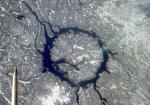 Manicouagan Impact Crater on Earth
12.12.2000
The Manicouagan Crater in northern Canada is one of the oldest impact craters known. Formed during a surely tremendous impact about 200 million years ago, the present day terrain supports a 70-kilometer diameter hydroelectric reservoir in the telltale form of an annular lake
|
January February March April May June July August |
||||||||||||||||||||||||||||||||||||||||||||||||||||||||