
|
Keyword: Orion
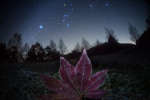 Frosted Leaf Orion
17.11.2010
Sometimes, you can put some night sky in your art. Captured above Japan earlier this month, a picturesque night sky was photographed behind a picturesque frosted leaf. The reflecting ice crystals on the leaf coolly mimic the shining stars far in the background.
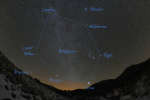 Winter Hexagon Over Stagecoach Colorado
3.01.2011
If you can find Orion, you might be able to find the Winter Hexagon. The Winter Hexagon involves some of the brightest stars visible, together forming a large and easily found pattern in the winter sky of Earth's northern hemisphere.
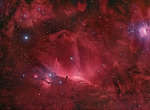 Wisps Surrounding the Horsehead Nebula
9.09.2012
The famous Horsehead Nebula in Orion is not alone. A deep exposure shows that the dark familiar shaped indentation, visible just below center, is part of a vast complex of absorbing dust and glowing gas.
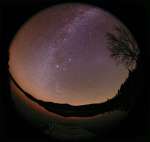 Zodiacal Light and Milky Way
20.10.2012
Ghostly apparitions of two fundamental planes in planet Earth's sky span this October all-sky view. The scene was captured from a lakeside campsite under dark skies in northern Maine, USA. In it, the plane of our Milky Way Galaxy arcs above faint airglow along the horizon.
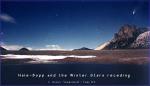 Hale-Bopp and Orion
29.04.1997
Comet Hale-Bopp is still brighter than most constellations. In fact, Comet Hale-Bopp may now hold the record for staying bright the longest. Last week the comet was photographed above in the same field...
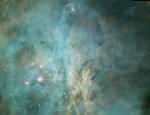 In the Center of the Trapezium
10.07.2005
Start with the constellation of Orion. Near Orion's belt is a fuzzy area known as the Great Nebula of Orion or M42. In this nebula is a bright star cluster known as the Trapezium, shown above. New stellar systems are forming there in gigantic globs of gas and dust known as Proplyds.
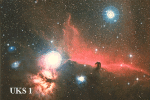 Orion's Horsehead Nebula
25.09.1995
The black indentation to the red emission nebula seen just to the right of center of the above photograph is one of the most famous features in any nebulae on the sky. Because of its shape, it is known as the Horsehead Nebula.
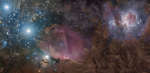 Orion in Gas, Dust, and Stars
29.09.2009
The constellation of Orion holds much more than three stars in a row. A deep exposure shows everything from dark nebula to star clusters, all imbedded in an extended patch of gaseous wisps in the greater Orion Molecular Cloud Complex.
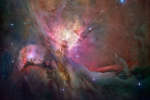 Orion Nebula: The Hubble View
22.02.2009
Few cosmic vistas excite the imagination like the Orion Nebula. Also known as M42, the nebula's glowing gas surrounds hot young stars at the edge of an immense interstellar molecular cloud only 1,500 light-years away.
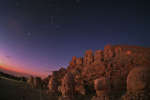 Orion Dawn Over Mount Nemrut
16.12.2008
What's that in front of Orion? Forty kilometers north of Kahta, Turkey, lies Mount Nemrut, a mountain adorned with the fragments of vast statues built over 2000 years ago. The stone sculptures once...
|
January February March April May June July August September October |
|||||||||||||||||||||||||||||||||||||||||||||||||