
|
Keyword: Orion
 M78 and Reflecting Dust Clouds in Orion
18.03.2008
An eerie blue glow and ominous columns of dark dust highlight M78 and other bright reflection nebula in the constellation of Orion. The dark filamentary dust not only absorbs light, but also reflects the light of several bright blue stars that formed recently in the nebula.
 Meteor Milky Way
26.11.1998
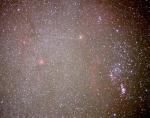
The bold, bright star patterns of Orion (right) are a familiar sight to even casual skygazers. But this gorgeous color photo also features a subtler spectacle - the faint stars of the Milky Way.
 Aurora and Orion
20.03.1999
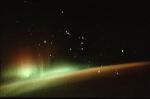
Looking toward the south from low Earth orbit, the crew of the Space Shuttle Endeavor made this stunning time exposure of the Aurora Australis or southern lights in April of 1994. Aurora are visible at high northern latitudes as well, with the northern lights known as Aurora Borealis.
 Alnitak, Alnilam, Mintaka
13.10.2005
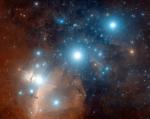
Alnitak, Alnilam, and Mintaka, are the bright bluish stars from east to west (left to right) along the diagonal in this gorgeous cosmic vista. Otherwise known as the Belt of Orion, these three blue supergiant stars are hotter and much more massive than the Sun.
 Southern Orion: From Belt to Witch
8.04.2008
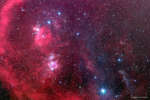
Do you recognize the belt of Orion in this image? The familiar trio of stars, visible to the unaided eye, can be found across the upper left. Otherwise, the southern part of the constellation...
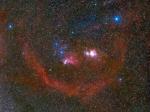 Barnards Loop Around Orion
20.04.2005
Why is the belt of Orion surrounded by a bubble? Although glowing like an emission nebula, the origin of the bubble, known as Barnard's Loop, is currently unknown. Progenitor hypotheses include the winds from bright Orion stars and the supernovas of stars long gone.
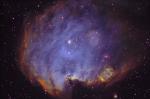 NGC 2174: Emission Nebula in Orion
8.12.2006
A lesser known sight in the nebula-rich constellation Orion, NGC 2174 can be found with binoculars near the head of the celestial hunter. About 6,400 light-years distant, the glowing cosmic cloud surrounds loose clusters of young stars.
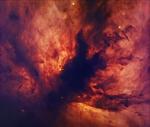 Flame Nebula Close Up
2.02.2007
Of course, the Flame Nebula is not on fire. Also known as NGC 2024, the nebula's suggestive reddish color is due to the glow of hydrogen atoms at the edge of the giant Orion molecular cloud complex some 1,500 light-years away.
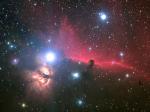 Orions Horsehead Nebula
21.03.2005
The Horsehead Nebula is one of the most famous nebulae on the sky. It is visible as the dark indentation to the red emission nebula seen above and to the right of center in the above photograph. The bright star on the left is located in the belt of the familiar constellation of Orion.
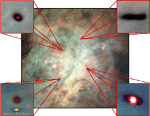 Planetary Systems Now Forming in Orion
7.12.1996
How do planets form? Astronomers are finding out by studying one of the most interesting of all astronomical nebulae known, the Great Nebula in Orion. Insets to above mosaic show several planetary systems in formation. The bottom left insert shows the relative size of our own Solar System. The Orion Nebula contains many stellar nurseries.
|
January February March April May June July August September October |
|||||||||||||||||||||||||||||||||||||||||||||||||