
|
Keyword: Orion
 Orion in Red and Blue
13.04.2016
When did Orion become so flashy? This colorful rendition of part of the constellation of Orion comes from red light emitted by hydrogen and sulfur (SII), and blue-green light emitted by oxygen (OIII). Hues...
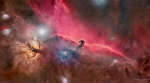 The Horsehead Nebula Region without Stars
29.08.2022
The famous Horsehead Nebula in Orion is not alone. A deep exposure shows that the dark familiar shaped indentation, visible just right of center, is part of a vast complex of absorbing dust and glowing gas.
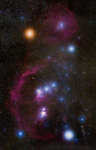 Camera Orion
21.03.2018
Do you recognize this constellation? Although it is one of the most recognizable star groupings on the sky, Orion's icons don't look quite as colorful to the eye as they do to a camera.
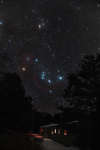 Northern Winter Night
25.12.2020
Orion always seems to come up sideways on northern winter evenings. Those familiar stars of the constellation of the Hunter are caught above the trees in this colorful night skyscape. Not a star at all but still visible to eye, the Great Nebula of Orion shines below the Hunter's belt stars.
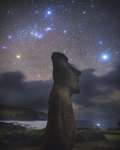 Orion above Easter Island
18.09.2017
Why were the statues on Easter Island built? No one is sure. What is sure is that over 800 large stone statues exist there. The Easter Island statues, stand, on the average, over twice as tall as a person and have over 200 times as much mass.
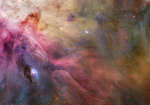 LL Ori and the Orion Nebula
3.02.2013
This esthetic close-up of cosmic clouds and stellar winds features LL Orionis, interacting with the Orion Nebula flow. Adrift in Orion's stellar nursery and still in its formative years, variable star LL Orionis produces a wind more energetic than the wind from our own middle-aged Sun.
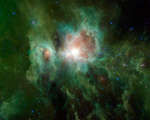 Infrared Orion from WISE
13.02.2013
The Great Nebula in Orion is a intriguing place. Visible to the unaided eye, it appears as a small fuzzy patch in the constellation of Orion. But this image, an illusory-color composite of four...
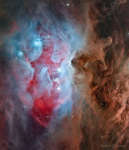 APOD: 2026 February 2 Б Orion: The Running Man Nebula
2.02.2026
What part of Orion is this? Just north of the famous Orion Nebula is a picturesque star forming region in Orion's Sword that contains a lot of intricate dust -- some of which appears blue because it reflects the light of bright embedded stars.
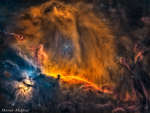 A Lion in Orion
7.03.2022
Yes, but can you see the lion? A deep exposure shows the famous dark indentation that looks like a horse's head, visible just left and below center, and known unsurprisingly as the Horsehead Nebula. The Horsehead Nebula (Barnard 33) is part of a vast complex of dark absorbing dust and bright glowing gas.
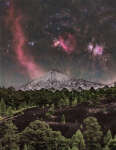 APOD: 2026 May 5 Б Orion over Mount Teide
5.05.2026
Orion is rarely seen like this. To achieve this majestic vista, you need a camera capable of taking such long duration exposures that faint features in the night sky become revealed. Iconic nebulas that appear include the Orion Nebula, the Flame Nebula, and Barnard's Loop.
|
January February March April May June July August September October |
|||||||||||||||||||||||||||||||||||||||||||||||||