
|
Keyword: M 31
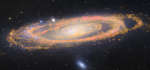 The Infrared Visible Andromeda
12.12.2014
This remarkable synthetic color composite image was assembled from archives of visible light and infrared astronomy image data. The field of view spans the Andromeda Galaxy (M31), a massive spiral a mere 2.5 million light-years away. In fact, with over twice the diameter of our own Milky Way, Andromeda is the largest nearby galaxy.
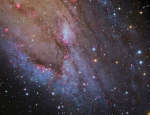 NGC 206 and the Star Clouds of Andromeda
25.09.2014
The large stellar association cataloged as NGC 206 is nestled within the dusty arms of the neighboring Andromeda galaxy. Also known as M31, the spiral galaxy is a mere 2.5 million light-years away.
 M31 versus M33
26.09.2013
Separated by about 14 degrees (28 Full Moons) in planet Earth's sky, spiral galaxies M31 ,left, and M33 are both large members of the Local Group, along with our own Milky Way galaxy.
 The Comet and the Galaxy
24.11.1997
The Moon almost ruined this photograph. During late March and early April, Comet Hale-Bopp passed nearly in front of the Andromeda Galaxy. Here the Great Comet of 1997 and the Great Galaxy in Andromeda were photographed together on March 24th. The problem was the brightness of the Moon.
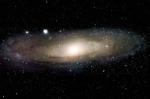 Andromeda Island Universe
18.05.2002
How far can you see? The most distant object easily visible to the unaided eye is M31, the great Andromeda Galaxy some two million light-years away. Without a telescope, even this immense spiral galaxy appears as an unremarkable, faint, nebulous cloud in the constellation Andromeda.
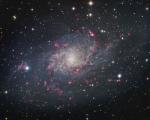 M33: Spiral Galaxy in Triangulum
24.09.2003
The small constellation Triangulum in the northern sky harbors this magnificent face-on spiral galaxy, M33. Its popular names include the Pinwheel Galaxy or just the Triangulum Galaxy. M33's diameter spans over 50,000 light-years, making it third largest in the Local Group of galaxies after the Andromeda Galaxy (M31), and our own Milky Way.
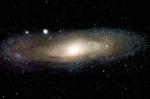 Andromeda Island Universe
8.09.2000
How far can you see? The most distant object easily visible to the unaided eye is M31, the great Andromeda Galaxy some two million light-years away. Without a telescope, even this immense spiral galaxy appears as an unremarkable, faint, nebulous cloud in the constellation Andromeda
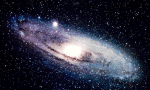 M31: The Andromeda Galaxy
31.10.1997
Andromeda is the nearest major galaxy to our own Milky Way Galaxy. Our Galaxy is thought to look much like Andromeda. Together these two galaxies dominate the Local Group of galaxies. The diffuse light from Andromeda is caused by the hundreds of billions of stars that compose it.
 Dwarf Elliptical Galaxy NGC 205 in the Local Group
23.10.2000
Our Milky Way Galaxy is not alone. It is part of a gathering of about 25 galaxies known as the Local Group. Members include the Great Andromeda Galaxy (M31), M32, M33, the Large Magellanic Cloud, the Small Magellanic Cloud, Dwingeloo 1, several small irregular galaxies, and many dwarf elliptical and dwarf spheroidal galaxies.
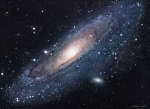 M31: The Andromeda Galaxy
16.12.2018
What is the nearest major galaxy to our own Milky Way Galaxy? Andromeda. In fact, our Galaxy is thought to look much like Andromeda. Together these two galaxies dominate the Local Group of galaxies. The diffuse light from Andromeda is caused by the hundreds of billions of stars that compose it.
|
January February March April May June July August September October |
|||||||||||||||||||||||||||||||||||||||||||||||||