
|
Keyword: Sun
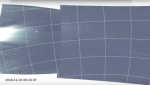 Looking Sideways from the Parker Solar Probe
9.12.2019
Everybody sees the Sun. Nobody's been there. Starting in 2018 though, NASA launched the robotic Parker Solar Probe (PSP) to investigate regions near to the Sun for the first time. The PSP's looping orbit brings it yet closer to the Sun each time around -- every few months.
 APOD: 2024 February 19 Б Looking Sideways from the Parker Solar Probe
19.02.2024
What's happening near the Sun? To help find out, NASA launched the robotic Parker Solar Probe (PSP) to investigate regions closer to the Sun than ever before. The PSP's looping orbit brings it nearer to the Sun each time around -- every few months.
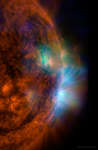 The Sun in X rays from NuSTAR
23.11.2021
Why are the regions above sunspots so hot? Sunspots themselves are a bit cooler than the surrounding solar surface because the magnetic fields that create them reduce convective heating. It is therefore unusual that regions overhead -- even much higher up in the Sun's corona -- can be hundreds of times hotter.
 Rocket Transits Rippling Sun
31.05.2022
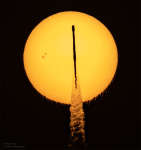
The launch of a rocket at sunrise can result in unusual but intriguing images that feature both the rocket and the Sun. Such was the case last month when a SpaceX Falcon 9 rocket blasted off from NASA's Kennedy Space Center carrying 53 more Starlink satellites into low Earth orbit.
 A Mercury Transit Music Video from SDO
21.10.2019
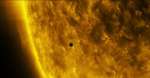
What's that small black dot moving across the Sun? Mercury. Possibly the clearest view of Mercury crossing in front of the Sun in 2016 May was from Earth orbit. The Solar Dynamics Observatory obtained an uninterrupted vista recording it not only in optical light but also in bands of ultraviolet light.
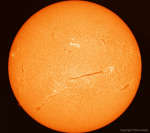 An Extremely Long Filament on the Sun
9.02.2015
Yesterday, the Sun exhibited one of the longest filaments ever recorded. It may still be there today. Visible as the dark streak just below the center in the featured image, the enormous filament extended across the face of the Sun a distance even longer than the Sun's radius -- over 700,000 kilometers.
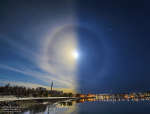 Sun and Moon Halo
3.04.2015
Two pictures captured on April 1 are combined in this creative day and night composite. Separated in time by about 10 hours the images otherwise match, looking along the coast at Östersund Sweden.
 Circling the Sun
13.01.2024
Earth's orbit around the Sun is not a circle, it's an ellipse. The point along its elliptical orbit where our fair planet is closest to the Sun is called perihelion. This year...
 Circular Sun Halo
14.10.2023
Want to see a ring around the Sun? It's easy to do in daytime skies around the world. Created by randomly oriented ice crystals in thin high cirrus clouds, circular 22 degree halos are visible much more often than rainbows.
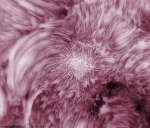 Fibrils Flower on the Sun
16.02.2015
When does the Sun look like a flower? In a specific color of red light emitted by hydrogen, as featured here, some regions of the solar chromosphere may resemble a rose. The color-inverted image was taken in 2014 October and shows active solar region 2177.
|
January February March April May June July August September October |
|||||||||||||||||||||||||||||||||||||||||||||||||