
|
Keyword: Sun
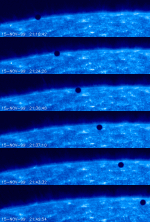 Mercury And The Sun
19.11.1999
Just days before the peak of the Leonid meteor shower, skywatchers were offered another astronomical treat as planet Mercury crossed the face of the Sun on November 15. Viewed from planet Earth, a transit of Mercury is not all that rare. The last occurred in 1993 and the next will happen in 2003.
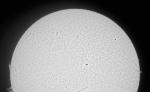 Mercury Transits the Sun
13.05.2003
How big is the Sun? The Sun is not only larger than any planet, it is larger than all of the planets put together. The Sun accounts for about 99.9 percent of all the mass in its Solar System.
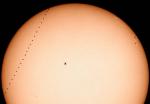 A Mercury Transit Sequence
27.05.2003
Earlier this month, the planet Mercury crossed the face of the Sun, as seen from Earth. Because the plane of Mercury's orbit is not exactly coincident with the plane of Earth's orbit, Mercury usually appears to pass over or under the Sun.
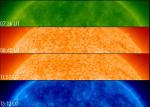 Mercury Spotting
8.05.2003
Can you spot the planet? The diminutive disk of Mercury, the solar system's innermost planet, spent about five hours crossing in front of the enormous solar disk yesterday (Wednesday, May 7th), as viewed from the general vicinity of planet Earth.
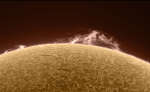 Reinvigorated Sun and Prominence
23.03.2010
Dramatic prominences can sometimes be seen looming just beyond the edge of the sun. Such was the case last week as a giant prominence, visible above on the right, highlighted a Sun showing increased activity as it comes off an unusually quiet Solar Minimum.
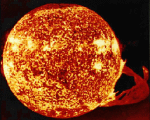 The Sun Erupts
13.08.1995
The sun was captured in 1973 throwing one of the largest eruptive prominences ever recorded. Sol, our sun, is a normal star. It formed about 5 billion years ago, and will last about another 5 billion years. The sun will never explode, and a solar flare will never destroy the earth.
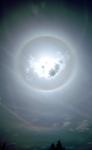 Solar Arcs and Halos
4.08.2004
Have you ever seen a bright halo around the Sun? Unusual halos and arcs were so bright one recent afternoon in Trier, Germany that even casual people on the street noticed them. The fantastic...
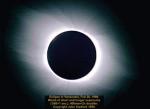 A Total Eclipse of the Sun
11.03.1998
On February 26th, it was dark during the day. This total solar eclipse was the last visible from the Americas for this millennium. A total solar eclipse is exciting partly because it is so short.
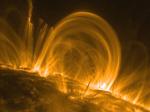 Heating Coronal Loops
14.08.2005
Why is the corona of the Sun so hot? Extending above the photosphere or visible surface of the Sun, the faint, tenuous solar corona can't be easily seen from Earth, but it is measured to be hundreds of times hotter than the photosphere itself.
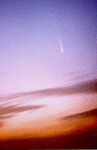 The Sun Sets on Comet Hyakutake
28.04.1996
Comet Hyakutake is seen here just as the Sun sets on April 22. As April draws to a close, Comet Hyakutake will be visible only just after sunset and will be hard to discern against the brightly lit sky.
|
January February March April May June July August September October |
|||||||||||||||||||||||||||||||||||||||||||||||||