
|
Keyword: Sun
 APOD: 2023 July 11 Б Sunspots on an Active Sun
11.07.2023
Why is our Sun so active now? No one is sure. An increase in surface activity was expected because our Sun is approaching solar maximum in 2025. However, last month our Sun sprouted more sunspots than in any month during the entire previous 11-year solar cycle -- and even dating back to 2002.
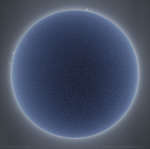 Blue Sun Bristling
4.11.2009
Our Sun may look like all soft and fluffy, but it's not. Our Sun is an extremely large ball of bubbling hot gas, mostly hydrogen gas. The above picture...
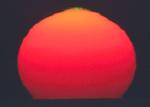 A Green Flash from the Sun
7.05.2000
Many think it is just a myth. Others think it is true but its cause isn't known. Adventurers pride themselves on having seen it. It's a green flash from the Sun. The truth is the green flash does exist and its cause is well understood.
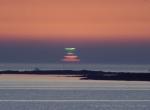 A Green Flash from the Sun
21.03.2004
Many think it is just a myth. Others think it is true but its cause isn't known. Adventurers pride themselves on having seen it. It's a green flash from the Sun. The truth is the green flash does exist and its cause is well understood.
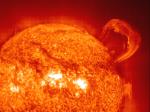 A Solar Prominence from SOHO
16.04.2006
How can gas float above the Sun? Twisted magnetic fields arching from the solar surface can trap ionized gas, suspending it in huge looping structures. These majestic plasma arches are seen as prominences above the solar limb.
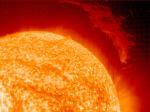 A Prominent Solar Prominence from SOHO
30.03.2004
One of the most spectacular solar sights is a prominence. A solar prominence is a cloud of solar gas held above the Sun's surface by the Sun's magnetic field. Last month, NASA's Sun-orbiting SOHO spacecraft imaged an impressively large prominence hovering over the surface, pictured above.
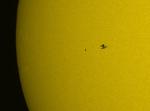 Sharp Silhouette
21.09.2006
Though it's 93 million miles away, the Sun still hurts your eyes when you look at it. But bright sunlight (along with accurate planning and proper equipment!) resulted in this sharp silhouette of spaceship and space station.
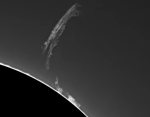 A Filament Leaps from the Sun
8.11.2021
Why, sometimes, does part of the Sun's atmosphere leap into space? The reason lies in changing magnetic fields that thread through the Sun's surface. Regions of strong surface magnetism, known as active regions, are usually marked by dark sunspots.
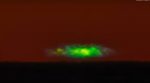 Video of a Green Flash
10.11.2021
Many think it is just a myth. Others think it is true but its cause isn't known. Adventurers pride themselves on having seen it. It's a green flash from the Sun. The truth is the green flash does exist and its cause is well understood.
 APOD: 2025 May 21 Б International Space Station Crosses the Sun
21.05.2025
Typically, the International Space Station is visible only at night. Slowly drifting across the night sky as it orbits the Earth, the International Space Station (ISS) can be seen as a bright spot about once a month from many locations.
|
January February March April May June July August September October |
|||||||||||||||||||||||||||||||||||||||||||||||||