
|
Keyword: binary star
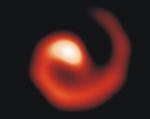 WR 104: Pinwheel Star
9.04.1999
Like a cosmic lawn sprinkler, dust streaming from a rotating star system creates a pinwheel pattern in this false color infrared image. Astronomers discovered the surprising star dust scenario using a sophisticated interferometer and the 10 meter Keck I telescope to observe the bright Wolf-Rayet star WR 104.
 Mizar Binary Star
19.02.1997
Mizar (sounds like "My Czar") is a binary star. In fact, most stars are binary stars. In a binary star system, each star of the pair follows an elliptical orbital path. Mutual gravity causes...
 Phi Persei: Double Star
2.10.1999
It's clear who is the biggest star in this binary system. Based on recent results, this artist's vision of the double star Phi Persei, 720 light years away, shows a bright, rapidly rotating massive star surrounded by a disk of gas. A small companion star orbits 100 million miles away.
 Phi Persei: Double Star
12.12.1997
It's clear who is the biggest star in this binary system. Based on recent results, this artist's vision of the double star Phi Persei, 720 light years away, shows a bright, rapidly rotating massive star surrounded by a disk of gas. A small companion star orbits 100 million miles away.
 Supernova Survivor
10.09.2005
Beginning with a full view of beautiful spiral galaxy M81, follow the insets (left, bottom, then right) to zoom in on a real survivor. Seen at the center of the final field on the right is a star identified as the survivor of a cosmic cataclysm -- the supernova explosion of its companion star.
 Supernova Survivor
12.02.2004
Beginning with a full view of beautiful spiral galaxy M81, follow the insets (left, bottom, then right) to zoom in on a real survivor. Seen at the center of the final field on the right is a star recently identified as the survivor of a cosmic cataclysm -- the supernova explosion of its companion star.
 An Intermediate Polar Binary System
21.05.2006
How can two stars create such a strange and intricate structure? Most stars are members of multiple-star systems. Some stars are members of close binary systems where material from one star swirls around the other in an accretion disk.
 Twin Proto Planetary Disks
25.09.1998
Sun-like stars are forming - and probably planets too - hidden inside Lynds 1551, an interstellar cloud of molecular gas and dust in the constellation Taurus. Using new receivers, coordinated radio telescopes at the Very Large Array near Socorro, New Mexico, USA, can now sharply image the dusty proto-planetary disks surrounding these young stars at radio wavelengths.
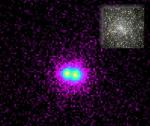 X Ray Stars in M15
20.09.2001
Side by side, two x-ray stars greeted astronomers in this false-color Chandra Observatory x-ray image of a region near the core of globular star cluster M15. The greeting was a pleasant surprise, as all previous x-ray images of the cluster showed only one such source where Chandra's sharper x-ray vision now reveals two.
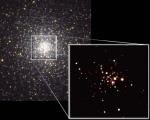 X Ray Stars of 47 Tucanae
24.05.2001
A deep optical image (left) of 47 Tucanae shows an ancient globular star cluster so dense and crowded that individual stars can not be distinguished in its closely packed core. An x-ray image of its central regions (inset right) from the Chandra Observatory reveals a wealth of x-ray stars hidden there.
|
January February March April May June July August September October |
|||||||||||||||||||||||||||||||||||||||||||||||||