
|
Keyword: Venus
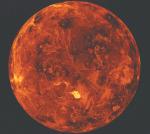 The North Pole of Venus
14.05.2003
If you could look down on the North Pole of Venus what would you see? The Magellan probe that orbited Venus from 1990 to 1994 was able to peer through the thick Venusian clouds and build up the above image by emitting and re-detecting cloud-penetrating radar.
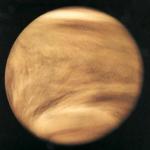 Ultraviolet Venus
7.05.1997
The forecast for Venus is cloudy, cloudy, cloudy. Although similar to the Earth in size and mass, Venus' slightly closer orbit to the Sun create for it a much thicker atmosphere and a much hotter surface. The thick atmosphere was photographed above in ultraviolet light in 1979 by the Pioneer Venus Orbiter.
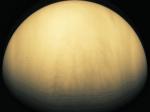 Venus: Earths Cloudy Twin
16.05.2004
This picture by the Galileo spacecraft shows just how cloudy Venus is. Venus is very similar to Earth in size and mass - and so is sometimes referred to as Earth's sister planet - but Venus has a quite different climate.
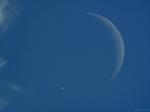 A Daylight Eclipse of Venus
20.06.2007
Something was about to happen. Just two days ago, two of the three celestial objects easily visible during the day appeared to collide. But actually, Earth's Moon passed well in front of the distant planet Venus. The occultation was caught from Switzerland in the hours before sunset.
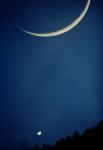 Moon And Venus Share The Sky
28.07.2000
July is drawing to a close and in the past few days, some early morning risers could have looked east and seen a crescent Moon sharing the pre-dawn skies with planets Jupiter and Saturn.
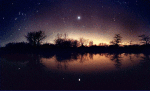 Hyakutake, Venus, Orion, and Pond
18.04.1996
Can you find Comet Hyakutake in the above picture? In this gorgeous photo, the starry night sky of April 9th is pictured with its new comet visitor. In the foreground is a pond with the lights of Kansas City, Missouri on the western horizon. On the upper left, the constellation of Orion is visible.
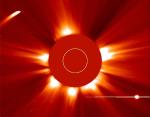 Sunbather
11.01.2002
Intense and overwhelming, the direct glare of the Sun is blocked by the smooth disk centered in this image from the sun-staring SOHO spacecraft. Taken on January 8, the picture shows streamers of solar wind billowing radially outward for millions of kilometers above the Sun's surface indicated by the white circle.
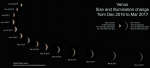 Phases of Venus
17.03.2017
Just as the Moon goes through phases, Venus' visible sunlit hemisphere waxes and wanes. This composite of telescopic images illustrates the steady changes for the inner planet, seen in the west as the evening star, as Venus grows larger but narrows to a thin crescent from December 20, 2016 through March 10.
 APOD: 2024 January 8 Б The Phases of Venus
8.01.2024
Venus goes through phases. Just like our Moon, Venus can appear as a full circular disk, a thin crescent, or anything in between. Venus, frequently the brightest object in the post-sunset or pre-sunrise sky, appears so small, however, that it usually requires binoculars or a small telescope to clearly see its current phase.
 APOD: 2023 March 15 Б Jupiter and Venus Converge over Germany
15.03.2023
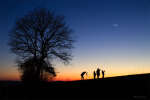
This was a sky to show the kids. Early this month the two brightest planets in the night sky, Jupiter and Venus, appeared to converge. At their closest, the two planets were separated by only about the angular width of the full moon.
|
January February March April May June July August September October |
|||||||||||||||||||||||||||||||||||||||||||||||||