
|
Keyword: Venus
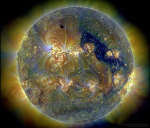 Venus and the Triply Ultraviolet Sun
4.02.2018
An unusual type of solar eclipse occurred in 2012. Usually it is the Earth's Moon that eclipses the Sun. That year, most unusually, the planet Venus took a turn. Like a solar eclipse by the Moon, the phase of Venus became a continually thinner crescent as Venus became increasingly better aligned with the Sun.
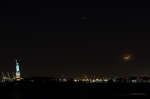 New York Harbor Moonset
6.01.2017
Moonset on January 1 is captured in this sea and night sky snapshot from the port city of New York. Its warm moonlight shining through haze and thin clouds, this New Year's Moon was about 3 days old, in a waxing crescent phase. The visible lunar disk is about 10 percent illuminated.
 Daytime Moon Meets Morning Star
16.11.2023
Venus now appears as Earth's brilliant morning star, shining above the southeastern horizon before dawn. For early morning risers, the silvery celestial beacon rose predawn in a close pairing with a waning crescent Moon on Thursday, November 9.
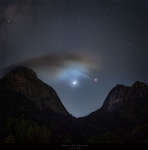 Venus and Mars: Passing in the Night
29.03.2022
When two planets pass on the night sky, they can usually be seen near each other for a week or more. In the case of this planetary conjunction, Venus and Mars passed within 4 degrees of each other earlier this month.
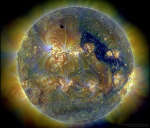 Venus and the Triply Ultraviolet Sun
6.03.2022
This was a very unusual type of solar eclipse. Typically, it is the Earth's Moon that eclipses the Sun. In 2012, though, the planet Venus took a turn. Like a solar eclipse by the Moon, the phase of Venus became a continually thinner crescent as Venus became increasingly better aligned with the Sun.
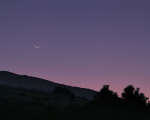 Friday the Moon Smiled
18.11.2017
Friday, an old Moon smiled for early morning risers. Its waning sunlit crescent is captured in this atmospheric scene from clear skies near Bursa, Turkey, planet Earth. In the subtle twilight hues nearby celestial lights are Jupiter (top) and Venus shining close to the eastern horizon.
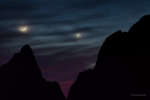 Twilight in a Western Sky
31.03.2018
A slender crescent Moon and inner planets Venus and Mercury never wander far from the Sun in planet Earth's skies. In the fading evening twilight of March 18, they line up near the western horizon in this atmospheric skyscape.
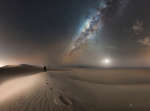 100 Steps Forward
15.09.2017
A beautiful conjunction of Venus and Moon, human, sand, and Milky Way is depicted in this night skyscape from planet Earth. The scene is a panorama of 6 photos taken in a moment near the end of a journey.
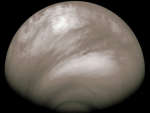 Mysterious Acid Haze on Venus
26.02.2008
Why did an acidic haze spread across Venus? The unusual clouds were discovered last July by ESA's robotic Venus Express spacecraft currently orbiting Venus. The bright and smooth haze was found by Venus...
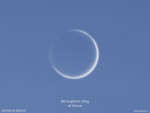 Atmospheric Ring of Venus
8.06.2020
Why is Venus surrounded by a bright ring? Sometimes called a ring of fire, this rare ring is caused by the Sun's light being visible all around an object. Usually seen around...
|
January February March April May June July August September October |
|||||||||||||||||||||||||||||||||||||||||||||||||