
|
Keyword: Solar System
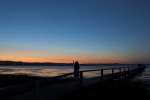 Planets Ahoy
30.09.2008
Can you spot the Solar System's four rocky planets? In the above image taken on September 20, all of them were visible in a single glance, but some of them may be different than you think. Pictured above, the brightest and highest object in the sky is the planet Venus.
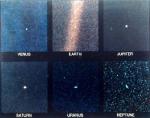 Our Solar System from Voyager
14.12.1996
After taking spectacular pictures of our Solar System's outer planets, Voyager 1 looked back at six planets to take our Solar System's first family portrait. Here Venus, Earth, Jupiter, Saturn, Uranus, and Neptune, were all visible across the sky.
 The Largest Rock Known
2.01.2000
There, that faint dot in the center - that's the largest rock known. It is larger than every known asteroid, moon, and comet nucleus. It is larger than any other rocky planet. (Nobody knows...
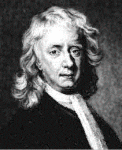 Isaac Newton Explains the Solar System
6.09.1997
Sir Isaac Newton changed the world. Born in 1643, Newton was only an above-average student. But he went home from Cambridge one summer in 1665, thought a lot about the physical nature of the world, and came back two years later with a revolutionary understanding of mathematics, gravitation, and optics.
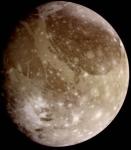 Ganymede: The Largest Moon in the Solar System
20.06.2000
If Ganymede orbited the Sun, it would be considered a planet. The reason is that Jupiter's moon Ganymede is not only the largest moon in the Solar System, it is larger than planets Mercury and Pluto.
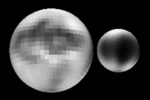 Mysterious Pluto and Charon
9.04.2000
Pluto is the only planet in our Solar System remaining unphotographed by a passing spacecraft. Distant Pluto and its moon Charon therefore remain somewhat mysterious. In addition to direct imaging by the Hubble Space...
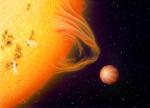 Upsilon Andromedae: An Extra Solar System
16.04.1999
Yesterday, astronomers announced the discovery of the first system of planets around a normal star other than our Sun. Previously, only single planet star systems had been found. Subtle changes in the wobble of Upsilon Andromedae, a Sun-like star in the constellation of Andromeda, allowed astronomers led by R. Paul Butler (AAO) and Geoffrey W.
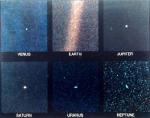 Our Solar System from Voyager
17.05.1998
After taking spectacular pictures of our Solar System's outer planets, Voyager 1 looked back at six planets to take our Solar System's first family portrait. Here Venus, Earth, Jupiter, Saturn, Uranus, and Neptune, were all visible across the sky.
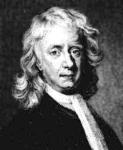 Isaac Newton Explains the Solar System
23.07.2000
Sir Isaac Newton changed the world. Born in 1643, Newton was only an above-average student. But he went home from Cambridge one summer in 1665, thought a lot about the physical nature of the world, and came back two years later with a revolutionary understanding of mathematics, gravitation, and optics.
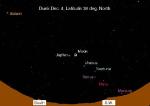 A Sky Full Of Planets
4.12.1997
Look up tonight. Just after sunset, the crescent moon and all five "naked-eye" planets (Mercury, Venus, Mars, Jupiter, and Saturn) will be visible (depending on your latitude), lying near our solar system's ecliptic plane.
|
January February March April May June July August September October |
|||||||||||||||||||||||||||||||||||||||||||||||||