
|
Keyword: reflection nebula
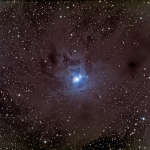 A Dusty Iris Nebula
10.06.2009
These clouds of interstellar dust and gas have blossomed 1,300 light-years away in the fertile star fields of the constellation Cepheus. Sometimes called the Iris Nebula and dutifully cataloged as NGC 7023, this is not the only nebula in the sky to evoke the imagery of flowers.
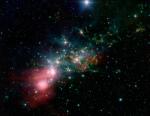 Dusty NGC 1333
24.11.2005
Dusty NGC 1333 is seen as a reflection nebula in visible light images, sporting bluish hues characteristic of starlight reflected by dust. But at longer infrared wavelengths, the interstellar dust itself glows - shown in red in this false-color Spitzer Space Telescope image.
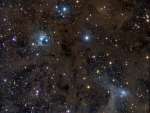 Stardust in Aries
25.11.2010
This composition in stardust covers almost 2 degrees on the sky, close to the border of the zodiacal constellation Aries and the plane of our Milky Way Galaxy. At the lower right...
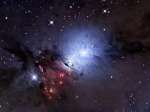 NGC 1333 Stardust
18.04.2009
NGC 1333 is seen in visible light as a reflection nebula, dominated by bluish hues characteristic of starlight reflected by dust. A mere 1,000 light-years distant toward the heroic constellation Perseus, it lies at the edge of a large, star-forming molecular cloud.
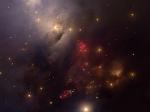 In the Center of Reflection Nebula NGC 1333
21.05.2007
The dust is so thick in the center of NGC 1333 that you can hardly see the stars forming. Conversely, the very dust clouds that hide the stars also reflects their optical light, giving NGC 1333's predominantly blue glow the general designation of a reflection nebula.
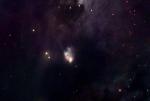 McNeil s Nebula
19.02.2004
It was a clear, cold western Kentucky night on January 23rd as seasoned amateur astronomer Jay McNeil tried out his recently acquired 3-inch refracting telescope by imaging the area around a familiar object, the M78 reflection nebula in Orion.
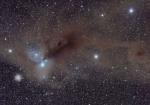 Stars and Dust in Corona Australis
15.07.2004
A cosmic dust cloud sprawls across a rich field of stars in this gorgeous wide field telescopic vista looking toward Corona Australis, the Southern Crown. Probably less than 500 light-years away and effectively blocking...
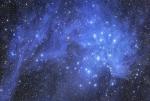 Pleiades and Stardust
22.11.2007
Hurtling through a cosmic dust cloud a mere 400 light-years away, the lovely Pleiades or Seven Sisters star cluster is well-known for its striking blue reflection nebulae. This remarkable wide-field (3 degree) image...
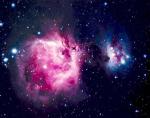 The Great Nebula in Orion
27.01.1998
The Great Nebula in Orion can be found just below and to the left of the easily identifiable belt of three stars in the popular constellation Orion. This fuzzy patch contains one of the closest stellar nurseries, lying at a distance of about 1500 light years.
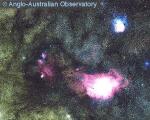 The Sky Towards Sagittarius
7.09.1998
A variety of stars and nebulae can be found towards the constellation of Sagittarius. Dense fields of stars laced with dark lanes of dust crowd this region only a few degrees from the center of our Galaxy.
|
January February March April May June July August September October |
|||||||||||||||||||||||||||||||||||||||||||||||||