
|
Keyword: Saturn
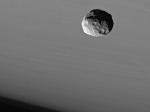 Janus: Potato Shaped Moon of Saturn
7.11.2006
Janus is one of the stranger moons of Saturn. First, Janus travels in an unusual orbit around Saturn where it periodically trades places with its sister moon Epimetheus, which typically orbits about 50 kilometers away. Janus, although slightly larger than Epimetheus, is potato-shaped and has a largest diameter of about 190 kilometers.
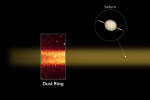 Giant Dust Ring Discovered Around Saturn
13.10.2009
What has created a large dust ring around Saturn? At over 200 times the radius of Saturn and over 50 times the radius of Saturn's expansive E ring, the newly discovered dust ring is the largest planetary ring yet imaged. The ring was found in infrared light by the Earth-orbiting Spitzer Space Telescope.
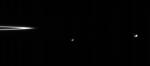 Epimetheus and Janus: Interchangeable Moons of Saturn
2.11.2005
These two moons change places. Epimetheus and Janus, two small moons of Saturn, actually switch positions as they orbit their home planet. The orbital radii of the moons are strangely separated by less than the radii of the moons themselves: about 50 kilometers. One moon orbits Saturn well ahead of the other, at first.
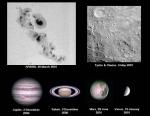 Solar System Web Cam
14.07.2001
Ranging throughout the solar system, these pictures all have something in common. They were taken with an 8 inch diameter telescope, a size popular with amateur astronomy buffs, and slightly modified "web cam" of the type widely used to send images out over the internet.
 The Encke Gap: A Moon Goes Here
2.07.2004
Yesterday, Cassini became the first spacecraft to enter orbit around the gas giant Saturn, rocketing through a 25,000 kilometer wide gap in the distant planet's magnificent system of icy rings at about 15 kilometers per second.
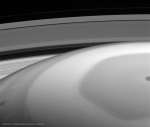 Cassini Looks Out from Saturn
30.04.2017
This is what Saturn looks like from inside the rings. Last week, for the first time, NASA directed the Cassini spacecraft to swoop between Saturn and its rings. During the dive, the robotic spacecraft took hundreds of images showing unprecedented detail for structures in Saturn's atmosphere.
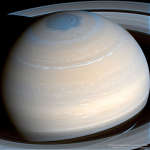 Saturn in Infrared from Cassini
3.04.2017
Many details of Saturn appear clearly in infrared light. Bands of clouds show great structure, including long stretching storms. Also quite striking in infrared is the unusual hexagonal cloud pattern surrounding Saturn's North Pole. Each side of the dark hexagon spans roughly the width of our Earth.
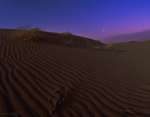 Brighter Than Mars
27.08.2010
Even though you may have just read an email claiming Mars will be incredibly bright tonight, the brightest star on the horizon is not Mars. From central Iran on August 24th, the brightest star in this twilight desert skyview is Venus, aka the Evening Star.
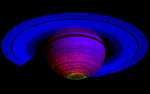 The Dancing Auroras of Saturn
27.09.2010
What drives auroras on Saturn? To help find out, scientists have sorted through hundreds of infrared images of Saturn taken by the Cassini spacecraft for other purposes, trying to find enough aurora images to correlate changes and make movies.
 55 Nights with Saturn
29.09.2018
For 55 consecutive nights Mediterranean skies were at least partly clear this summer, from the 1st of July to the 24th of August 2018. An exposure from each night was incorporated in this composited telephoto and telescopic image to follow bright planet Saturn as it wandered through the generous evening skies.
|
January February March April May June July August September October |
|||||||||||||||||||||||||||||||||||||||||||||||||