
|
Keyword: Saturn
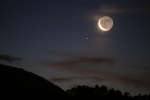 Saturn and the Da Vinci Glow
4.05.2019
On February 2nd early morning risers saw Saturn near an old Moon low on the eastern horizon. On that date bright planet, sunlit crescent, and faint lunar night side were captured in this predawn skyscape from Bursa, Turkey. Of course the Moon's ashen glow is earthshine, earthlight reflected from the Moon's night side.
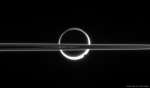 Saturn, Titan, Rings, and Haze
5.05.2019
This is not a solar eclipse. Pictured here is a busy vista of moons and rings taken at Saturn. The large circular object in the center of the image is Titan, the largest moon of Saturn and one of the most intriguing objects in the entire Solar System.
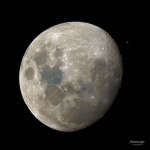 Saturn Behind the Moon
14.08.2019
What's that next to the Moon? Saturn. In its monthly trip around the Earth -- and hence Earth's sky -- our Moon passed nearly in front of Sun-orbiting Saturn earlier this week. Actually the Moon passed directly in front of Saturn from the viewpoints of a wide swath of Earth's Southern Hemisphere.
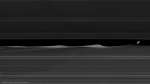 Daphnis and the Rings of Saturn
22.02.2017
What's happening to the rings of Saturn? Nothing much, just a little moon making waves. The moon is 8-kilometer Daphnis and it is making waves in the Keeler Gap of Saturn's rings using just its gravity -- as it bobs up and down, in and out.
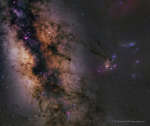 Saturn in the Milky Way
10.06.2017
Saturn is near opposition in planet Earth's sky. Rising at sunset and shining brightly throughout the night, it also lies near a line-of-sight to crowded starfields, nebulae, and obscuring dust clouds along the Milky Way.
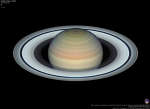 Saturn near Opposition
17.06.2017
Saturn reached its 2017 opposition on June 16. Of course, opposition means opposite the Sun in Earth's sky and near opposition Saturn is up all night, at its closest and brightest for the year.
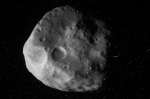 Views from Cassini at Saturn
18.06.2017
What has the Cassini orbiter seen at Saturn? The featured music video shows some of the early highlights. In the first time-lapse sequence (00:07), a vertical line appears that is really Saturn's thin rings seen nearly edge-on. Soon some of Saturn's moon shoot past.
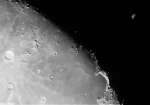 The Moon Eclipses Saturn
16.07.2014
What happened to half of Saturn? Nothing other than Earth's Moon getting in the way. As pictured above on the far right, Saturn is partly eclipsed by a dark edge of a Moon itself only partly illuminated by the Sun.
 Mars, Antares, Moon, and Saturn
4.10.2014
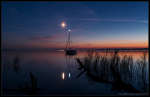
Mars, Antares, Moon, and Saturn are the brightest celestial beacons in this serene sky. The Sun's golden light is still scattered along the southwestern horizon though, captured after sunset on September 28.
 Crescent Rhea Occults Crescent Saturn
3.01.2015
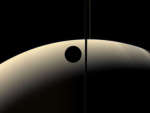
Soft hues, partially lit orbs, a thin trace of the ring, and slight shadows highlight this understated view of the majestic surroundings of the giant planet Saturn. Looking nearly back toward the Sun, the robot Cassini spacecraft now orbiting Saturn captured crescent phases of Saturn and its moon Rhea in color a few years ago.
|
January February March April May June July August September October |
|||||||||||||||||||||||||||||||||||||||||||||||||