
|
Keyword: Saturn
 APOD: 2025 February 23 Б Saturn in Infrared from Cassini
22.02.2025
Saturn looks slightly different in infrared light. Bands of clouds show great structure, including long stretching storms. Also quite striking in infrared is the unusual hexagonal cloud pattern surrounding Saturn's North Pole. Each side of the dark hexagon spans roughly the width of our Earth.
 Riverbeds and Lakebeds Discovered on Saturn's Titan
23.01.2005
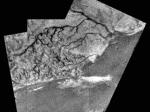
Methane rain, evaporating lakes, flowing rivers, and water ice-volcanoes all likely exist on Saturn's moon Titan, according to preliminary analyses of recent images taken by the successful Huygen's lander. A snaking...
 Prometheus and the Rings of Saturn
16.12.2004
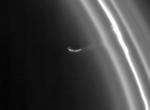
In Greek Mythology, Prometheus was known for stealing fire from the gods. Ironically, in a story for more modern times Prometheus may also become known for stealing, but this time for stealing icy particles from Saturn's rings.
 Saturn and Vesta in Taurus
17.01.2002
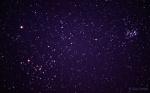
Last November, while skygazing toward the constellation Taurus, astrophotographer Joe Orman arranged this time exposure to include the lovely Hyades and Pleiades star clusters in the field of his telephoto lens. A distance...
 Saturn Rotates
3.10.2000
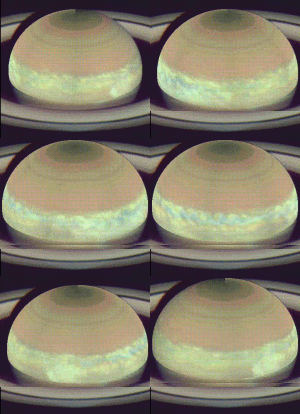
The dramatic rotation of the cloud-tops of Saturn every ten-hours is particularly evident from orbit around the gas giant planet. With a good enough telescope, however, such rotation is visible even from Earth, as shown by this time-lapse image sequence from the Hubble Space Telescope taken in November 1990.
 Saturnian Aurora
8.01.1998
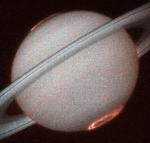
Girdling the second largest planet in the Solar System, Saturn's Rings are one of the most spectacular sights for earthbound telescopes. This recently released image, from the orbiting Hubble Space Telescope's STIS instrument, offers a striking view of another kind of ring around Saturn - pole encircling rings of ultraviolet aurora.
 Saturnian Aurora
17.09.2000
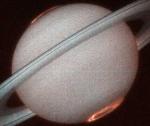
Girdling the second largest planet in the Solar System, Saturn's Rings are one of the most spectacular sights for earthbound telescopes. This image from the orbiting Hubble Space Telescope's STIS instrument, offers a striking view of another kind of ring around Saturn - pole encircling rings of ultraviolet aurora.
 Looking Down on Saturn
21.09.1997
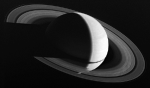
This picture of Saturn could not have been taken from Earth. No Earth based picture could possibly view the night side of Saturn and the corresponding shadow cast across Saturn's rings. Since Earth is much closer to the Sun than Saturn, only the day side of the planet is visible from the Earth.
 Sunlight Through Saturn's Rings
11.05.1996
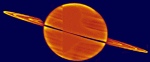
Normally, Earth based astronomers view Saturn's spectacular ring system fully illuminated by reflected sunlight. However, this November 1995 Hubble Space Telescope composite image was made to take advantage of an unusual perspective, with the Sun actually illuminating the rings from below.
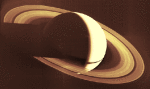 The Night Side of Saturn
5.07.1995
This image of Saturn was made in November 1980 by the Voyager 1 spacecraft as it flew past the ringed gas giant planet. From a spectacular vantage point, looking back toward the inner solar system, the robot spacecraft recorded this view of the night side of Saturn casting a sharp shadow across the bright rings.
|
January February March April May June July August September October |
|||||||||||||||||||||||||||||||||||||||||||||||||