
|
Keyword: Jupiter
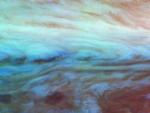 Jupiter: At The Belt-Zone Boundary
10.03.1997
Jupiter's thick atmosphere is striped by wind-driven cloud bands that remain fixed in latitude - dark colored bands are known as belts while light colored bands are zones. At Jupiter's belt-zone boundaries the shearing wind velocities can reach nearly 300 miles per hour.
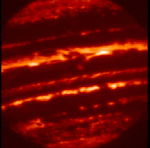 Beneath Jupiter's Clouds
23.01.1996
This near-infrared image of Jupiter was made using instrumentation at NASA's Infrared Telescope Facility, located on the summit of Mauna Kea, Hawaii, in support of the Galileo mission to Jupiter. The brightest spots...
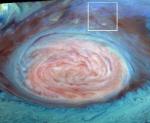 Storm Clouds Over Jupiter
27.11.1996
Storm clouds, similar to the familiar cumulonimbus thunderheads of Earth, appear to be present on Jupiter. The mosaic of images above shows the region near the raging edge of Jupiter's Great Red Spot, itself some 2 to 3 Earths wide, as observed by the Galileo spacecraft in June of this year.
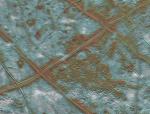 Europa: Ridges and Rafts on a Frozen Moon
10.09.1998
The large Jovian moon Europa may harbor liquid water beneath its frozen crust. Controversy surrounding this idea has been recently fueled by dramatic images of Europa's surface from the Galileo spacecraft. This alluring...
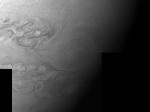 New Horizons Spacecraft Passes Jupiter
7.03.2007
A new spacecraft is headed for the outer Solar System. Named New Horizons, this robotic explorer passed Jupiter last week after being launched only in early 2006. New Horizons is being pulled by Jupiter's gravity to a greater speed toward its next target: Pluto in 2015.
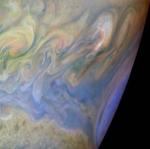 West Of The Great Red Spot
26.12.1999
The turbulent region West of Jupiter's Great Red Spot is highlighted in this picture constructed from data recorded by the Galileo spacecraft. The image is color coded to show cloud height and thickness; white clouds are high and thick, light blue clouds are high and thin, and reddish clouds are low.
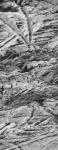 560 Kilometers Above Europa
3.03.1998
This is the closest photograph ever taken of Europa. Last December, NASA's spacecraft Galileo swept past the Jovian moon and took photographs which were released yesterday. Speculation that life-bearing oceans exist beneath Europa's surface caused NASA to put Galileo on orbits that approach Europa.
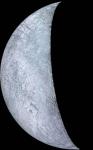 Crescent Europa
25.02.2002
Although the phase of this moon might appear familiar, the moon itself might not. In fact, this crescent shows part of Jupiter's moon Europa. The passing robot spacecraft Voyager 2 captured this image in 1979.
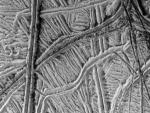 Cracks and Ridges on Europa
10.03.1998
Which way to the interstate? What appears to be a caricature of a complex highway system on Earth is actually a system of ridges and cracks on the icy surface of Jupiter's moon Europa. The distance between parallel ridges in the above photograph is typically about 1 kilometer.
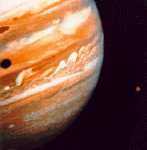 Jupiter, Io, and Ganymede's Shadow
13.10.1995
Jupiter, the solar system's largest planet, is seen here next to Io, its closest Galilean moon. On the cloud tops of Jupiter near the left edge of the picture can be seen a dark circular spot which is caused by the shadow of Jupiter's largest moon Ganymede.
|
January February March April May June July August September October |
|||||||||||||||||||||||||||||||||||||||||||||||||