
|
Keyword: cassini spacecraft
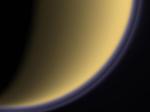 The Double Haze above Titan
10.08.2004
Most moons have no haze layer at all - why does Titan have two? Images from the Cassini spacecraft that slipped into orbit around Saturn last month confirm that the Solar System's most mysterious moon is surrounded not only by a thick atmosphere but also by two distinct spheres of haze.
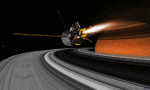 Cassini To Saturn
29.08.1997
Scheduled for launch in October, the Cassini spacecraft will spend seven years traveling through the Solar System -- its destination, Saturn. On arrival Cassini will begin an ambitious mission of exploration which will include parachuting a probe to the surface of Titan, Saturn's largest moon.
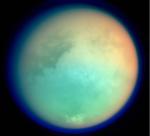 Tantalizing Titan
28.10.2004
Normally hidden by a thick, hazy atmosphere, tantalizing features on Titan's surface appear in this false-color view. The image was recorded as the Cassini spacecraft approached its first close flyby of Saturn's smog-shrouded moon on October 26.
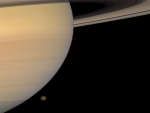 Saturn and Titan from Cassini
24.03.2008
Spectacular vistas of Saturn and its moon continue to be recorded by the Cassini spacecraft. Launched from Earth in 1997, robotic Cassini entered orbit around Saturn in 2004 and has revolutionized much of humanity's knowledge of Saturn, its expansive and complex rings, and it many old and battered moons.
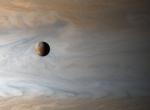 Io: Moon Over Jupiter
20.04.2001
How big is the Jovian moon Io? The most volcanic body in the Solar System, Io (usually pronounced "EYE-oh") is 3,600 kilometers in diameter, about the size of planet Earth's single large natural satellite.
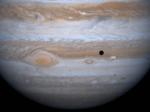 Jupiter, Io, and Shadow
26.12.2000
Just as planets orbit our Sun, Jupiter's Moons orbit Jupiter. Pictured above is the closest of Jupiter's Galilean Satellites, Io, superposed in front of the giant planet it circles. To the left of Io is a dark spot that is its own shadow.
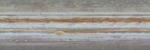 Jupiter Unpeeled
15.02.2001
Slice Jupiter from pole to pole, peel back its outer layers of clouds, stretch them onto a flat surface ... and for all your trouble you'd end up with something that looks a lot like this. Scrolling right will reveal the full picture, a color mosaic of Jupiter from the Cassini spacecraft.
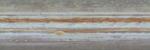 Jupiter Unpeeled
6.09.2003
Slice Jupiter from pole to pole, peel back its outer layers of clouds, stretch them onto a flat surface ... and for all your trouble you'd end up with something that looks a lot like this. Scrolling right will reveal the full picture, a color mosaic of Jupiter from the Cassini spacecraft.
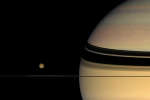 Moons, Rings, and Unexpected Colors on Saturn
20.10.2008
Why would Saturn show such strange colors? The robotic Cassini spacecraft currently orbiting Saturn has beamed back images showing that the northern hemisphere our Solar System's most spectacularly ringed planet has changed noticeably since Cassini arrived in 2004, now sporting unusual and unexpected colors. No one is sure why.
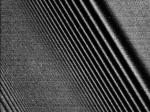 Cassini Images Density Waves in Saturns Rings
5.07.2004
What causes the patterns in Saturn's rings? The Cassini spacecraft just entering orbit around Saturn has started sending back spectacular images of Saturn's immense ring system in unprecedented detail. The physical cause for many of newly resolved ring structures is not always understood.
|
January February March April May June July August September October |
|||||||||||||||||||||||||||||||||||||||||||||||||