
|
Keyword: Mercury
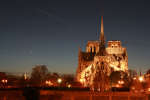 Mercury and Venus Over Paris
12.04.2010
Go outside tonight and see one of the more interesting planetary conjunctions of recent years. Just after sunset, the planets Mercury and Venus are visible quite near each other. Now Venus, being commonly discernible as one of the brightest objects in the sky, is frequently mistaken for an airplane.
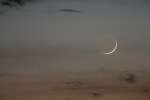 Moon Meets Mercury
9.05.2008
On Tuesday, May 6, while standing on planet Earth and sweeping your binoculars along the western horizon just after sunset, you might have encountered this arresting skyscape. The view features a slender crescent Moon and bright planet Mercury separated on the sky by only about 2 degrees.
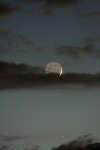 Framed by Clouds
30.04.2009
Last Sunday's fading evening twilight featured a young crescent Moon along the western horizon. The young Moon also shared the sky with the lovely Pleiades star cluster and wandering planet Mercury. Framed by clouds in this serene skyscape from Selsey, UK, a similar twilight scene was visible around the globe.
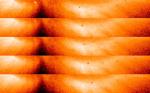 X-ray Transit of Mercury
2.07.1998
This sequence of false color X-ray images captures a rare event - the passage or transit of planet Mercury in front of the Sun. Mercury's small disk is silhouetted against the bright background of X-rays from the hot Solar Corona.
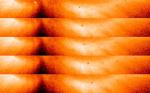 X ray Transit of Mercury
6.11.1999
This sequence of false color X-ray images captures a rare event - the passage or transit of planet Mercury in front of the Sun. Mercury's small disk is silhouetted against the bright background of X-rays from the hot Solar Corona.
 Mercury: A Cratered Inferno
12.09.2004
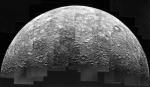
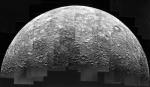
Mercury's surface looks similar to our Moon's. Each is heavily cratered and made of rock. Mercury's diameter is about 4800 km, while the Moon's is slightly less at about 3500 km (compared with about 12,700 km for the Earth). But Mercury is unique in many ways.
 Mercury: A Cratered Inferno
19.08.2001
Mercury's surface looks similar to our Moon's. Each is heavily cratered and made of rock. Mercury's diameter is about 4800 km, while the Moon's is slightly less at about 3500 km (compared with about 12,700 km for the Earth). But Mercury is unique in many ways.
 Mercury Over Leeds
7.03.2005
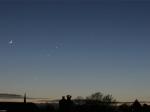
Have you ever seen the planet Mercury? This week might be a good time. Because Mercury orbits so close to the Sun, it never wanders far from the Sun in Earth's sky. If trailing the Sun, Mercury will be visible low on the horizon for only a short while after sunset.
 Southwest Mercury
16.02.2003
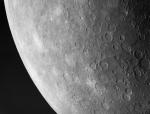
The planet Mercury resembles a moon. Mercury's old surface is heavily cratered like many moons. Mercury is larger than most moons but smaller than Jupiter's moon Ganymede and Saturn's moon Titan. Mercury is much denser and more massive than any moon, though, because it is made mostly of iron.
 Mercury And The Sun
19.11.1999
Just days before the peak of the Leonid meteor shower, skywatchers were offered another astronomical treat as planet Mercury crossed the face of the Sun on November 15. Viewed from planet Earth, a transit of Mercury is not all that rare. The last occurred in 1993 and the next will happen in 2003.
|
January February March April May June July August September October |
|||||||||||||||||||||||||||||||||||||||||||||||||