
|
Keyword: Mercury
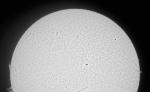 Mercury Transits the Sun
13.05.2003
How big is the Sun? The Sun is not only larger than any planet, it is larger than all of the planets put together. The Sun accounts for about 99.9 percent of all the mass in its Solar System.
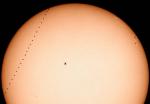 A Mercury Transit Sequence
27.05.2003
Earlier this month, the planet Mercury crossed the face of the Sun, as seen from Earth. Because the plane of Mercury's orbit is not exactly coincident with the plane of Earth's orbit, Mercury usually appears to pass over or under the Sun.
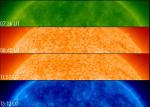 Mercury Spotting
8.05.2003
Can you spot the planet? The diminutive disk of Mercury, the solar system's innermost planet, spent about five hours crossing in front of the enormous solar disk yesterday (Wednesday, May 7th), as viewed from the general vicinity of planet Earth.
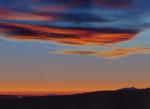 Mercury on the Horizon
12.04.2003
Have you ever seen the planet Mercury? Because Mercury orbits so close to the Sun, it never wanders far from the Sun in Earth's sky. If trailing the Sun, Mercury will be visible low on the horizon for only a short while before sunset.
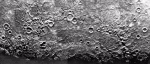 Mercury's Caloris Basin
20.01.1996
Mercury, the closest planet to the Sun, has a surface with so many craters it resembles the Earth's Moon. The largest surface feature on Mercury is the Caloris Basin, which resulted from a collision with an asteroid.
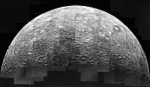 Mercury: A Cratered Inferno
30.11.1997
Mercury's surface looks similar to our Moon's. Each is heavily cratered and made of rock. Mercury's diameter is about 4800 km, while the Moon's is slightly less at about 3500 km (compared with about 12,700 km for the Earth). But Mercury is unique in many ways.
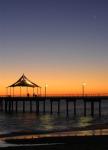 Three Planets by the Sea
2.07.2005
On Tuesday, June 28th, the setting Sun flooded the horizon with a beautiful warm light in this view from the beach beside the pier at Brighton in Adelaide, South Australia. The Sun also illuminated three planets gathered in the western sky, Mercury, Venus, and Saturn.
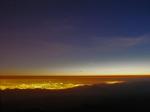 Three Planets from Mt Hamilton
30.06.2005
Venus, Mercury, and Saturn wandered close together in western evening skies last week. On Saturnday, June 25, astronomer R. Jay GaBany recorded this snapshot of their eye-catching planetary conjunction, from historic Lick Observatory on Mt. Hamilton, California, USA.
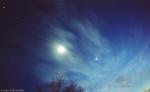 Nashville Four Planet Skyline
9.02.2001
So far this February, evening skies have been blessed with a glorious Moon and three bright planets; Venus, Jupiter, and Saturn. But just last week, on January 30th, an extreme wide-angle lens allowed astrophotographer Larry Koehn to capture this twilight view of Moon and four planets
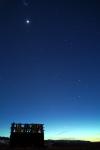 Mercury and Venus in the West
2.04.2004
Doing their part in the ongoing dance of the planets, Mercury and Venus both reached their greatest elongation or maximum apparent distance from the Sun only a few days ago, on March 29th. Eager...
|
January February March April May June July August September October |
|||||||||||||||||||||||||||||||||||||||||||||||||