
|
Keyword: asteroid
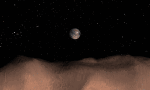 Earth Nears Asteroid Toutatis
20.01.1997
On November 29, 1996 the Earth came within 3.3 million miles of the asteroid Toutatis. Above is a computer simulated picture of this spectacle from the surface of Toutatis (a 2.5 degree field of view looking toward Earth). In Earth's sky, Toutatis appeared only as a faint object moving against a background of stars.
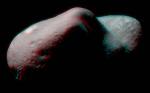 Stereo Eros
17.02.2007
Get out your red/blue glasses and float next to asteroid 433 Eros, now over 220 million kilometers away! Orbiting the Sun once every 1.8 earth-years, asteroid Eros is a diminutive 40 x 14 x 14 kilometer world of undulating horizons, craters, boulders and valleys.
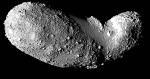 Smooth Sections on Asteroid Itokawa
22.04.2007
Why are parts of this asteroid's surface so smooth? No one is yet sure, but it may have to do with the dynamics of an asteroid that is a loose pile of rubble rather than a solid rock.
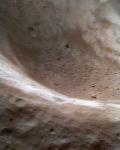 The Regolith of Asteroid Eros
29.08.2000
From fifty kilometers above asteroid Eros, the surface inside one of its largest craters appears covered with an unusual substance: regolith. The thickness and composition of the surface dust that is regolith remains a topic of much research.
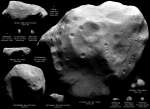 Lutetia: The Largest Asteroid Yet Visited
26.07.2010
As humans explore the universe, the record for largest asteroid visited by a spacecraft has increased yet again. Earlier this month, ESA's robotic Rosetta spacecraft zipped past the asteroid 21 Lutetia taking data and snapping images in an effort to better determine the history of the asteroid and the origin of its unusual colors.
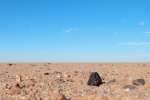 Almahata Sitta 15
28.03.2009
Small asteroid 2008 TC3 fell to Earth at dawn on October 7, 2008, tracking through the skies over the Nubian Desert in northern Sudan. That event was remarkable because it was the first time an asteroid was detected in space before crashing into planet Earth's atmosphere.
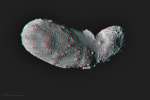 Stereo Itokawa
19.06.2010
Get out your red/blue glasses and float next to asteroid Itokawa, a diminutive world of the solar system only half a kilometer across. Boulders strewn across its rough surface and the lack of craters indicate that this asteroid is a rubble pile, formed as smaller pieces collected and were kept together by gravity.
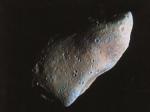 Asteroid Gaspra's Best Face
12.07.1998
Asteroid 951 Gaspra is a huge rock tumbling in space. Gaspra became one of the best-studied asteroids in 1991 when the spacecraft Galileo flew by. In the above photograph, subtle color variations have been exaggerated to highlight changes in reflectivity, surface structure and composition.
 Asteroid Gaspra's Best Face
20.10.1995
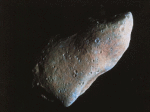
Above is the best yet color image of the asteroid Gaspra based on data returned by NASA's Galileo spacecraft. Color variations have been added to high resolution images and enhanced to highlight changes in reflectivity, surface structure and composition. The illuminated portion of the asteroid is about 11 miles long.
 Ida and Dactyl: Asteroid and Moon
7.08.1999
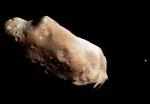
This asteroid has a moon! The robot spacecraft Galileo currently exploring the Jovian system, encountered and photographed two asteroids during its long journey to Jupiter. The second asteroid it photographed, Ida, was discovered to have a moon which appears as a small dot to the right of Ida in this picture.
|
January February March April May June July August September October |
|||||||||||||||||||||||||||||||||||||||||||||||||