
|
Keyword: Orion Nebula
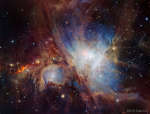 The Orion Nebula in Infrared from HAWK I
18.07.2016
The deepest infrared image of the Orion Nebula has uncovered a bonanza of previously unknown low-mass stars and -- quite possibly -- free floating planets. The picturesque nebula is best known in visible light where it shows a many bright stars and bright glowing gas.
 Orion in Red and Blue
13.04.2016
When did Orion become so flashy? This colorful rendition of part of the constellation of Orion comes from red light emitted by hydrogen and sulfur (SII), and blue-green light emitted by oxygen (OIII). Hues...
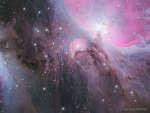 M43: Streams of Orion
6.10.2021
Where do the dark streams of dust in the Orion Nebula originate? This part of the Orion Molecular Cloud Complex, M43, is the often imaged but rarely mentioned neighbor of the more famous M42. M42, seen in part to the upper right, includes many bright stars from the Trapezium star cluster.
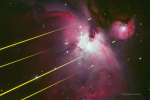 Nebula with Laser Beams
29.03.2017
Four laser beams cut across this startling image of the Orion Nebula, as seen from ESO's Paranal Observatory in the Atacama desert on planet Earth. Not part of an interstellar conflict, the lasers...
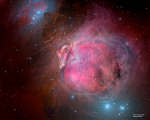 The Great Turkey Nebula
26.11.2020
Surprisingly reminiscent of The Great Nebula in Orion, The Great Turkey Nebula spans this creative field of view. Of course if it were the Orion Nebula it would be our closest large stellar nursery, found at the edge of a large molecular cloud a mere 1,500 light-years away.
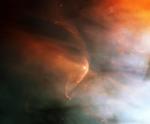 LL Orionis: When Cosmic Winds Collide
15.11.2003
This arcing, graceful structure is actually a bow shock about half a light-year across, created as the wind from young star LL Orionis collides with the Orion Nebula flow. Adrift in Orion's stellar...
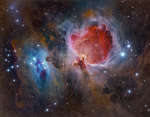 Great Orion Nebulae
13.09.2011
The Great Nebula in Orion, also known as M42, is one of the most famous nebulas in the sky. The star forming region's glowing gas clouds and hot young stars...
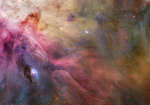 LL Ori and the Orion Nebula
3.02.2013
This esthetic close-up of cosmic clouds and stellar winds features LL Orionis, interacting with the Orion Nebula flow. Adrift in Orion's stellar nursery and still in its formative years, variable star LL Orionis produces a wind more energetic than the wind from our own middle-aged Sun.
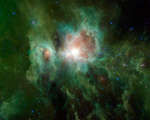 Infrared Orion from WISE
13.02.2013
The Great Nebula in Orion is a intriguing place. Visible to the unaided eye, it appears as a small fuzzy patch in the constellation of Orion. But this image, an illusory-color composite of four...
 Orion and the Running Man
13.11.2025
Few cosmic vistas can excite the imagination like The Great Nebula in Orion. Visible as a faint, bland celestial smudge to the naked-eye, the nearest large star-forming region sprawls across this sharp colorful telescopic image. Designated M42 in the Messier Catalog, the Orion Nebula's glowing gas and dust surrounds hot, young stars.
|
January February March April May June July August September October |
|||||||||||||||||||||||||||||||||||||||||||||||||