
|
Keyword: galaxies
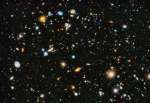 Hubble Ultra Deep Field 2014
5.06.2014
Galaxies like colorful pieces of candy fill the Hubble Ultra Deep Field 2014. The dimmest galaxies are more than 10 billion times fainter than stars visible to the unaided eye and represent the Universe in the extreme past, a few 100 million years after the Big Bang.
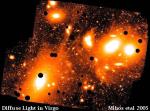 Streams of Stars in the Virgo Cluster of Galaxies
26.09.2005
How do huge clusters of galaxies evolve? To help find out, astronomers pointed the wide-angle Burrell-Schmidt telescope on Kitt Peak National Observatory in Arizona, USA at the nearby Virgo Cluster of Galaxies. After hundreds...
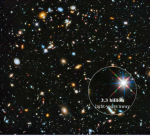 The Hubble Ultra Deep Field in Light and Sound
1.08.2021
Have you heard about the Hubble Ultra-Deep Field? Either way, you've likely not heard about it like this -- please run your cursor over the featured image and listen! The Hubble Ultra-Deep Field (HUDF)...
 APOD: 2025 March 2 Б The Hubble Ultra Deep Field in Light and Sound
1.03.2025
Have you heard about the Hubble Ultra-Deep Field? Either way, you've likely not heard about it like this -- please run your cursor over the featured image and listen! The Hubble Ultra-Deep Field (HUDF)...
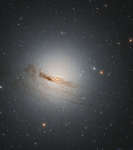 Threads of NGC 1947
6.04.2021
Found in far southern skies, deep within the boundaries of the constellation Dorado, NGC 1947 is some 40 million light-years away. In silhouette against starlight, obscuring lanes of cosmic dust thread across the peculiar galaxy's bright central regions.
 APOD: 2024 December 31 Б The Twisted Disk of NGC 4753
30.12.2024
What do you think this is? HereБs a clue: it's bigger than a bread box. Much bigger. The answer is that pictured NGC 4753 is a twisted disk galaxy, where unusual dark dust filaments provide clues about its history.
 APOD: 2026 January 26 Б NGC 55: A Galaxy of Nebulas
25.01.2026
Can you see nebulas in other galaxies? Yes, some nebulas shine brightly enough -- if you know how to look. Clouds of hydrogen and oxygen emit light at very specific colors, and by isolating them, astronomers and astrophotographers can reveal structures that would otherwise be too faint to notice.
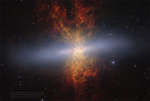 APOD: 2026 June 29 Б M82: Galaxy with a Supergalactic Wind
28.06.2026
Why is the Cigar Galaxy billowing red smoke? M82, as this starburst galaxy is also known, was stirred up by a recent pass near large spiral galaxy M81. This doesn't fully explain the source of the red-glowing outwardly expanding gas and dust, however.
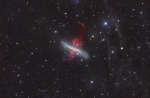 APOD: 2026 April 17 Б M82: Starburst Galaxy with a Superwind
16.04.2026
Messier 82 is a starburst galaxy with a superwind. In fact, through supernova explosions and powerful winds from massive stars, the burst of star formation in M82 is driving a prodigious outflow. Evidence for the superwind from the galaxy's central regions is clear in the sharp telescopic portrait.
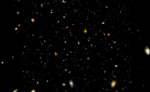 APOD: 2020 July 26 Б A Flight through the Hubble Ultra Deep Field
25.07.2020
What would it look like to fly through the distant universe? To find out, a team of astronomers estimated the relative distances to over 5,000 galaxies in one of the most distant fields of galaxies ever imaged: the Hubble Ultra Deep Field (HUDF).
|
January February March April May June July August September October |
|||||||||||||||||||||||||||||||||||||||||||||||||