
|
Keyword: Moon
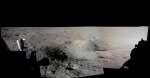 Apollo 11 Landing Panorama
22.07.2022
Have you seen a panorama from another world lately? Assembled from high-resolution scans of the original film frames, this one sweeps across the magnificent desolation of the Apollo 11 landing site on the Moon's Sea of Tranquility.
 Shackleton from ShadowCam
4.05.2023
Shackleton crater lies at the lunar south pole. Peaks along the 21 kilometer diameter are in sunlight, but Shackleton's floor is in dark permanent shadow. Still, this image of the shadowed rim wall...
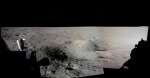 Apollo 11 Landing Panorama
19.07.2024
Have you seen a panorama from another world lately? Assembled from high-resolution scans of the original film frames, this one sweeps across the magnificent desolation of the Apollo 11 landing site on the Moon's Sea of Tranquility.
 America and the Sea of Serenity
9.12.2022
Get out your red/blue glasses and check out this stereo view of another world. Fifty years ago the scene was recorded by Apollo 17 mission commander Eugene Cernan on December 11, 1972, one orbit before descending to land on the Moon.
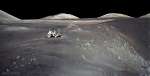 Apollo 17 at Shorty Crater
23.11.2017
In December of 1972, Apollo 17 astronauts Eugene Cernan and Harrison Schmitt spent about 75 hours on the Moon in the Taurus-Littrow valley, while colleague Ronald Evans orbited overhead. This sharp image was taken by Cernan as he and Schmitt roamed the valley floor.
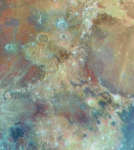 A Colourful Moon
10.11.2017
The Moon is normally seen in subtle shades of grey. But small, measurable color differences have been greatly exaggerated in this mosaic of high-resolution images captured near the Moon's full phase, to construct a multicolored, central moonscape.
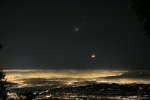 A Happy Sky over Los Angeles
11.11.2017
Sometimes, the sky may seem to smile over much of planet Earth. On this day in 2008, visible the world over, was an unusual superposition of our Moon and the planets Venus and Jupiter.
 APOD: 2023 November 14 Б Three Planets Rock
13.11.2023
In the fading darkness before dawn, a tilted triangle appeared to balance atop a rock formation off the southern tip of Sicily. Making up the points of the triangle are three of the four brightest objects visible in EarthБs sky: Jupiter, Venus and the Moon.
 Jupiter by Moonlight
2.11.2023
That bright beacon you've seen rising in the east just after sunset is Jupiter. Climbing high in midnight skies, our Solar System's ruling gas giant was at its 2023 opposition, opposite the Sun in planet Earth's sky, on November 2.
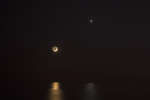 Reflections of Venus and Moon
18.05.2018
Posing near the western horizon, a brilliant evening star and slender young crescent shared reflections in a calm sea last Thursday after sunset. Recorded in this snapshot from the Atlantic beach at Santa Marinella...
|
January February March April May June July August September October |
|||||||||||||||||||||||||||||||||||||||||||||||||