
|
Keyword: Moon
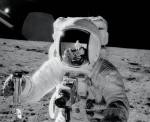 Apollo 12: Self-Portrait
21.01.2006
In November of 1969, Apollo 12 astronaut-photographer Charles "Pete" Conrad recorded this masterpiece while documenting colleague Alan Bean's lunar soil collection activities on the Oceanus Procellarum. The image is dramatic and stark.
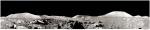 Apollo 17 Panorama: Astronaut Running
10.12.2006
What would it be like to explore the surface of another world? In 1972 during the Apollo 17 mission, astronaut Harrison Schmitt found out first hand. In this case, the world was Earth's own Moon.
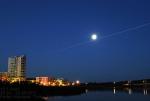 Moons and Bright Mars
1.08.2003
In this serene view, the moons of Earth along with the bright planet Mars shine above the city of Turku near the southwestern tip of Finland. Of course Earth's large natural satellite, the Moon, at a distance of 400,000 kilometers, is by far the brightest object in this sky.
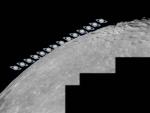 Eclipsing the Rings
16.03.2007
The March 3rd total lunar eclipse was widely viewed by denizens of planet Earth. But only a day before, well placed observers could also watch a lunar occultation of Saturn as the planet passed behind the nearly Full Moon.
 Southern Moonscape
23.08.2007
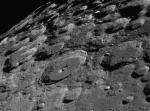
The Moon's south pole is near the top of this sharp telescopic view looking across the southern lunar highlands. Recorded on August 3rd from Tecumseh, Oklahoma, planet Earth, the foreshortened perspective heightens the impression of a dense field of craters and makes the craters themselves appear more oval shaped.
 Moon, Mercury, Monaco
18.03.2005
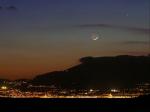
Low on the western horizon after sunset, a slender crescent Moon and wandering planet Mercury join the lights of Menton and Monaco along the French Riviera. Astronomer Vincent Jacques took advantage of this gorgeous...
 Reflections on the Inner Solar System
15.07.2005
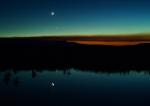
Only Mars is missing from this reflective view of the major rocky bodies of the inner solar system. Captured on July 8th, the serene, twilight picture looks out over the Flat Tops Wilderness area from near Toponas, Colorado, USA and includes planets Mercury, Venus, Earth, and Earth's large natural satellite, the Moon.
 Bright Venus
8.03.2001
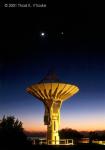
Have you seen a bright evening star in the western sky lately? That's no star, that's planet Venus the second "rock" from the Sun. Blazing at -4.6 magnitude, Venus, after the Sun and Moon, is the third brightest celestial body in planet Earth's sky.
 Sirius, Sun, Moon, and Southern Cross
7.07.2000
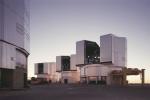
From left to right are the enclosures of Yepun (ye-poon; Sirius), Antu (an-too; Sun), Kueyen (qua-yen; Moon), and Melipal (me-li-pal; Southern Cross), pictured here as night falls at Paranal Observatory in northern Chile. These are the four 8.2 meter wide telescope units of the European Southern Observatory's Very Large Telescope (VLT).
 Serene Paraselene
2.04.2010
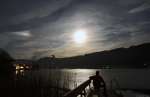
Nestled in the Austrian Alps, frozen Lake Ossiach stretches across the foreground of this serene view. Recorded on March 1, the night sky includes a nearly full Moon and bright planet Saturn seen through thin clouds near picture center. It also includes a remarkably bright and colorful moondog or paraselene at the left.
|
January February March April May June July August September October |
|||||||||||||||||||||||||||||||||||||||||||||||||