
|
Keyword: Moon
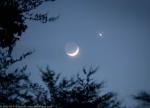 Love and War by Moonlight
24.05.2002
Venus, named for the Roman goddess of love, and Mars, the war god's namesake, approach each other by moonlight in this lovely sky view recorded on May 14th from Dunkirk, Maryland, USA.
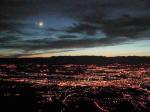 The Moon and Venus Over Geneva
19.06.2002
The Moon, fresh from a biting encounter with the Sun last week, appeared next to threaten Venus. The waxing Moon appeared to glide right past, however, just a few degrees away. Venus, of course, is much further away from the Earth than the Moon, so the passing was really just an angular illusion.
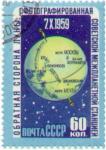 The Averted Side Of The Moon
7.10.1999
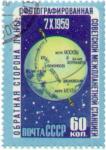
This vintage 60-kopek stamp celebrates a dramatic achievement. On October 7th, forty years ago (7/X/1959), the Soviet interplanetary station which has come to be called "Luna 3" successfully photographed the far side of the moon giving denizens of planet Earth their first ever view of this hidden hemisphere.
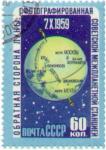 The Averted Side Of The Moon
21.10.2000
This vintage 60-kopek stamp celebrates a dramatic achievement. On the 7th of October, 1959 (7/X/1959), the Soviet interplanetary station which has come to be called "Luna 3" successfully photographed the far side of the moon giving denizens of planet Earth their first ever view of this hidden hemisphere.
 The Averted Side Of The Moon
9.10.2004
This vintage 60-kopek stamp celebrates a dramatic achievement. On the 7th of October, 1959 (7/X/1959), the Soviet interplanetary station which has come to be called "Luna 3" successfully photographed the far side of the moon giving denizens of planet Earth their first ever view of this hidden hemisphere.
 Bright Planets, Crescent Moon
11.10.2007
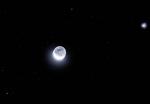
Early risers are currently enjoying the sight of dazzling Venus, near the eastern horizon as the morning star. Recorded on October 7, this predawn skyview does feature Venus at the upper right. It also includes a crescent Moon and Saturn (lower left).
 Planets in the West
18.04.2002
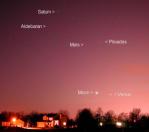
Have you seen any bright planets lately? Chances are if you've been outside under clear skies just after sunset, then you have. Now shining in the west as bright "stars" in the night sky, are all five planets of the solar system known to ancient astronomers - Mercury, Venus, Mars, Saturn, and Jupiter.
 Ida and Dactyl: Asteroid and Moon
19.06.2004
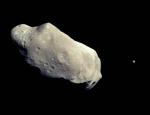
This asteroid has a moon! The robot spacecraft Galileo destined to explore the Jovian system, encountered and photographed two asteroids during its long interplanetary voyage to Jupiter. The second asteroid it photographed, Ida, was discovered to have a moon which appears as a small dot to the right of Ida in this image from 1993.
 At first he couldn t see the Moon
11.04.2008
At first, he couldn't see it, but searching with binoculars along a cloudy western horizon near sunset, photographer Laurent Laveder finally spotted a delicate lunar crescent. Captured in this dramatic picture on April 6th from Bretagne, France, the Moon was only 15 hours and 38 minutes old.
 Lunar Dust and Duct Tape
1.05.1999
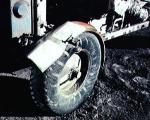
Why is the Moon dusty? On Earth, rocks are weathered by wind and water, creating soil and sand. On the Moon, the long history of micrometeorite bombardment has blasted away at the rocky surface creating a layer of powdery lunar soil or regolith. This lunar regolith could be a scientific and industrial bonanza.
|
January February March April May June July August September October |
|||||||||||||||||||||||||||||||||||||||||||||||||