
|
Keyword: Moon
 Sky and Planets
9.03.2000
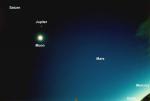
On February 10th, an evocative evening sky above Rocklin, California, USA inspired astrophotographer Steve Sumner to record this remarkable sight - five planets and the Moon. Near its first quarter phase, the bright Moon...
 Earthrise
23.12.2005
In December of 1968, the Apollo 8 crew flew from the Earth to the Moon and back again. Frank Borman, James Lovell, and William Anders were launched atop a Saturn V rocket on December 21, circled the Moon ten times in their command module, and returned to Earth on December 27.
 31 Million Miles from Planet Earth
3.09.2008
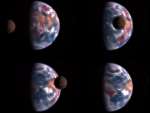
On July 4th, 2005, the Deep Impact spacecraft directed a probe to impact the nucleus of Comet Tempel 1. Still cruising through the solar system, earlier this year the robotic spacecraft looked back to record a series of images of its home world 31 million miles (50 million kilometers) away.
 Eclipsed Moon in Infrared
23.04.2005
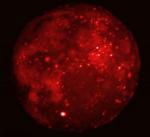
In September of 1996, the Midcourse Space Experiment (MSX) satellite had a spectacular view of a total lunar eclipse from Earth orbit. SPIRIT III, an on board infrared telescope, was used to repeatedly image the moon during the eclipse.
 Eclipsed Moon in Infrared
15.09.2001
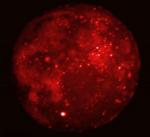
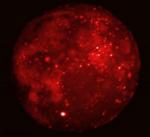
The total lunar eclipse of September 1996 disappointed many observers in North America who were cursed with cloudy skies. However, the Midcourse Space Experiment (MSX) satellite had a spectacular view from Earth orbit and SPIRIT III, an onboard infrared telescope, was used to repeatedly image the moon during the eclipse.
 Eclipsed Moon in Infrared
7.11.2003
The total lunar eclipse of September 1996 disappointed many observers in North America who were cursed with cloudy skies. However, the Midcourse Space Experiment (MSX) satellite had a spectacular view from Earth orbit and SPIRIT III, an on board infrared telescope, was used to repeatedly image the moon during the eclipse.
 Blue Marble 2000
20.04.2000
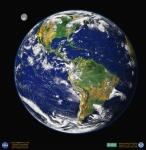
This newly released digital portrait of our planet is reminiscent of the Apollo-era pictures of the "big blue marble" Earth from space. To create it, researchers at Goddard Space Flight Center's Laboratory...
 Full Moon, Lake, and Leonids Indeed
21.11.2002
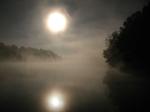
Full of itself moon - EVERYONE SHOULD LOOK AT ME. What's 33 years? And for those who need a story ... photographer Blake Suddeth took over a hundred digital pictures early Tuesday morning in order...
 Restored: First Image of the Earth from the Moon
17.11.2008
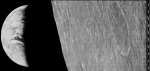
Pictured above is the first image ever taken of the Earth from the Moon. The image was taken in 1966 by Lunar Orbiter 1 and heralded by then-journalists as the Image of the Century. It was taken about two years before the Apollo 8 crew snapped its more famous color cousin.
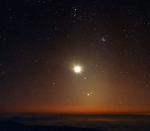 Planets Above The Clouds
4.05.2000
Clouds scatter the faint orange rays of the setting sun in the foreground of this breathtaking photograph from the summit of Mauna Kea, Hawaii. Taken on April 7th, this skyscape features a dramatic lunar and planetary alignment.
|
January February March April May June July August September October |
|||||||||||||||||||||||||||||||||||||||||||||||||