
|
Keyword: Mars
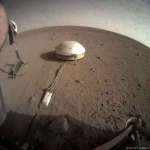 SEIS: Listening for Marsquakes
4.06.2019
If you put your ear to Mars, what would you hear? To find out, and to explore the unknown interior of Mars, NASA's Insight Lander deployed SEIS late last year, a sensitive seismometer that can detect marsquakes.
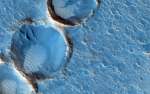 Ares 3 Landing Site: The Martian Revisited
22.06.2019
This close-up from the Mars Reconnaissance Orbiter's HiRISE camera shows weathered craters and windblown deposits in southern Acidalia Planitia. A striking shade of blue in standard HiRISE image colors, to the human eye the area would probably look grey or a little reddish.
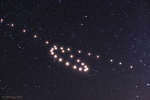 Mars in the Loop
8.11.2018
This composite of images spaced some 5 to 9 days apart, from late April (bottom right) through November 5 (top left), traces the retrograde motion of ruddy-colored Mars through planet Earth's night sky.
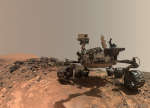 Curiosity Rover Takes Selfie on Mars
20.11.2017
Yes, but have you ever taken a selfie on Mars? The Curiosity rover on Mars has. This selfie was compiled from many smaller images -- which is why the mechanical arm holding the camera is not visible.
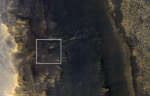 Opportunity After the Storm
4.10.2018
On Mars dust storms can't actually blow spacecraft over, but they can blot out the Sun. Over three months ago a planet-wide dust storm caused a severe lack of sunlight for the Mars rover Opportunity at its location near the west rim of Endeavor crater.
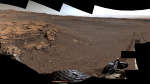 Curiosity at Teal Ridge
8.08.2019
Part of a 360 degree panorama, this view looks out from the Mars rover Curiosity's current location on the Red Planet dubbed Teal Ridge. The mosaicked scene was captured by the rover's Mastcam on Earth calendar date June 18, 2019.
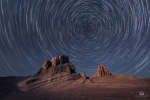 Star Trails for a Red Planet
30.11.2019
Does Mars have a north star? In long exposures of Earth's night sky, star trails make concentric arcs around the north celestial pole, the direction of our fair planet's axis of rotation. Bright star Polaris is presently the Earth's North Star, close on the sky to Earth's north celestial pole.
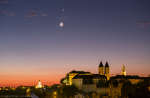 A September Morning Sky
21.09.2017
The Moon, three planets, and a bright star gathered near the ecliptic plane in the September 18 morning sky over Veszprem Castle, Hungary. In this twilight skyscape, Mercury and Mars still shine close to the eastern horizon, soon to disappear in the glare of the Sun.
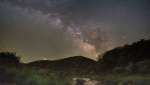 Countryside Mars and Milky Way
9.06.2018
Mars shines brightly now in planet Earth's sky. Seen with a yellowish hue it rises over the hills and far away in this serene night skyscape, a countryside panorama recorded last month from Parque Nacional de Cabaneros in Spain. The Milky Way too extends above the distant hills into a starry sky.
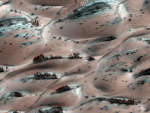 Dark Sand Cascades on Mars
29.11.2015
They might look like trees on Mars, but they're not. Groups of dark brown streaks have been photographed by the Mars Reconnaissance Orbiter on melting pinkish sand dunes covered with light frost. The above image was taken in 2008 April near the North Pole of Mars.
|
January February March April May June July August September October |
|||||||||||||||||||||||||||||||||||||||||||||||||