
|
Keyword: Mars
 Mars Rover Races to Survive
12.12.2007
The Martian rover Spirit is now in the race of its life. The rolling robot is trying to reach an outpost to spend the winter, but it keeps getting bogged down in soft sand on Mars.
 Metal on the Plains of Mars
21.01.2005
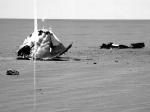
What has the Opportunity rover found on Mars? While traversing a vast empty plain in Meridiani Planum, one of Earth's yearling rolling robots found a surprise when visiting the location of it own metallic heat shield discarded last year during descent.
 3D Mars: Northern Terra Meridiani
28.08.2002
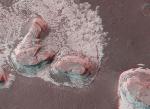
In this spectacular 3D stereoscopic view from orbit, steep-sided, flat-topped hills stand above the Terra Meridiani region of Mars. Seen best with red/blue glasses (red for the left eye), the structures are reminiscent of buttes and mesas found in southwestern areas of the North American continent on planet Earth.
 THEMIS of Mars
2.11.2001
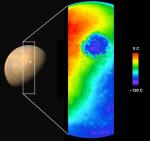
Not an ancient Greek goddess, THEMIS is modern acronese for THermal EMission Imaging System. Above is this remarkable instrument's premier infrared image of Mars, from the newly orbiting Mars Odyssey spacecraft. Taken...
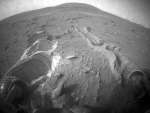 Spirit Encounters Soft Ground on Mars
1.06.2009
Will Spirit be able to free itself from soft ground on Mars? The robotic Spirit rover currently rolling across Mars ran into unexpectedly soft ground last month while exploring the red planet. A worry...
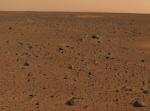 Red Mars from Spirit
7.01.2004
Rocks are strewn across the broad, flat Gusev crater floor in this sharp color picture from NASA's Spirit rover. Recorded by the rover's panoramic camera, the picture is part of Spirit's first color image of Mars - the highest resolution picture yet taken on the surface of another planet.
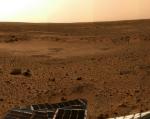 Sol 5 Postcard from Mars
9.01.2004
A martian Sol - the average martian solar day - is about 39 minutes longer than Earth's familiar 24 hour day. Operating on martian time, the Spirit rover recently sent back this color postcard image, recorded on Sol 5 of its stay on the martian surface.
 Spirit Pan from Gusev Crater
5.01.2004
After a seven month voyage of nearly 500 million kilometers through interplanetary space, NASA's Spirit Rover has reached the surface of Mars. Scroll right and see a mosaic panorama of Spirit's first images returned from its landing site in Gusev Crater!
 Rock Nest Panorama from Curiosity on Mars
25.06.2013
This is Mars -- have a look around. More specifically, this is one area picked for its promise of holding clues to the habitability of Mars to ancient life. To better search for telling leads, the robotic Curiosity rover took a series of detailed images from a location called Rock Nest.
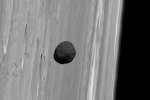 Martian Moon Phobos from Mars Express
1.12.2010
Why is Phobos so dark? Phobos, the largest and innermost of two Martian moons, is the darkest moon in the entire Solar System. Its unusual orbit and color indicate that it may be a captured asteroid composed of a mixture of ice and dark rock.
|
January February March April May June July August September October |
|||||||||||||||||||||||||||||||||||||||||||||||||