
|
Keyword: pleiades
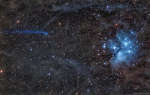 Blue Comet Meets Blue Stars
11.02.2018
What's that heading for the Pleiades star cluster? It appears to be Comet C/2016 R2 (PanSTARRS), but here, appearances are deceiving. On the right and far in the background, the famous Pleiades star cluster is dominated by blue light from massive young stars.
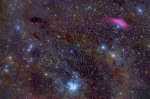 Comet PanSTARRS is near the Edge
15.02.2018
The comet PanSTARRS, also known as the blue comet (C/2016 R2), really is near the lower left edge of this stunning, wide field view recorded on January 13. Spanning nearly 20 degrees on the sky, the cosmic landscape is explored by well-exposed and processed frames from a sensitive digital camera.
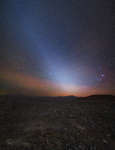 Zodiacal Light before Dawn
11.09.2014
You might not guess it, but sunrise was still hours away when this nightscape was taken, a view along the eastern horizon from a remote location in Chile's Atacama desert. Stretching high into...
 APOD: 2024 September 29 Б Seven Dusty Sisters
28.09.2024
Is this really the famous Pleiades star cluster? Known for its iconic blue stars, the Pleiades is shown here in infrared light where the surrounding dust outshines the stars. Here, three infrared colors have been mapped into visual colors (R=24, G=12, B=4.6 microns).
 APOD: 2023 February 19 Б Seven Dusty Sisters in Infrared
18.02.2023
Is this really the famous Pleiades star cluster? Known for its iconic blue stars, the Pleiades is shown here in infrared light where the surrounding dust outshines the stars. Here three infrared colors have been mapped into visual colors (R=24, G=12, B=4.6 microns).
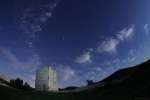 Castle and Meteor by Moonlight
13.08.2011
Each August, as planet Earth swings through dust trailing along the orbit of periodic comet Swift-Tuttle, skygazers enjoy the Perseid Meteor Shower. As Earth moves through the denser part of the comet's wide...
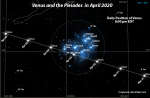 Venus and the Pleiades in April
1.04.2020
Venus is currently the brilliant evening star. Shared around world, in tonight's sky Venus will begin to wander across the face of the lovely Pleiades star cluster. This digital sky map illustrates the path of the inner planet as the beautiful conjunction evolves, showing its position on the sky over the next few days.
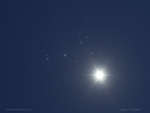 Venus and the Sisters
3.04.2020
After wandering about as far from the Sun on the sky as Venus can get, the brilliant evening star is crossing paths with the sister stars of the Pleiades cluster. Look west after sunset and you can share the ongoing conjunction with skygazers around the world.
 Venus and the Pleiades in April
10.04.2020
Shared around world in early April skies Venus, our brilliant evening star, wandered across the face of the lovely Pleiades star cluster. This timelapse image follows the path of the inner planet during the beautiful conjunction showing its daily approach to the stars of the Seven Sisters.
 Pleiades: The Seven Sisters Star Cluster
23.11.2021
Have you ever seen the Pleiades star cluster? Even if you have, you probably have never seen it as large and clear as this. Perhaps the most famous star cluster on the sky, the bright stars of the Pleiades can be seen without binoculars from even the depths of a light-polluted city.
|
January February March April May June July August September October |
|||||||||||||||||||||||||||||||||||||||||||||||||