
|
Keyword: M 42
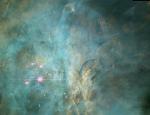 In the Center of the Trapezium
2.03.2003
Start with the constellation of Orion. Near Orion's belt is a fuzzy area known as the Great Nebula of Orion or M42. In this nebula is a bright star cluster known as the Trapezium, shown above. New stellar systems are forming there in gigantic globs of gas and dust known as Proplyds.
 Orion Nebula in Oxygen, Hydrogen, and Sulfur
13.07.2004
The Great Nebula in Orion, an immense, nearby starbirth region, is arguably the most famous of all astronomical nebulae. The Orion Nebula, also known as M42, is shown above through ultraviolet and blue filters augmented with three exact colors specifically emitted by hydrogen, oxygen, and sulfur.
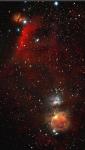 Orion Nebulosities
30.05.2002
Adrift 1,500 light-years away in one of the night sky's most recognizable constellations, the glowing Orion Nebula and the dark Horsehead Nebula are contrasting cosmic vistas. They both appear in this stunning composite color photograph along with other nebulosities as part of the giant Orion Molecular Cloud complex, itself hundreds of light-years across.
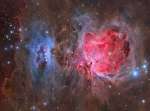 Great Orion Nebulae
23.10.2008
The Great Nebula in Orion, also known as M42, is one of the most famous nebulae in the sky. The star forming region's glowing gas clouds and hot young stars...
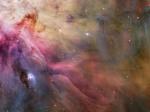 LL Ori and the Orion Nebula
20.01.2006
This esthetic close-up of cosmic clouds and stellar winds features LL Orionis, interacting with the Orion Nebula flow. Adrift in Orion's stellar nursery and still in its formative years, variable star LL Orionis produces a wind more energetic than the wind from our own middle-aged Sun.
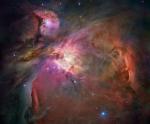 Orion Nebula, The Hubble View
19.01.2006
Few cosmic vistas excite the imagination like the Orion Nebula. Also known as M42, the nebula's glowing gas surrounds hot young stars at the edge of an immense interstellar molecular cloud only 1,500 light-years away.
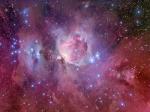 M42: Wisps of the Orion Nebula
20.11.2006
The Great Nebula in Orion, an immense, nearby starbirth region, is probably the most famous of all astronomical nebulas. Here, glowing gas surrounds hot young stars at the edge of an immense interstellar molecular cloud only 1500 light-years away. In the above deep image, faint wisps and sheets of dust and gas are particularly evident.
|
January February March April May June July August September October |
|||||||||||||||||||||||||||||||||||||||||||||||||