
|
Keyword: comet
 PanSTARRS: The Anti Tail Comet
29.06.2013
Once known as Earth's sunset comet, PanSTARRS (C/2011 L4) is up all night now, but only for northern hemisphere skygazers. Telescopes are required to track its progress as it fades and heads for the outer solar system.
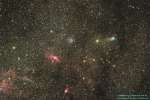 Comet Lemmon and the Deep Sky
20.07.2013
Now sweeping high above the ecliptic plane, Comet Lemmon has faded dramatically in planet Earth's night sky as it heads for the outer solar system. Some 16 light-minutes (2 AU) from...
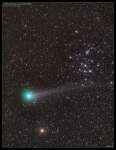 Comet Lovejoy with M44
9.11.2013
While anxiously waiting for Comet ISON to brighten further as it falls toward the Sun, northern skygazers can also find three other bright comets in the east before dawn. In fact, Comet Lovejoy C/2013 R1 is currently the morning sky's brightest.
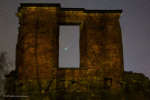 Comet Lovejoy through Morby Castle Ruins
4.12.2013
This new comet is quite photogenic. Comet Lovejoy, discovered only three months ago, was imaged through ruins of ancient MЖrby Castle in Sweden last week sporting a green-glowing coma and tails trailing several degrees.
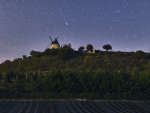 Comet Lovejoy over a Windmill
9.12.2013
Lovejoy continues to be an impressive camera comet. Pictured above, Comet C/2013 R1 (Lovejoy) was imaged above the windmill in Saint-Michel-l'Observatoire in southern France with a six-second exposure. In the foreground is a field of lavender.
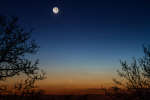 PanSTARRS from France
16.03.2013
Still looking for that comet? Comet PanSTARRS (C/2011 L4) naked-eye appearance in the northern hemisphere is described by successful comet spotters as a dim star with faint a tail. If you want to catch it the next few days could be your best bet.
 Comet PANSTARRS Just After Sunset
18.03.2013
Have you seen the comet? As Comet PANSTARRS fades, careful observers -- even with unaided eyes -- should still be able to find the shedding ice ball on the western horizon just after sunset. Pictured above, Comet PANSTARRS (C/2011 L4) was pointed out from a hilltop last week on First Encounter Beach in Massachusetts, USA.
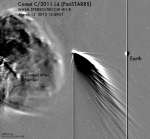 CME, Comet, and Planet Earth
15.03.2013
After appearing in a popular photo opportunity with a young crescent Moon near sunset, naked-eye Comet PanSTARRS continues to rise in northern hemisphere skies. But this remarkable interplanetary perspective from March 13, finds the comet posing with our fair planet itself - as seen from the STEREO Behind spacecraft.
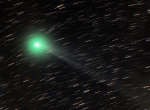 Comet Lemmon near the South Celestial Pole
7.02.2013
Currently sweeping through southern skies, Comet Lemmon (C/2012 F6) was named for its discovery last year as part of the Mount Lemmon (Arizona) Survey. Brighter than expected but still just below naked-eye visibility, Comet Lemmon sports a stunning lime green coma and faint divided tail in this telescopic image from February 4.
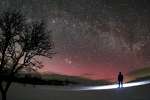 Comet of the North
5.04.2013
It looks like a double comet, but Comet PanSTARRS (C/2011 L4) is just offering skygazers a Messier moment. Outward bound and fading in this starry scene, the well-photographed comet is remarkably similar in brightness to M31, the Andromeda Galaxy.
|
January February March April May June July August September October |
|||||||||||||||||||||||||||||||||||||||||||||||||