
|
Keyword: comet
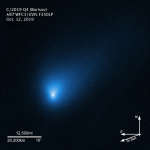 Interstellar Interloper 2I Borisov
18.10.2019
After the 2017 detecton of 1I/'Oumuamua, comet 2I/Borisov has become the second recognized interstellar interloper. Like 'Oumuamua, Borisov's measured hyperbolic trajectory and speed as it falls toward the Sun confirm that its origin is from beyond our Solar System.
 Comet Leonard behind JWST Launch Plume
27.12.2021
Which one of these two streaks is a comet? Although they both have comet-like features, the lower streak is the only real comet. This lower streak shows the coma and tail of Comet Leonard...
 Comet 13P Olbers
28.06.2024
Not a paradox, Comet 13P/Olbers is returning to the inner Solar System after 68 years. The periodic, Halley-type comet will reach its next perihelion or closest approach to the Sun on June 30 and has become a target for binocular viewing low in planet Earth's northern hemisphere night skies.
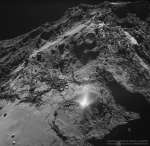 A Dust Jet from the Surface of Comet 67P
6.11.2017
Where do comet tails come from? There are no obvious places on the nuclei of comets from which the jets that create comet tails emanate. Last year, though, ESA's Rosetta spacecraft not only imaged a jet emerging from Comet 67P/Churyumov-Gerasimenko, but flew right through it.
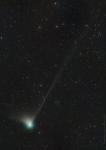 Comet 2022 E3 ZTF
24.12.2022
Comet C/2022 E3 (ZTF) was discovered by astronomers using the wide-field survey camera at the Zwicky Transient Facility this year in early March. Since then the new long-period comet has brightened substantially and is now sweeping across the northern constellation Corona Borealis in predawn skies.
 Galaxies and a Comet
20.10.2023
Galaxies abound in this sharp telescopic image recorded on October 12 in dark skies over June Lake, California. The celestial scene spans nearly 2 degrees within the boundaries of the well-trained northern constellation Canes Venatici.
 APOD: 2025 January 28 Б Comet G3 ATLAS over Uruguay
28.01.2025
Comets can be huge. When far from the Sun, a comet's size usually refers to its hard nucleus of ice and rock, which typically spans a few kilometers -- smaller than even a small moon.
 APOD: 2024 December 16 Б A Kilometer High Cliff on Comet Churyumov Gerasimenko
16.12.2024
This kilometer high cliff occurs on the surface of a comet. It was discovered on the dark nucleus of Comet Churyumov - Gerasimenko (CG) by Rosetta, a robotic spacecraft launched by ESA, which orbited the comet from 2014 to 2016. The ragged cliff, as featured here, was imaged by Rosetta early in its mission.
 APOD: 2024 November 11 Б The Unusual Tails of Comet Tsuchinshan Atlas
11.11.2024
What created an unusual dark streak in Comet Tsuchinshan-Atlas's tail? Some images of the bright comet during mid-October not only caught its impressively long tail and its thin anti-tail, but a rather unexpected feature: a dark streak in the long tail.
 APOD: 2024 November 6 Б Comet Tsuchinshan Atlas over the Dolomites
6.11.2024
Comet Tsuchinshan-Atlas is now headed back to the outer Solar System. The massive dusty snowball put on quite a show during its trip near the Sun, resulting in many impressive pictures from planet Earth during October. The featured image was taken in mid-October and shows a defining visual feature of the comet -- its impressive anti-tail.
|
January February March April May June July August September October |
|||||||||||||||||||||||||||||||||||||||||||||||||