
|
Keyword: star formation
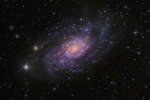 NGC 2403 in Camelopardalis
26.03.2015
Magnificent island universe NGC 2403 stands within the boundaries of the long-necked constellation Camelopardalis. Some 10 million light-years distant and about 50,000 light-years across, the spiral galaxy also seems to have more than its fair share of giant star forming HII regions, marked by the telltale reddish glow of atomic hydrogen gas.
 The Clouds of Orion the Hunter
15.03.2015
Cradled in cosmic dust and glowing hydrogen, stellar nurseries in Orion the Hunter lie at the edge of giant molecular clouds some 1,500 light-years away. Spanning about 30 degrees, this breath-taking vista stretches across the well-known constellation from head to toe (left to right) and beyond.
 Portrait of NGC 281
27.11.2014
Look through the cosmic cloud cataloged as NGC 281 and you might miss the stars of open cluster IC 1590. But, formed within the nebula, that cluster's young, massive stars ultimately power the pervasive nebular glow.
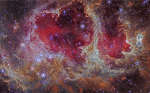 W5: Pillars of Star Formation
15.12.2014
How do stars form? Images of the star forming region W5 like those in the infrared by NASA's Wide Field Infrared Survey Explorer (WISE) satellite provide clear clues with indications that massive stars near the center of empty cavities are older than stars near the edges.
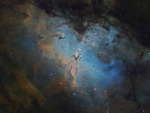 M16 Close Up
10.08.2019
A star cluster around 2 million years young surrounded by natal clouds of dust and glowing gas, M16 is also known as The Eagle Nebula. This beautifully detailed image of the region adopts the colorful Hubble palette and includes cosmic sculptures made famous in Hubble Space Telescope close-ups of the starforming complex.
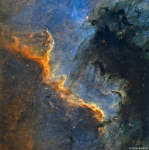 The Cygnus Wall of Star Formation
15.08.2022
The North America nebula on the sky can do what the North America continent on Earth cannot -- form stars. Specifically, in analogy to the Earth-confined continent, the bright part that appears as Central America and Mexico is actually a hot bed of gas, dust, and newly formed stars known as the Cygnus Wall.
 APOD: 2024 October 22 Б M16: Pillars of Star Creation
22.10.2024
These dark pillars may look destructive, but they are creating stars. This pillar-capturing picture of the Eagle Nebula combines visible light exposures taken with the Hubble Space Telescope with infrared images taken with the James Webb Space Telescope to highlight evaporating gaseous globules (EGGs) emerging from pillars of molecular hydrogen gas and dust.
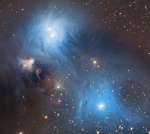 Stars and Dust in Corona Australis
18.10.2017
Blue dust clouds and young, energetic stars inhabit this telescopic vista, less than 500 light-years away toward the northern boundary of Corona Australis, the Southern Crown. The dust clouds effectively block light from more distant background stars in the Milky Way.
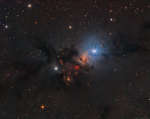 NGC 1333: Stellar Nursery in Perseus
27.03.2019
NGC 1333 is seen in visible light as a reflection nebula, dominated by bluish hues characteristic of starlight reflected by interstellar dust. A mere 1,000 light-years distant toward the heroic constellation Perseus, it lies at the edge of a large, star-forming molecular cloud.
 Star Factory Messier 17
8.09.2023
Sculpted by stellar winds and radiation, the star factory known as Messier 17 lies some 5,500 light-years away in the nebula-rich constellation Sagittarius. At that distance, this 1/3 degree wide field of view spans over 30 light-years.
|
January February March April May June July August September |
|||||||||||||||||||||||||||||||||||||||||||||||||