
|
Keyword: star formation
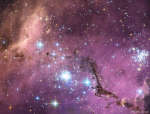 N11: Star Clouds of the LMC
28.04.2019
Massive stars, abrasive winds, mountains of dust, and energetic light sculpt one of the largest and most picturesque regions of star formation in the Local Group of Galaxies. Known as N11, the region...
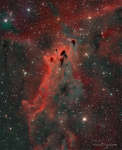 APOD: 2026 April 28 Б CG 30: Cometary Globules
27.04.2026
They're like mountain peaks, but they are forming stars. Bright-rimmed, flowing shapes gather near the center of this rich starfield toward the borders of the nautical southern constellations Puppis and Vela. Composed of interstellar gas and dust, the grouping of light-year sized cometary globules is about 1300 light-years distant.
 Cocoon Nebula Wide Field
25.10.2022
When does a nebula look like a comet? In this crowded starfield, covering over two degrees within the high flying constellation of the Swan (Cygnus), the eye is drawn to the Cocoon Nebula.
 APOD: 2023 August 28 Б Star Formation in the Pacman Nebula
27.08.2023
Look through the cosmic cloud cataloged as NGC 281 and you might miss the stars of open cluster IC 1590. Formed within the nebula, that cluster's young, massive stars ultimately power the pervasive nebular glow.
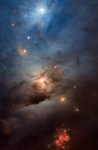 NGC 1333: Stellar Nursery in Perseus
21.04.2023
In visible light NGC 1333 is seen as a reflection nebula, dominated by bluish hues characteristic of starlight reflected by interstellar dust. A mere 1,000 light-years distant toward the heroic constellation Perseus, it lies at the edge of a large, star-forming molecular cloud.
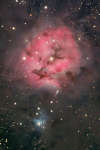 IC 5146: The Cocoon Nebula
26.08.2022
Inside the Cocoon Nebula is a newly developing cluster of stars. Cataloged as IC 5146, the beautiful nebula is nearly 15 light-years wide. Climbing high in northern summer night skies, it's located some 4,000 light years away toward the constellation Cygnus the Swan.
 APOD: 2024 August 19 Б IC 5146: The Cocoon Nebula
18.08.2024
Inside the Cocoon Nebula is a newly developing cluster of stars. Cataloged as IC 5146, the beautiful nebula is nearly 15 light-years wide. Soaring high in northern summer night skies, it's located some 4,000 light years away toward the constellation of the Swan (Cygnus).
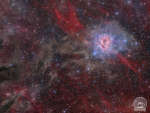 Cocoon Nebula Deep Field
18.09.2018
Inside the Cocoon Nebula is a newly developing cluster of stars. The cosmic Cocoon on the upper right also punctuates a long trail of obscuring interstellar dust clouds to its left. Cataloged...
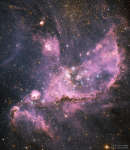 NGC 346: Star Forming Cluster in the SMC
30.11.2020
Are stars still forming in the Milky Way's satellite galaxies? Found among the Small Magellanic Cloud's (SMC's) clusters and nebulas, NGC 346 is a star forming region about 200 light-years across, pictured here in the center of a Hubble Space Telescope image.
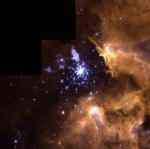 NGC 3603: From Beginning To End
4.06.1999
From beginning to end, different stages of a star's life appear in this exciting Hubble Space Telescope picture of the environs of galactic emission nebula NGC 3603. For the beginning, eye-catching "pillars" of glowing hydrogen at the right signal newborn stars emerging from their dense, gaseous, nurseries.
|
January February March April May June July August September |
|||||||||||||||||||||||||||||||||||||||||||||||||