
|
Keyword: star formation
 APOD: 2025 June 23 Б W5: Pillars of Star Formation
22.06.2025
How do stars form? Images of the star forming region W5 like those in the infrared by NASA's Wide Field Infrared Survey Explorer (WISE, later NEOWISE) satellite provide clear clues with indications that massive stars near the center of empty cavities are older than stars near the edges.
 APOD: 2025 April 28 Б Gum 37 and the Southern Tadpoles
27.04.2025
This cosmic skyscape features glowing gas and dark dust clouds alongside the young stars of NGC 3572. A beautiful emission nebula and star cluster, it sails far southern skies within the nautical constellation Carina.
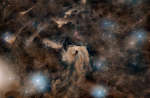 APOD: 2023 March 21 Б Dark Nebulae and Star Formation in Taurus
20.03.2023
Can dust be beautiful? Yes, and it can also be useful. The Taurus molecular cloud has several bright stars, but it is the dark dust that really draws attention. The pervasive dust has waves...
 Lynds Dark Nebula 1251
2.07.2020
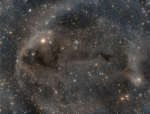
Stars are forming in Lynds Dark Nebula (LDN) 1251. About 1,000 light-years away and drifting above the plane of our Milky Way galaxy, the dusty molecular cloud is part of a complex of dark nebulae mapped toward the Cepheus flare region.
 Lynds Dark Nebula 1251
23.11.2022
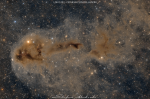
Stars are forming in Lynds Dark Nebula (LDN) 1251. About 1,000 light-years away and drifting above the plane of our Milky Way galaxy, the dusty molecular cloud is part of a complex of dark nebulae mapped toward the Cepheus flare region.
 APOD: 2025 October 21 Б IC 1805: The Heart Nebula
20.10.2025
What electrifies the Heart Nebula? First, the large emission nebula on the left, catalogued as IC 1805, looks somewhat like a human heart. The nebula glows brightly in red light emitted by its most prominent element, hydrogen, but this long-exposure image was also blended with light emitted by sulfur (yellow) and oxygen (blue).
 APOD: 2025 December 28 Б NGC 1898: Globular Cluster in the Large Magellanic Cloud
27.12.2025
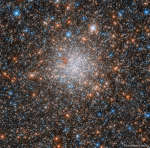
Jewels don't shine this bright -- only stars do. And almost every spot in this jewel-box of an image from the Hubble Space Telescope is a star. Now, some stars are more red than our Sun, and some more blue -- but all of them are much farther away.
 APOD: 2025 December 9 Б The Heart of the Soul Nebula
8.12.2025
This cosmic close-up looks deep inside the Soul Nebula. The dark and brooding dust clouds outlined by bright ridges of glowing gas are cataloged as IC 1871. About 25 light-years across, the telescopic field of view spans only a small part of the much larger Heart and Soul nebulae.
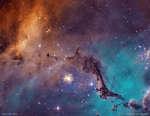 N11: Star Clouds of the LMC
11.04.2022
Massive stars, abrasive winds, mountains of dust, and energetic light sculpt one of the largest and most picturesque regions of star formation in the Local Group of Galaxies. Known as N11, the region...
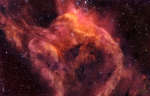 NGC 3572 and the Southern Tadpoles
5.05.2022
This cosmic skyscape features glowing gas and dark dust clouds along side the young stars of NGC 3572. A beautiful emission nebula and star cluster it sails far southern skies within the nautical constellation Carina.
|
January February March April May June July August September |
|||||||||||||||||||||||||||||||||||||||||||||||||