
|
Keyword: supernova
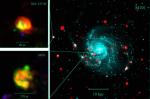 Candidates for a Hypernova
20.04.1999
What created these huge explosion remnants? Speculation has been building recently that outbursts even more powerful than well-known supernovae might occur. Dubbed hypernovae, these explosions might result from high-mass stars and liberate perhaps ten times more energy than conventional supernovae.
 The Case of the Missing Supernova
13.04.1999
Would you notice a second Moon in the sky? About 700 years ago, light from a tremendous explosion reached Earth that should have appeared almost as bright as a full Moon. The bright spot should have lasted for weeks, yet no notation of such an occurrence has been found in historical records.
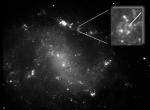 ESO 184 G82: and the Supernova Gamma Ray Burst Connection
28.02.2002
Modern astronomers keep a long list of things that go bump in the night. Near the top are supernovae - the death explosions of massive stars, and gamma-ray bursts - the most powerful explosions seen across the Universe.
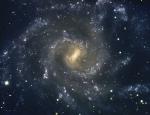 The Arms of NGC 7424
16.12.2004
The grand, winding arms are almost mesmerizing in this face-on view of NGC 7424, a spiral galaxy with a prominent central bar. About 40 million light-years distant in the headlong constellation Grus, this island universe is also about 100,000 light-years across making it remarkably similar to our own Milky Way.
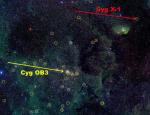 Cyg X-1: Can Black Holes Form in the Dark
12.06.2003
The formation of a black hole from the collapsing core of a massive star is thought to be heralded by a spectacular supernova explosion. Such an extremely energetic collapse is also a leading explanation for the mysterious cosmic gamma-ray bursts.
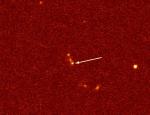 Gamma Ray Burst Afterglow: Supernova Connection
5.04.2002
What causes the mysterious gamma-ray bursts? Indicated in this Hubble Space Telescope exposure of an otherwise unremarkable field in the constellation Crater, is the dwindling optical afterglow of a gamma-ray burst first detected by the Beppo-SAX satellite on 2001 December 11.
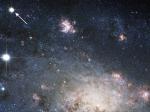 A Supernova in Nearby Galaxy NGC 2403
7.09.2004
The closest and brightest supernova in over a decade was recorded just over a month ago in the outskirts of nearby galaxy NGC 2403. Officially tagged SN 2004dj, the Type IIP explosion likely annihilated most of a blue supergiant star as central fusion could no longer hold it up.
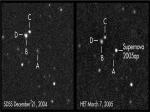 SN 2005ap: The Brightest Supernova Yet Found
16.10.2007
What could cause a bang this big? This supernova explosion was so inherently bright that it could be seen nearby 5 billion light years away (a redshift of 0.28) even with a small telescope.
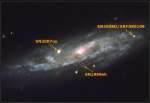 Supernova Factory NGC 2770
18.01.2008
The stellar explosions known as supernovae are among the most powerful events in the universe. Triggered by the collapsing core of a massive star or the nuclear demise of a white dwarf, supernovae occur in average spiral galaxies only about once every century.
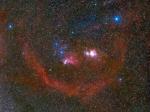 Barnards Loop Around Orion
20.04.2005
Why is the belt of Orion surrounded by a bubble? Although glowing like an emission nebula, the origin of the bubble, known as Barnard's Loop, is currently unknown. Progenitor hypotheses include the winds from bright Orion stars and the supernovas of stars long gone.
|
January February March April May June July August September October |
|||||||||||||||||||||||||||||||||||||||||||||||||