
|
Keyword: supernova
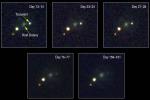 Gamma Ray Burst, Supernova Bump
17.05.2002
On the 21st of November 2001, satellites detected yet another burst of gamma-rays from the cosmos. While this flash of high-energy photons lasted for less than a minute, eager astronomers have been following the fading optical light from the location of the burst source ever since.
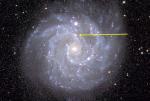 A Gamma Ray Burst Supernova Connection
14.04.2003
New evidence has emerged that a mysterious type of explosion known as a gamma ray burst is indeed connected to a supernova of the type visible in the above image. Two weeks ago, the orbiting HETE satellite detected gamma-ray burst GRB030329.
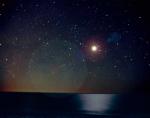 1006 AD: Supernova in the Sky
30.04.2006
A new star, likely the brightest supernova in recorded human history, appeared in planet Earth's sky about 1,000 years ago today, in 1006 AD. The expanding debris cloud from the stellar explosion is still visible to modern astronomers, but what did the supernova look like in 1006?
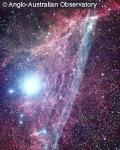 The Vela Supernova Remnant Expands
3.08.1999
The explosion is over but the consequences continue. About eleven thousand years ago a star in the constellation of Vela exploded, creating a strange point of light briefly visible to humans living near the beginning of recorded history.
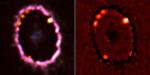 New Shocks For Supernova 1987A
17.02.2000
In February of 1987, astronomers witnessed the brightest supernova of modern times - supernova 1987A in the Large Magellanic Cloud. Mysterious rings of material surrounding the expanding stellar debris were soon emitting a visible glow excited by intense light from the explosion.
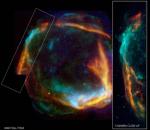 APOD: 2006 September 28- RCW 86: Historical Supernova Remnant
28.09.2006
In 185 AD, Chinese astronomers recorded the appearance of a new star in the Nanmen asterism - a part of the sky identified with Alpha and Beta Centauri on modern star charts. The new star was visible for months and is thought to be the earliest recorded supernova.
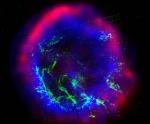 Supernova Remnant E0102 72 from Radio to X-Ray
14.04.2000
Not all stars form a big Q after they explode. The shape of supernova remnant E0102-72, however, is giving astronomers a clue about how tremendous explosions disperse elements and interact with surrounded gas. The above image is a composite of three different photographs in three different types of light.
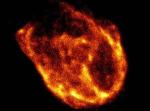 Supernova Remnant N132D in X Rays
13.09.1999
Thousands of years after a star explodes, an expanding remnant may still glow brightly. Such is the case with N132D, a supernova remnant located in the neighboring Large Magellanic Cloud galaxy. The expanding shell from this explosion now spans 80 light-years and has swept up about 600 Suns worth of mass.
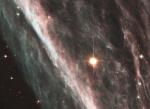 APOD: 2003 June 9 Ш The Pencil Nebula Supernova Shockwave
9.06.2003
At 500,000 kilometers per hour, a supernova shockwave plows through interstellar space. This shockwave is known as the Pencil Nebula, or NGC 2736, and is part of the Vela supernova remnant, an expanding shell of a star that exploded about 11,000 years ago.
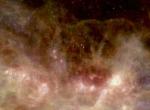 The W4 Chimney
7.02.2000
A huge chimney venting hot clouds of gas out from the plane of our Milky Way Galaxy has recently been imaged in radio waves. The Canadian Galactic Plane Survey team used an array of radio telescopes to survey an ionized gas region known as W4.
|
January February March April May June July August September October |
|||||||||||||||||||||||||||||||||||||||||||||||||