
|
Keyword: molecular cloud
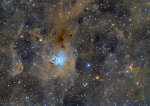 Haunting the Cepheus Flare
29.10.2021
Spooky shapes seem to haunt this dusty expanse, drifting through the night in the royal constellation Cepheus. Of course, the shapes are cosmic dust clouds visible in dimly reflected starlight. Far from your...
 APOD: 2024 March 5 Б NGC 2170: Angel Nebula Abstract Art
5.03.2024
Is this a painting or a photograph? In this celestial abstract art composed with a cosmic brush, dusty nebula NGC 2170, also known as the Angel Nebula, shines just above the image center. Reflecting...
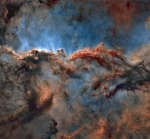 APOD: 2024 June 19 Б NGC 6188: Dragons of Ara
19.06.2024
Do dragons fight on the altar of the sky? Although it might appear that way, these dragons are illusions made of thin gas and dust. The emission nebula NGC 6188, home to the glowing...
 Lynds Dark Nebula 1251
22.06.2024
Stars are forming in Lynds Dark Nebula (LDN) 1251. About 1,000 light-years away and drifting above the plane of our Milky Way galaxy, LDN 1251 is also less appetizingly known as "The Rotten Fish Nebula." The dusty molecular cloud is part of a complex of dark nebulae mapped toward the Cepheus flare region.
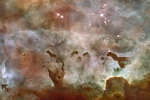 Dark Clouds of the Carina Nebula
28.05.2008
What dark forms lurk in the mists of the Carina Nebula? These ominous figures are actually molecular clouds, knots of molecular gas and dust so thick they have become opaque. In comparison, however, these clouds are typically much less dense than Earth's atmosphere.
 Along the Taurus Molecular Cloud
23.11.2023
The cosmic brush of star formation composed this interstellar canvas of emission, dust, and dark nebulae. A 5 degree wide telescopic mosaic, it frames a region found north of bright star Aldebaran on the sky, at an inner wall of the local bubble along the Taurus molecular cloud.
 The Protostars within Lynds 483
13.03.2025
Two protostars are hidden in a single pixel near the center of a striking hourglass-shaped nebula in this near-infrared image from the James Webb Space Telescope. The actively forming star system lies in a dusty molecular cloud cataloged as Lynds 483, some 650 light-years distant toward the constellation Serpens Cauda.
 Chamaeleon I Molecular Cloud
27.05.2024
Dark markings and bright nebulae in this telescopic southern sky view are telltale signs of young stars and active star formation. They lie a mere 650 light-years away, at the boundary of the local bubble and the Chamaeleon molecular cloud complex.
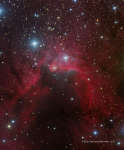 SH2-155: The Cave Nebula
23.03.2017
This skyscape features dusty Sharpless catalog emission region Sh2-155, the Cave Nebula. In the telescopic image, data taken through a narrowband filter tracks the reddish glow of ionized hydrogen atoms. About 2,400 light-years away, the scene lies along the plane of our Milky Way Galaxy toward the royal northern constellation of Cepheus.
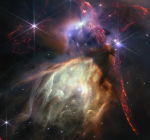 Webb's Rho Ophiuchi
25.10.2025
A mere 390 light-years away, Sun-like stars and future planetary systems are forming in the Rho Ophiuchi molecular cloud complex, the closest star-forming region to our fair planet. The James Webb Space Telescope's NIRCam peered into the nearby natal chaos to capture this infrared image at an inspiring scale.
|
January February March April May June July August September October |
|||||||||||||||||||||||||||||||||||||||||||||||||