
|
Keyword: molecular cloud
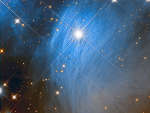 Meropes Reflection Nebula
15.02.2012
Reflection nebulas reflect light from a nearby star. Many small carbon grains in the nebula reflect the light. The blue color typical of reflection nebula is caused by blue light being more efficiently scattered by the carbon dust than red light.
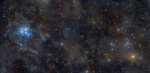 Pleiades to Hyades
17.11.2011
This cosmic vista stretches almost 20 degrees across the gentle constellation Taurus. It begins at the Pleiades and ends at the Hyades, two of the best known star clusters in planet Earth's sky. At left, the lovely Pleiades star cluster is about 400 light-years away.
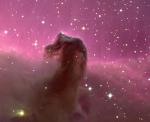 The Horsehead Nebula
19.05.1999
One of the most identifiable nebulae in the sky, the Horsehead Nebula in Orion, is part of a large, dark, molecular cloud. Also known as Barnard 33, the unusual shape was first discovered on a photographic plate in the late 1800s.
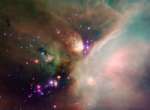 Young Stars in the Rho Ophiuchi Cloud
15.02.2008
Cosmic dust clouds and embedded newborn stars glow at infrared wavelengths in this tantalizing false-color view from the Spitzer Space Telescope. Pictured is of one of the closest star forming regions, part of the Rho Ophiuchi cloud complex some 400 light-years distant near the southern edge of the pronounceable constellation Ophiuchus.
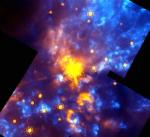 The Heart Of Orion
6.05.2000
Newborn stars lie at at the heart of the the Orion Nebula, hidden from view by the dust and gas of the giant Orion Molecular Cloud number 1 (OMC-1). Sensitive to invisible infrared...
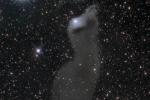 vdB 152: Reflection Nebula in Cepheus
14.06.2007
Described as a "dusty curtain" or "ghostly apparition", mysterious reflection nebula vdB 152 really is very faint. It lies about 1400 light-years away, along the northern Milky Way in the royal constellation Cepheus. Near...
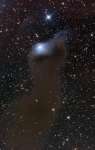 VdB 152: Reflection Nebula in Cepheus
31.10.2009
Described as a "dusty curtain" or "ghostly apparition", mysterious reflection nebula VdB 152 really is very faint. Far from your neighborhood on this Halloween Night, the cosmic phantom is nearly 1,400 light-years away. Also cataloged as Ced 201, it lies along the northern Milky Way in the royal constellation Cepheus.
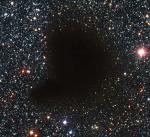 Molecular Cloud Barnard 68
11.05.1999
Where did all the stars go? What used to be considered a hole in the sky is now known to astronomers as a dark molecular cloud. Here, a high concentration of dust and molecular gas absorb practically all the visible light emitted from background stars.
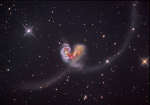 The Antennae
7.05.2010
Some 60 million light-years away in the southerly constellation Corvus, two large galaxies collided. But the stars in the two galaxies cataloged as NGC 4038 and NGC 4039 don't collide in the course of the ponderous, billion year or so long event.
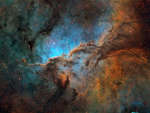 Shaping NGC 6188
16.07.2010
Dark shapes with bright edges winging their way through dusty NGC 6188 are tens of light-years long. The emission nebula is found near the edge of an otherwise dark large molecular cloud in the southern constellation Ara, about 4,000 light-years away.
|
January February March April May June July August September October |
|||||||||||||||||||||||||||||||||||||||||||||||||